
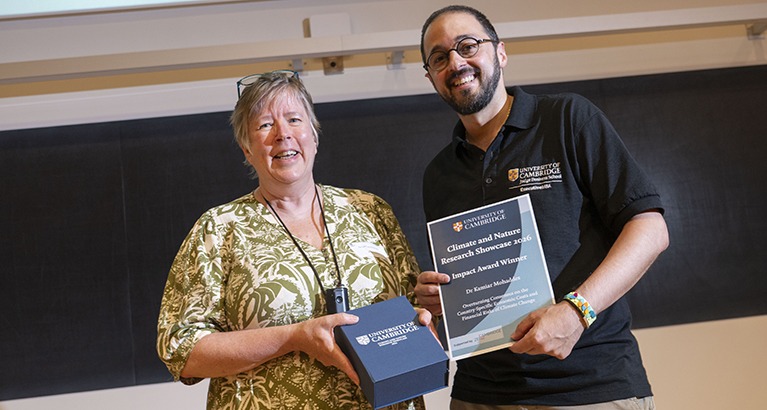
The award to Kamiar, reflecting a series of studies he co-authored with the team at climaTRACES Lab, was for Overturning Consensus on the Country-Specific Economic Costs and Financial Risks of Climate Change. The research challenges conventional thought that climate change will only affect low-income countries near the equator while sparing cooler and wealthier countries, as well as the view that financial risks of climate change are decades out before being realised.
The Climate and Nature Research Showcase was held on 26 June, bringing together more than 140 University of Cambridge researchers on disciplines ranging from energy to law and from infrastructure to food. The event coincided with the end of London Climate Action Week.
Says one of the studies co-authored by Kamiar: “Quantifying the macroeconomic impact of climate change has been a focal point in academic and policy discussions since the early 1990s. The estimates of global GDP losses at future warming levels vary widely due to differing methodologies, complicating the formulation of effective climate policies. We bridge the gap between these varying estimates by quantifying country-specific annual per-capita GDP losses from global warming using the most recent climate scenarios of the Intergovernmental Panel on Climate Change (IPCC) under different mitigation, adaptation and climate variability assumptions. Motivated by the need to inform policy decisions, we hypothesise that without substantial mitigation and adaptation efforts, global GDP per capita could decline by up to 24% under high-emissions climate scenarios by 2100.”
Interdisciplinary research at the University of Cambridge
The research teams behind the papers are now part of the climaTRACES Lab, an interdisciplinary research initiative at the University of Cambridge that focuses on sustainability and nature research. The work of the lab, as reflected in this Impact Award, was cited extensively by the US Congressional Budget Office and in a letter to the Federal Reserve Board chairman by 25 members of Congress.
Another research report, done by the climaTRACES Lab and BCG (Boston Consulting Group), found that the cost of inaction in the face of climate change would by 2100 be 11% to 27% of cumulative GDP.
“Governments, businesses and people worldwide are paying the price for the storms, floods, heatwaves and droughts that are caused by climate change,” says the report. “Without investment to avoid future climate change, it’s likely that the world’s economic output will be severely diminished, threatening the livelihoods of billions of people. This report sets out the economic case for climate action – and how we can make it influence decisions today.”
Another paper co-authored by Kamiar suggested that, if nothing is done to reduce carbon emissions, up to 63 nations could have their credit rating downgraded by the end of this decade, including 3 notches for Germany and Sweden, and the US and Canada falling 2 notches, thereby making the cost of servicing (the already high) government debt significantly more expensive.
Engagement with other Cambridge researchers and beyond
“Cambridge Judge Business School is delighted for Kamiar and all his colleagues who contributed to this Impact Award,” said Professor Gishan Dissanaike, Dean of Cambridge Judge Business School.
“The award reflects research over several years on some of the most critical issues of this era, sustainability and economics, and demonstrates how Cambridge Judge academics engage with colleagues across the University of Cambridge and in the private sector to produce impactful research on these really timely issues.”
Featured faculty
Kamiar Mohaddes
Associate Professor in Economics and Policy
Director of the Global Executive MBA Programme
Photography
Dr Kamiar Mohaddes receives his climate change research award from Dr Lucinda Spokes. Photography © David Rose/Cambridge Zero.
Featured research
Kahn, M.E., Mohaddes, K., Ng, R.N.C., Pesaran, M.H., Raissi, M. and Yang, J.-C. (2021) “Long-term macroeconomic effects of climate change: a cross-country analysis.” Energy Economics, 104: 105624 (DOI: 10.1016/j.eneco.2021.105624)
Klusak, P., Agarwala, M., Burke, M., Kraemer, M. and Mohaddes, K. (2023) “Rising temperatures, falling ratings: the effect of climate change on sovereign creditworthiness.” Management Science, 69(12): 7468-7491 (DOI: 10.1287/mnsc.2023.4869)
Mohaddes, K. and Raissi, M. (2025) “Rising temperatures, melting incomes: country-specific macroeconomic effects of climate scenarios.” PLOS Climate, 4(9): e0000621 (DOI: 10.1371/journal.pclm. 0000621)
Related content
“Climate & Nature Research showcase a Cambridge first.” cam.ac.uk, 26 June 2026
“Why investing in climate action makes good economic sense.” bcg.com, 12 March 2025
Related articles
Research centre news
EPRG Spring Summit focuses on UK and EU energy policies
The Spring Seminar of the Energy Policy Research Group included a panel on the potential convergence of energy and climate policies of the European Union and the UK, against a backdrop of ongoing bilateral negotiations. A decade after Britain voted to leave the EU, negotiating teams from the UK and EU are preparing to meet to discuss details of re-aligning carbon and energy policies including the key issue on whether and, if so, how the UK should rejoin the EU’s emissions trading scheme (ETS).
Faculty news
Global energy markets hold the key to climate action
As the world races to decarbonise, competing pressures – from AI-driven energy demand to geopolitical fragmentation – are complicating the transition. Michael Pollitt, Professor of Business Economics at Cambridge Judge Business School, argues that the answer isn't energy nationalism, but deeper global cooperation. In a wide-ranging interview, he explains why international trade, cross-border carbon markets, and smarter grid technology are the tools that will ultimately determine whether the world meets its climate goals.

Programme news
Top 10 reads of 2025
Articles about artificial intelligence and sustainability were among the most popular stories on the Cambridge Judge Business School website in 2025, reflecting a year in which AI capabilities expanded apace and the November COP30 climate-change summit in Brazil focused attention on the environment.