
Discovering infrastructure beyond the firm
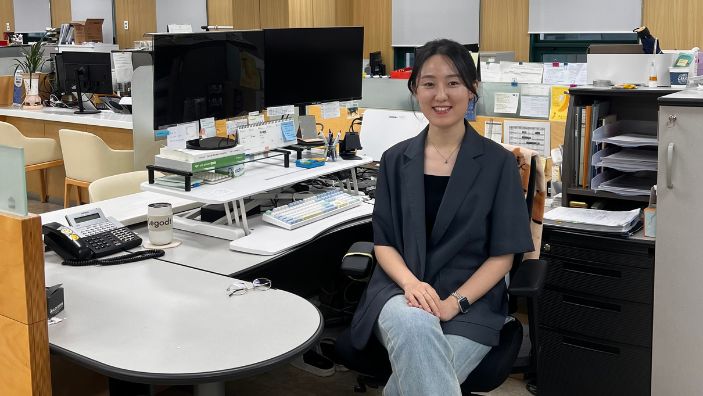
Three hours by bus to reach a recycling facility on the outskirts of the city. When I arrived, the scale of it stopped me: entire buildings filled with compressed plastic, sorted and staged for redistribution across supply chains I had never considered before.
I was there as a credit analyst at Korea Credit Guarantee Fund, evaluating the company for a financing decision. But standing inside that facility, I realised I was looking at something more than a business. It was infrastructure – a system that other industries and communities depended on to function. That distinction stayed with me. It was what eventually brought me to Cambridge Judge Business School.
Building a community around a gap
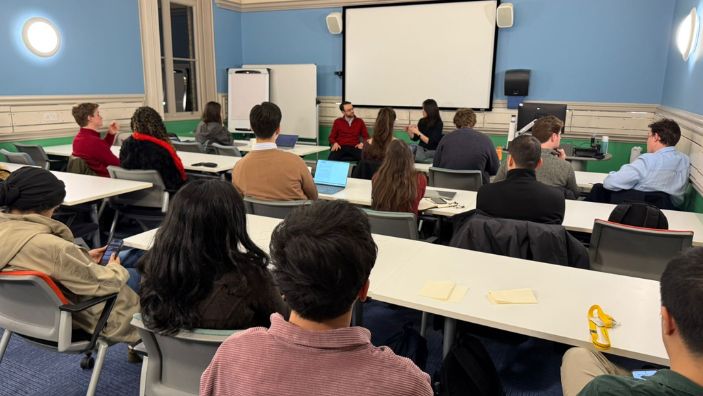
When I arrived, I found that the Infrastructure Finance course had been removed from the curriculum that year. Rather than wait, I started a study group with classmates who shared the interest – some with direct infrastructure experience, others approaching it for the first time.
By Lent term, that group had grown into the Cambridge Infrastructure Society, bringing together students across the Master of Finance (MFin), MBA, Executive MBA (EMBA) and MPhil programmes. We hosted alumni from the Asian Infrastructure Investment Bank (AIIB), the European Bank for Reconstruction and Development (EBRD), International Finance Corporation (IFC) and Asian Development Bank (ADB). Not as a networking exercise, but because we wanted to understand how these institutions actually work: how they assess risk, how they mobilise private capital and what it takes to move a project forward in markets where financing rarely flows easily.
From framework to practice
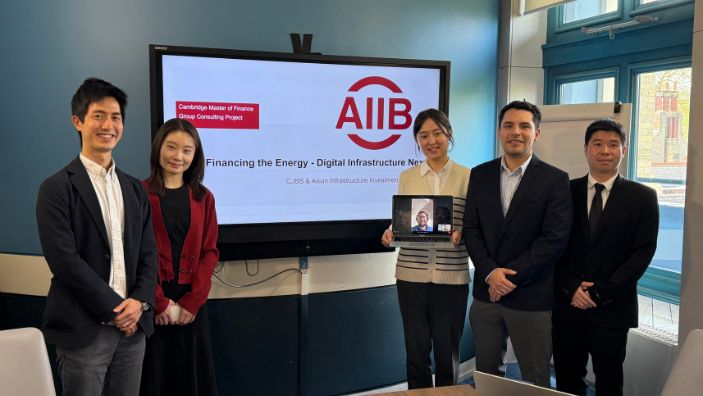
The clearest test of that came during our group consulting project with AIIB in Easter term. The engagement grew out of outreach I had started during the Christmas break – conversations with alumni and contacts at AIIB to explore whether a collaboration was possible.
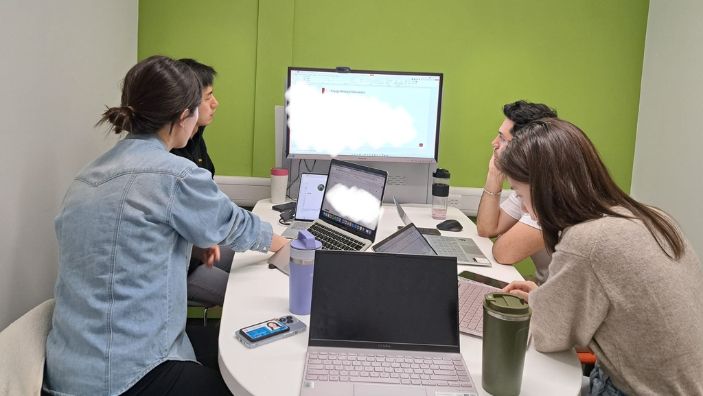
Our team spent the term working on what AIIB framed as the energy-digital infrastructure nexus: how do you make renewable energy commitments work in markets where grid reliability and curtailment risk remain real constraints? These were not abstract problems. They were the kind of interconnected constraints that make infrastructure investment genuinely difficult – and genuinely consequential.
Presenting our work to a client group composed largely of energy specialists and discussing investment decisions in emerging markets was one of the most valuable experiences of my time at Cambridge. It showed me that infrastructure finance is rarely about finding perfect solutions. More often, it is about navigating competing constraints and building systems that can function over the long term.
What finance is for

As I look ahead to infrastructure and energy transition finance, I often think back to that recycling facility in Korea. At the time, I thought I was simply evaluating another company. In hindsight, it was the moment I began shifting from thinking about financing firms to thinking about financing systems.
What I value most about the Cambridge MFin is that it gave me the space and the people – to take that transition seriously. Through classmates, alumni and real projects I came to see finance not simply as the allocation of capital, but as a way of coordinating long-term relationships between institutions, technology, private investment and the communities that infrastructure is ultimately meant to serve.
About the blog author: Seoil Jang

Seoil Jang is a finance professional with nearly 9 years of experience at Korea Credit Guarantee Fund (KCGF), one of Korea’s major public financial institutions, where she has worked across SME financing, credit execution, and public financing programmes spanning a range of industries, including collaborating with commercial banks and venture capital firms on financing and risk-sharing structures.
She has represented KCGF at international forums including the ADB Annual Meeting, serving as liaison officer for overseas delegations. At Cambridge Judge Business School, Seoil is focused on infrastructure and development finance, with particular interest in energy transition, digital infrastructure and multilateral development banks. She is the co-founder of the Cambridge Infrastructure Society.
Master of Finance
Engage with the world’s best financial minds and skilled professionals. Open doors to exciting new career possibilities with a Cambridge Master of Finance (MFin).
More from the MFin blog
Shivin Sharma (MFin 2025) reflects on how the Cambridge Master of Finance and University experience presented opportunities he would never have expected, from joining Cambridge Varsity to participating in the King's Entrepreneurship Lab.
Andres Camacho (MFin 2025) reflects on how the MFin has broadened his horizons beyond traditional finance, leading to opportunities in impact investing, entrepreneurship, search funds and Entrepreneurship Through Acquisition (ETA).

Three alumni share how the Cambridge Master of Finance helped them pivot across roles, sectors and countries, and helped shape the mindset that carried them through.