

A native of the Nepalese capital of Kathmandu, Nimesh moved to the US as an undergraduate student studying economics at Swarthmore College in Pennsylvania, and more recently he has been back at Swarthmore as a senior fellow at the college’s Lang Center for Civic and Social Responsibility, where he co-leads initiatives related to social innovation and introduces students to systems approaches for engaging in complex social challenges.
In practice, this involves students applying these tools to real-world problems: for example, one student used systems mapping to explore stunting in rural Indonesia, resulting in an awareness-focused documentary that has been viewed more than 250,000 times on YouTube.
Those have been important stopping-off points in his journey, which in some ways is only just beginning.
From Cambridge Judge to Kathmandu: testing a new university model in Nepal
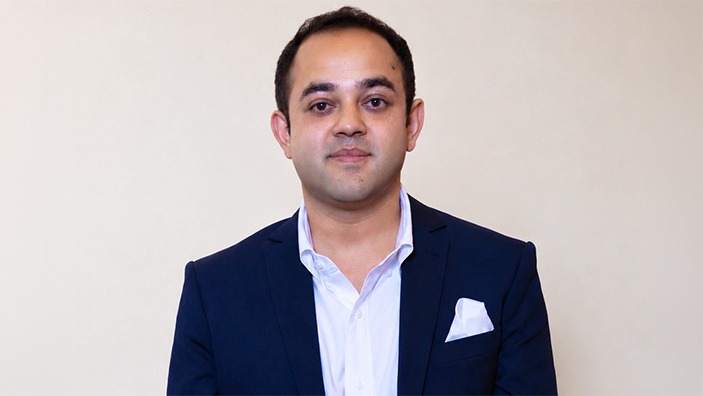
This summer, Nimesh will be in Nepal to take practical steps toward launching a new university in Kathmandu – inspired by his learnings at Cambridge Judge including his dissertation on how a new university, Ashesi University, was launched a quarter-century ago in Ghana.
“My first job after graduating from Swarthmore was with Ashoka, a nonprofit organisation that works with universities in 10 countries around the world (including Colombia, Mexico, Australia and South Korea) to embed social innovation practices,” says Nimesh. “More recently, in addition to my work at Swarthmore, I have been involved in creating programmes where undergraduate students spend summers interning at a social enterprise organisation in Nepal. These are early-stage experiments to prototype components of a future university model in Nepal.”
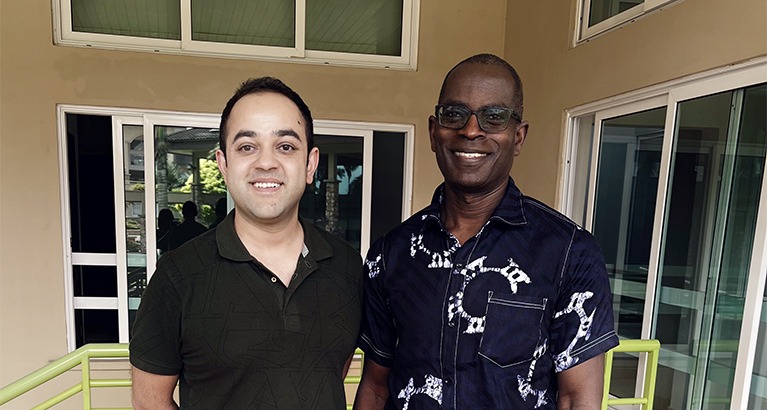
For his dissertation at Cambridge Judge, Nimesh focused on how Ashesi founder and president Patrick Awuah (a fellow Swarthmore alumnus who later worked at Microsoft) created a university from scratch in Berekuso, 18 miles northeast of the Ghanaian capital Accra. Beginning with 30 Ghanaian students in 2002, Ashesi now enrols 1,800 students from 30 nationalities in Africa. Building on his dissertation, Nimesh developed the Ashesi research into a case study subsequently published in the Summer 2026 issue of Stanford Social Innovation Review.
How social innovation ideas can – and cannot – be adapted to a new setting
A key issue addressed in Nimesh’s dissertation is how ideas developed in one setting can or cannot be imported into another setting – and from his conversations with Patrick Awuah it’s clear that Nimesh realises there are limits to such transplantation of ideas.
“Sometimes it is better to bring a seed than transplant a whole plant,” Patrick Awuah told him, as Nimesh relates in the Stanford Social Innovation Review article. “Transplanting involves handling an entire root network – a complex, difficult task. If you identify a tree species suitable for your context, planting a seed is simpler.”
And that’s what Nimesh is now trying to do in Nepal.
“Ghana is obviously different from America, so in my dissertation I was looking at what sticks and what doesn’t,” he says, “and I’m now applying those learnings to what I’m trying to do in Nepal. It’s clear that that the history of liberal arts in the US will be hard to replicate in the Nepalese context, including finances. Liberal arts colleges in the US tend to have large endowments, as tuition doesn’t nearly cover all the costs, but if you look at countries like Ghana and Nepal you’re clearly not going to have those types of endowment resources. Pedagogically, too, you have to be careful – what to adopt, what to adapt and what to offer that is unique to the Nepali context.”
Still early days: starting small to build a new university model in Nepal
Nimesh emphasises that his project to create a new university in Nepal is at a relatively early stage.
“My work over the past several years, including at Ashoka, Swarthmore and my dissertation at Cambridge Judge, has been focused on understanding how ideas, frameworks and institutional models can be translated across contexts,” he says. “The Nepal work represents an attempt to apply and adapt lessons from my experiences in the United States, at Cambridge and through Ashoka, to a Nepali context.”
So the plan is to start small in Nepal.
As a prelude, this summer will be the third year that Nimesh has tested out some of his ideas with American students in Nepal – with this summer’s 8 students coming from Swarthmore, Haverford College and the University of Michigan. These students will join a liberal-arts inspired summer programme in Kathmandu, spending a majority of their time on an internship with a local organisation, alongside seminars led by Nepali scholars and practitioners that explore Nepal’s history, economy and society.
“The Nepalese parliament in 2024 enacted a bill for a new University of Nepal, and the parliament sought a broad-based university model. That effort is ongoing, but I thought it was better to build up to an institution rather than start with too grand a plan – because even if you get brick and mortar set up but not get the cultural readiness.”
Thus, Nimesh’s current plan is to start with the small programme of summer students, then invite Nepalese and non-Nepali students to a winter programme, and then work up to semester-based programmes. He acknowledges that from a fundraising perspective it will be difficult to scale up rapidly through such an approach, but the idea is to build revenue models at the university itself without the need for lots of fundraising in advance.
“Because we won’t immediately need large infrastructure, we hope to bring in enough revenue to support the early days by building pricing around these plans. It’s not that we don’t need to fundraise, but it would be at a smaller scale”, in part because the university would rent space initially rather than erect a building.

My work over the past several years, including at Ashoka, Swarthmore and my dissertation at Cambridge Judge, has been focused on understanding how ideas, frameworks and institutional models can be translated across contexts…The Nepal work represents an attempt to apply and adapt lessons from my experiences in the United States, at Cambridge and through Ashoka, to a Nepali context.
How Cambridge Judge helped turn social innovation ideas into action
As for his studies at Cambridge Judge, Nimesh identified 3 key points that stand out as he starts his new journey in Nepal.
“The first thing is that the programme did a really good job curating a great group of people I shared values with, doing different things but with values around openness, competency and kindness – and that kind of network is difficult to find. The second thing is that although I and others in the programme had been involved in the social impact space for a while, Cambridge Judge gave an academic language to something we already knew – and that academic language helps me understand what others have done as I’ve gone about my research, providing an academic rigour that leads to social innovation. The third thing is that the programme gives the space for our ideas to grow: when you’re working it’s hard to carve out time and space and think about all the academic interests you may have, so the Masters programme gave me time and space to write a business plan and also an opportunity to travel to Ghana to see what this model might look like.”
At Cambridge Judge, Nimesh’s supervisor was Neil Stott, Management Professor of Social Innovation and Co-Director of the Cambridge Centre for Social Innovation, who says: “Nimesh’s work illustrates the real-world impact of the Masters in social innovation – in essence, the fusion of experience and academic endeavour to create social change.”

Nimesh’s work illustrates the real-world impact of the Masters in social innovation – in essence, the fusion of experience and academic endeavour to create social change..
Dissertation at Cambridge Judge showed how frameworks can evolve
In the conclusion to his dissertation at Cambridge Judge, Nimesh says:
“I have explored how a university in the Global South translates established global social innovation frameworks while navigating isomorphic pressures. My research was motivated by my experience growing up in Nepal and now working to establish a university there.
“My findings show that (Ashesi University’s) engagement with and translation of social innovation frameworks unfolded through a phased process, influenced by changing responsiveness to isomorphic pressures. In its early years, Ashesi’s need for credibility and legitimacy meant translation of these frameworks were largely shaped by external expectations. As Ashesi gained credibility, its responsiveness to isomorphic pressures decreased. As a result, it began to engage with global social innovation frameworks in its own terms, guided by internal values and priorities. More recently, Ashesi has also begun creating its own social innovation frameworks.
“In this way, Ashesi’s story and trajectory offer an uplifting reminder that translation within Global South contexts does not have to be about passive adoption and adaptation, but can also pave the way for eventual field-leadership and contribution. This is the idea I hope to carry forward in my work in Nepal.”
The Cambridge Judge Business School community will be watching closely.
In this way, Ashesi’s story and trajectory offer an uplifting reminder that translation within Global South contexts does not have to be about passive adoption and adaptation, but can also pave the way for eventual field-leadership and contribution. This is the idea I hope to carry forward in my work in Nepal.
Related content
Ghimire, N. (2026) “Changemaker U.” Stanford Social Innovation Review
Related articles

Student and alumni news
Cambridge study rethinks power and meaning at COP summits
A new study by a recent graduate of the Master of Studies in Social Innovation degree programme at Cambridge Judge Business School sheds new light on how power operates in global climate negotiations, not only through bargaining over outcomes but through contests over meaning at the annual COP climate-change summits.

Student and alumni news
MBE for graduate of Master of Social Innovation programme
Bill McHugh, an alumnus of the Master of Social Innovation degree programme at Cambridge Judge Business School (MSt 2017), was named an MBE (Member of the Order of the British Empire) for services to local government, heritage and the community in South Yorkshire in the recent King’s Birthday Honours.
Student and alumni news
Cambridge Judge theses adapted into award-winning papers
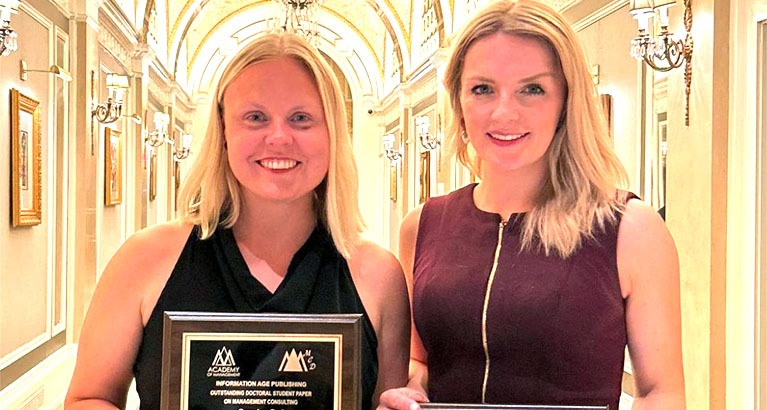
Two alumna of the Master of Studies in Social Innovation programme at Cambridge Judge Business School are named winners at the annual Academy of Management convention.