


By Lennart Niermann, Winner of the CERF/CCFin Best Student Paper Award
Real transmission of monetary policy
When central banks cut interest rates by more than markets expect, 2 things happen. On the one hand, lower policy rates reduce borrowing costs across the economy. This should encourage firms to invest. On the other hand, previous studies show that markets become more pessimistic about the economic outlook around such unexpected rate cuts. If this makes firms more cautious, this could work in the opposite direction and discourage investment. It is unclear how important each of these 2 channels are for the way monetary policy affects the economy. This blog post summarises a recent study showing that changes in firms’ expectations matter substantially. On average, a monetary policy shock has about one-third less effect on firm investment than it would if firms’ expectations remained unchanged.
The identification challenge
Traditionally, research has used monetary policy surprises to study the effects of changes in policy rates. They measure how much a monetary policy decision differs from what markets expected before the announcement. Researchers isolate this unexpected component within a tight event window around the announcement. However, the surprise may also reveal information that changes financial market expectations. For example, when a central bank cuts rates by more than expected, markets may conclude that the central bank knows more about where the economy is headed and take the rate cut as a signal for deteriorating economic conditions. The decision may also change expectations about the central bank’s future policy. As a result, a series of such surprises risks conflating a change in borrowing costs with changes in market expectations about economic fundamentals.
A unique monetary policy event
A particular event in 2016 helps address this problem. That year, the ECB launched the Corporate Sector Purchase Programme (CSPP). Under the programme, it announced that it would buy substantial amounts of certain European corporate bonds. The announcement exhibits 2 useful features. First, borrowing costs fell for bonds that were eligible for purchase, but not for similar European bonds that were ineligible. Second, firms differed in how they benefited from this fall in borrowing costs.
Chart 1, panel a, visualises the first fact. It shows that the yield spreads on eligible bonds fell sharply after the announcement, relative to those on certain other ineligible European bonds. Panel b shows the latter. It compares firms according to how heavily they had relied on CSPP-eligible bonds before the programme began. Importantly, firms outside the euro area could not easily switch to cheaper eligible bonds. This stickiness persistently exposed firms to the wedge in borrowing costs. Why does this distortion in borrowing costs help address the identification challenge? It is useful because it arises in otherwise similar companies. These firms all were large multinationals based in the European single market with globally diversified revenue streams. The programme created a lasting difference in borrowing costs across these otherwise similar firms. The monetary policy surprise inducing this, however, was the same for all firms. Thus, possible belief-revisions should be the same across firms. Consequently, this setup allows us to estimate how lower borrowing costs affect investment, without also capturing changes in firms’ beliefs.
Chart 1: A shock to borrowing costs
Panel A: y-axis: corporate yield spreads in percentage points around the CSPP announcement. Panel B: y-axis: firms’ 2015 pre-exposure to borrowing under different debt instruments in percentage points.
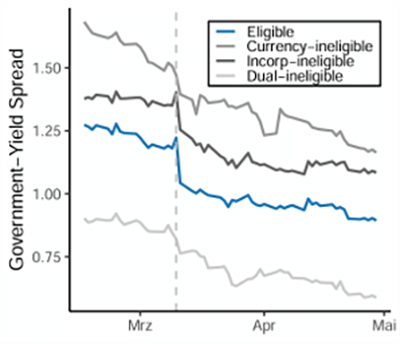
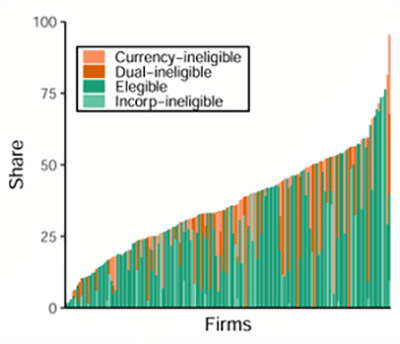
Notes: Panel a) shows the impact of the CSPP announcement on 10 March 2016 for government-yield spreads of eligible corporate bonds relative to other ineligible European bonds. The dashed vertical line reflects the CSPP announcement date. Results are shown relative to bonds that are ineligible because they are issued in a currency different from the euro, because they were issued in a country not in the euro area, or because of both. Panel b) plots firms 2015 pre-exposure to borrowing in these 4 types of corporate bonds. The residual largely reflects bank borrowing.
Belief revisions matter for real transmission
Relating these results to existing estimates reveals that the estimated effect of lower borrowing costs on investment is much larger than previously thought. Among the same firms and over a similar period, the response to an average monetary policy surprise is about one-third smaller than this estimate would imply. This suggests that changes in firms’ expectations matter for their investment decision. When firms become more pessimistic after a surprise rate cut, their caution can partly offset the boost from lower borrowing costs. This effect may be even stronger when a policy decision has an above average impact on firms’ expectations. The key takeaway is that, to understand how different monetary policy shocks affect firm investment, we also need to understand how they shapes firms’ views of the economic outlook.
Featured student
Lennart Niermann
Winner of the CERF/CCFin Best Student Paper Award
PhD Candidate, Faculty of Economics, University of Cambridge
Related content
Visit the CERF website to learn more about the CERF/CCFin Best Student Paper Award, which Lennart Niermann won in 2025/26 for the paper “Decomposing the investment channel of monetary policy”, co-authored with Mathis Momm.
Related articles

Research centre news
Monetary policy’s hidden conduit: who gets your deposits?
Trillions of dollars sit in bank deposits. Banks compete for savers' money, but not all banks can put it to equally good use. This article explains why healthy competition steers deposits to the banks that can do the most with it, and how monetary policy can throw sand in the wheels.

Research centre news
CERF at 25: milestone is celebrated at Cambridge Judge
The 25th anniversary of the Cambridge Endowment for Research in Finance (CERF) was celebrated at a 2-day conference at Cambridge Judge Business School that highlighted the research and scholars that CERF has supported over the last quarter-century. Founding benefactors William and Weslie Janeway were among the distinguished guests, who also included Professor Deborah Prentice, Vice-Chancellor of the University of Cambridge, and Professor Gishan Dissanaike, Dean of Cambridge Judge.

Research centre news
Why money helps strangers co-operate at scale
Edoardo Gallo and co-authors Maria Bigoni and Gabriele Camera investigate how co-operation can be sustained among strangers in networks of different sizes. Their laboratory experiment compares permanent ostracism, temporary ‘time-outs’, and intrinsically worthless tokens that participants can exchange for help. Temporary exclusion and monetary exchange work similarly well in small networks. In large networks, however, tokens are the only institution that produces near-full co-operation while keeping the network intact. The results show why money can be more than a means of payment: it can be a scalable institution for co-operation.