
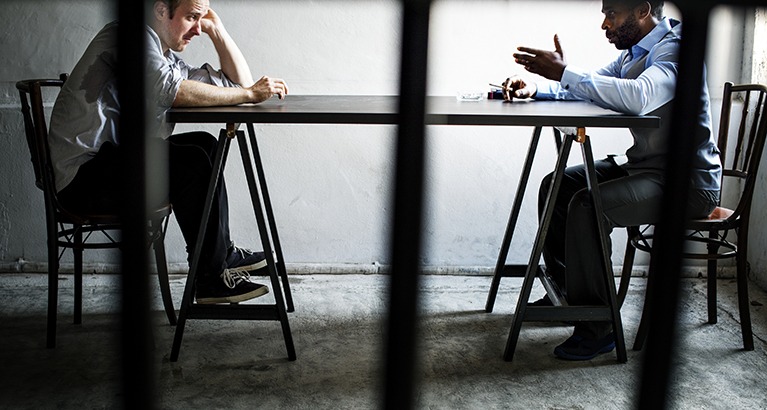

People tend to think of an atmosphere as something aesthetic, like the romantic music and candles in an intimate restaurant, or the way a retail store is lit and laid out to encourage higher sales. As consumers, we tend to think of atmosphere as something we encounter after someone else has firmly established such a setting in advance in a way to affect our senses.
Yet when it comes to security, a fast-growing industry around the world, what is known as atmospheric work goes far beyond how physical premises are laid out also encompasses the practices used by security personnel in ways best designed to prevent trouble and harm. This is particularly important in prisons, where prisoners may outnumber officers by a factor of 50 to 1.
A male-only prison is England is the setting for research co-authored by 3 academics associated with Cambridge Judge Business School – PhD graduates Adrian Marrison (PhD 2017) and Jaco Lok (PhD 2002), and Professor of Organisational Ethnography Mark de Rond. Their research goes beyond physical atmosphere to examine what is termed jailcraft – which reflects the fact that in such a high-pressure security environment, says their research, atmosphere goes beyond backdrop to encompass something “actively sensed and ‘worked’ in real time” by security personnel in a way that is “strikingly purposive, yet curiously non-aesthetic in orientation”.
3 tactics officers use to control the room
The research by Adrian (Assistant Professor at Warwick University and an Honorary Associate at Cambridge Judge), Jaco (Professor at Macquarie University in Australia) and Mark finds 3 key ways in which prison officers engage with atmosphere:
- sensing the atmosphere for rising tension
- amplifying tension as a means of control
- dampening this tension if the tension risks violence occurring
The research – entitled Jailcraft: atmospheric security work in violent contexts – is published in the Academy of Management Journal.
2,000 hours inside a prison holding 950 men
The research took place in a Category B prison, which was built in the 19th century and operated as a high-security facility until early this century. At the time of the research, the prison held around 950 men and was staffed by both male and female prison officers. Adrian’s research spanned 12 months, resulting in around 2,000 hours inside the prison to observe how such atmospherics play out.
Gaining access required patience. “There was plenty of back and forth in getting approval,” Adrian recalls. “We got really great support from the prison governor, but also needed formal approval from HM Prison Service, and that took around 6 months.” As for his own preparation, Adrian took courses on self-protection and studied prison officer guides, but nothing totally prepares someone for such an experience.
When you first go in it’s very scary, as prisoners are trying to test you out to see if you are weak.
“The prisoners at the prison we studied were on remand pending trial on a variety of charges ranging from very minor such as petty theft to murders, rapes and organised crime,” he says. “When you first go in it’s very scary, as prisoners are trying to test you out to see if you are weak. I was very much on my guard all the time: you always have your back to the wall, always looking around, while standing up straight and tall while keeping your hands free and actively looking around. It’s all pretty performative.”
Guidelines on Adrian’s access to the prison did not allow in-depth study of individual prisoners, but Adrian nevertheless developed a rapport with some of them. “I wouldn’t ask them anything but they’d often talk about court cases and their family at home, so I got to know them pretty well. Those who struggled with reading would ask me for help with their letters.”
There were a few hairy moments: “On one occasion I locked myself behind a door because a fight was breaking out, and on another occasion there was a gang fight in which a prisoner got stabbed pretty close to me. There was also what seemed to be a suicide attempt using bed sheets, and on one occasion I had to take a couple of days off from the fieldwork after accidently inhaling second-hand smoke from the drug spice. It’s known as the ‘zombie drug’ because it typically leaves people frozen and slumped over, sometimes unresponsive, other times screaming.”
It’s not just prisons – this happens in courtrooms and operating rooms too
Part of the research delves into non-prison procedures to examine how atmospheres can be reinforced through institutional routines – such as the way courtrooms maintain an air of gravity through formal introduction of the judge as all rise, and how surgical teams foster calm through hierarchical systems. “We came to see that our findings were less centrally about violence, security and sensory experience per se, and more about the work that officers did to modulate the prison’s atmosphere in the course of their everyday practices,” says the research, which focuses extensively on 3 mechanisms through which prison officers amplify the prison’s atmospherics to help maintain order.
1
Sensing: reading the room before trouble starts
Officers cultivate over years the ability to distinguish between sensory cues that matter and those that can be ignored, scanning for signs of trouble and indicators that activity is developing. The key, as one officer put it, is recognising when “the pattern of daily life is off”: a sudden hush, repeated glances, or prisoners clustering where they normally wouldn’t. On one occasion, an officer broke conversation to ask a prisoner “are you gonna smash up?” – alerted, he explained, by the prisoner’s tone of voice.
Such sensing is also a collective practice. During one association, 2 officers remarked that something felt off: more prisoners out than normal, higher noise levels and prisoners trying to distract them. One officer gestured towards a group, prompting colleagues to direct their gazes, whilst another moved over to the laundry room where they suspected violence might occur. This feel that officers develop is particularly fine grained. As Adrian remarked: “it was only after around 3-4 months I developed the ability to feel atmospheric shifts, and even then, this ability was pretty poor compared to experienced officers.” New officers often struggled to detect subtle shifts to the atmosphere, sometimes becoming overwhelmed. One was even found crying on the landing.
2
Amplifying: using visible tension as a deterrent
The authors also describe how prison officers do not just read the prison’s atmosphere – at certain times and places they amplify it as a deterrent. Officers believed that certain times and places posed the most risk of trouble occurring, so they sharpened their voice, gestures and movements in them, in ways intended to be seen by prisoners.
“This ‘zoned’ intensified vigilance was particularly evident during larger communal activities like the daily association period,” says the research. “The prisoners would be unlocked and allowed to socialise, take showers and complete various tasks. These were particularly intensive atmospheric periods with up to 100 men unlocked at once and supervised by the 4 landing officers on a large, main wing. Officers’ embodied vigilance and readiness would visibly intensify.”
As Adrian outlines in a vignette from his contemporaneous notes about such zoning:
“10am, Association time. Prisoners are unlocked, filling the bottom floor. They gather in groups, with pockets of movement and noise: shouts, whistles, conversation. Jonny stands above, watching over the railing. His eyes sweep: left corner, right side, pool table, back stairs, cell 1-32. One foot forward, one shoulder turned, keeping the floor in view. A group heads to the showers, normal stuff. But fist bumping and raised smiles when they emerge. Jonny stands up straight and moves off to the showers. Two other officers shift their gaze in the same direction. He gets there, but no sign of blood, nobody down. He nods to the others, returns to post. His eyes move again. The same sweep. Not looking for trouble, just the moment it begins to show.” The deterrent effect could also be collective. Multiple officers would sometimes direct their presence to an area, on the logic that prisoners are unlikely to act when the area appeared “swamped with staff”. And when officers deemed violence to be immanent, they intervened in ways that signalled their awareness. On one occasion, when a prisoner began doing pullups and stretching – a typical warning sign of a fight – an officer shouted at him to stop, not because pull ups were forbidden but to make clear officers knew what was about to happen.
3
Dampening work: cooling things down before it’s too late
Dampening work entails such techniques by officers as visibly adopting an empathetic and calm demeanour to signal that the situation remained manageable with no need for force either way, and by showing respect to prisoners. “In other words, their bodies and voices worked to deliberately dampen the atmospheric intensity of the situation before it could tip into confrontation,” the authors say.
Adrian’s fieldnotes on such dampening techniques say:
“The landing hummed. Evening movement fading. Two new prisoners, brothers, stood by the doors, arms tight. Voices sharp, muttering, threats. They’d been told they’d share a cell, but none were empty, they had to be split up. Brian paused, hands loose at his sides. He stepped forward, slow. Gaze steady. He explained, just for this first night, they’d be split, but he’d get them a cell together in the morning. His words dropped into the tension. Hesitation. ‘Lads’, he said, low and slow, ‘I’ve got more respect for you than to lie. I’d much rather have you together, you’ll be happy, much more settled.’ The hesitation loosened, not entirely, but enough for the evening.”
Why this matters beyond prison walls
Implications of the findings go far beyond prison walls. Security personnel are becoming more present in many areas of everyday life, including at retail shops, restaurants, schools and other settings – as the authors note, private security officers now outnumber police by a wide margin in the US. As 2025 immigration raids in Minneapolis showed, how such security practices are carried out can be deeply divisive. “The public may not experience the presence of security personnel and their vigilant affective orientation as benign and reassuring,” the authors note.
Adds Adrian:
“If you increase security in society, this paradoxically can make people more worried, concerned that something bad is going to happen. So the way that security personnel shape and influence the atmosphere is really important. I read a lot about music and lighting in restaurants as part of my research, but what the study looks at goes far beyond such staging efforts to focus on what the people involved are doing to actively shape the atmosphere.”
The public may not experience the presence of security personnel and their vigilant affective orientation as benign and reassuring.
The authors note some important differences between keeping order in prisons and policing airports or protests. Prison populations are not as transient as frequent flyers or protesters, so officers can over time learn about inmates’ individual characters and histories, and can develop relationships with them. In addition, prison officers can sometimes rely on inmates themselves to enforce social hierarchies and keep the calm.
“Yet despite these differences, we suspect that the broader forms of atmospheric work identified here: sensing, amplifying and dampening, likely extend across a broad range of security settings, even if the specific practices involved may vary,” the authors conclude.
Featured faculty and alumni
Mark de Rond
Professor of Organisational Ethnography
Adrian Marrison
PhD 2017 and Honorary Associate
Jaco Lok
PhD 2002
Featured research
Marrison, A., Lok, J. and de Rond, M. (2026) “Jailcraft: atmospheric security work in violent contexts.” Academy of Management Journal (DOI: 10.5465/amj.2025.0026)
Related articles

Leadership and organisational behaviour
How early-career success or failure shapes leaders’ mindsets
Timing matters greatly when it comes to how workplace wins and losses impact employees. Success or failure on a person’s first project after entering the workforce is associated with the mindset they display as a leader around a decade later, which in turn predicts their team’s creativity or routine performance. The same pattern was not found for project outcomes experienced when employees first moved into a formal leadership role, according to research from Cambridge Judge Business School.

Leadership and organisational behaviour
Are women really more emotionally intelligent than men?
Emotional intelligence (EI) has been studied intensively since the early 1990s, and a stubborn stereotype has developed that women possess more EI than men. Yet is that really the case? A meta-study of 1,279 academic articles comprising 609,278 participants from 76 countries over 3 decades finds a far more nuanced result.

Leadership and organisational behaviour
How different types of envy affect workplace ideas
Envy is a natural human emotion, but it can be harmful in the workplace. Research co-authored at Cambridge Judge Business School finds that in evaluating colleagues’ creative ideas, people can have benign envy or malicious envy – so managers need to understand this better to ensure that the most creative ideas are not stifled.