

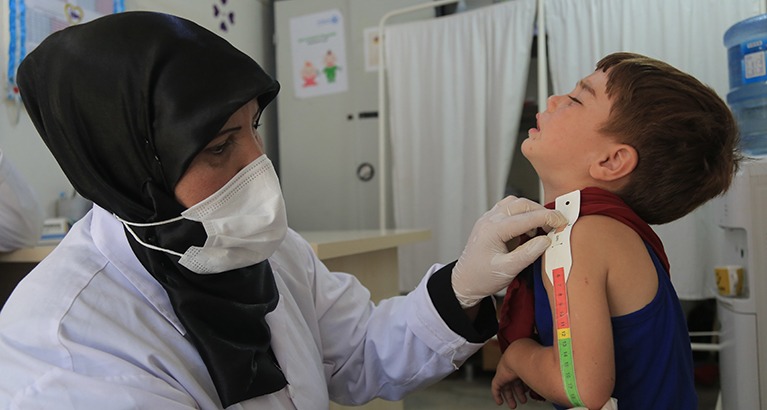
Global health has become expert at establishing what a war does to a population and has built almost nothing that would stop the next one. A new Comment in The Lancet Global Health co-authored by Dr Adam Coutts, a Centre for Business Research Research Associate at Cambridge Judge Business School, argues that this is not a gap in the evidence – but is rather a gap in willingness held in place by how institutions are funded, mandated and rewarded.
We have been monitoring misery for too long. Monitoring is not the same as ending it.
The authors contend in the Comment, entitled Beyond monitoring misery during conflict: the political economy of global health reform, that the sector is paid to monitor and paid for very little else. The institutions, including UN agencies, donor governments and the university-based commissions that advise them, run sophisticated machinery for mortality estimation, attacks-on-healthcare reporting and needs assessment. The machinery for accountability barely exists. Power, financing and governance stay where the incentives leave them, which is untouched.
Adam Coutts said: “We have been monitoring misery for too long. Monitoring is not the same as ending it.”
Reforms in health institutions stalled by funding incentives
One everyday observation carries most of the case. Ask anyone in the sector privately whether health in conflict is political and the answer comes back without hesitation. That answer rarely reaches the published output. The analysis exists, but it stops at the door of the institution that would have to act on it.
The argument is equally direct about recent flagship reform reviews, which diagnose the problem accurately and then dissolve it. They conclude that reform commitments stalled because donor incentives and institutional mandates were never confronted, and then address their recommendations to those same actors, holding those same incentives, and expect different behaviour. A recommendation that does not change what an institution is rewarded for is not a reform. It is a record of having noticed.
Humanitarian neutrality is not the same as technical neutrality that reflects politics
Central to the argument is a distinction between 2 things the field treats as one. Humanitarian neutrality, the operational duty to assist all civilians regardless of affiliation, is a precondition for protected access and is defended without qualification. Technical neutrality is the bracketing of political accountability in the name of impartiality by researchers, evaluators and agencies that are not themselves delivering care. It borrows the moral standing of the first while carrying none of its risk, and in practice it protects budgets, mandates and access while leaving intact the conditions that generate the casualties being counted.
Fifteen years of field research across Syria, Lebanon, Gaza and Jordan sit behind the argument. What follows from it is a political economy approach that treats political decisions, donor incentives and governance structures as determinants of health outcomes in conflict rather than as background conditions.
From redefining the health mission to embedding new practices
The Comment proposes 6 concrete shifts, each specifying who must act:
- redefining the mission: from parallel delivery to state capacity
- accountability infrastructure: independent evaluation with teeth
- economic enforcement of IHL: making military suppliers bear cost
- regional health intelligence: distributed, not centralised
- data harmonisation and procurement transparency
- bridging the knowing-doing gap: embedded practice for global health researchers
Health institutions have the analysis to stop harm, but not the will
Dr Vlad Chaddad, one of the authors, said: “We keep asking the same actors, holding the same incentives, to behave differently because another report recommends it. That is not a reform strategy. Fund an evaluation body that no government can defund and that publishes without clearance, and you have changed the incentive rather than the recommendation.”
We need interventions that work and are fit for local economic, social and political contexts not ones transplanted en masse from the EU and US.
Adam Coutts adds: “We need interventions that work and are fit for local economic, social and political contexts not ones transplanted en masse from the EU and US.”
Simon Deakin, CBR Director, adds: “It is vital that lessons are learned from the research carried out in Cambridge and elsewhere on the relationship between conflict and health. This is an issue which affects us all.”
The authors are not arguing that global health lacks the analysis. They are arguing that it has the analysis and files it. The question they leave open is what the field would look like if the rigour it applies to counting the harm were applied to naming who causes it and who pays for it to continue.
Related content
Coutts, A.P., Orcutt, M., Sullivan, R., Ekzayez, A. and Chaddad, V. (2026) “Beyond monitoring misery during conflict: the political economy of global health reform.” The Lancet Global Health: 104038 (DOI: 10.1016/j.langlo.2026.104038)
Related articles

Research centre news
Report finds stronger UK worker protection under new law
Legal protection for British workers under the Employment Rights Act 2025 will move closer to the Organisation for Economic Cooperation and Development (OECD) average, according to a new UK government report that uses the Labour Regulation Index of the Cambridge Centre for Business Research (CBR) at Cambridge Judge Business School.

Research centre news
Report on UK tech cites testimony from Cambridge Judge
The UK House of Lords Science and Technology Committee cited testimony and written evidence by David Connell, Senior Research Fellow at the Centre for Business Research at Cambridge Judge Business School, in a new report on the failure of UK technology companies to scale up to become global players. The report is entitled Bleeding to death: the science and technology growth emergency.

Research centre news
Paper says UK economic data issues reflected defective methodology
Data that seriously distort Britain’s post-war economic history arose because the UK’s Office for National Statistics (ONS) made errors that should have been easily spotted and adopted a highly defective methodology, says a new working paper written by Bill Martin, Senior Research Associate at the Centre for Business Research (CBR) at Cambridge Judge Business School.