


The programmes, which all launch in July, complement existing Executive Education offerings at Cambridge Judge that look at areas including Generative AI, innovation using AI, and leadership through AI disruption.
The new programmes address 3 key pillars relating to AI and the modern enterprise: building agentic AI capability, scaling and strategy, and governance including risk management – all of them vital to businesses and other organisations seeking to remain competitive.
While all focused on AI, the programmes lean into different areas: these include building an infrastructure to move beyond AI pilots, moving beyond legal compliance to governance as a capability, and the return on investment that firms using AI successfully can realise.
The new programmes are:
Agentic AI: Design, Build, Govern programme
9-10 July in Cambridge
This programme examines how agentic AI represents the next critical evolution in enterprise technology: while generative AI produces content, agentic AI takes action by planning, executing multi-step workflows and adapting autonomously.
Fewer than 12% of organisations have moved agentic AI beyond piloting, and the biggest obstacle is having the right systems and data in place to use it at scale. So the programme includes hands-on labs that allow participants to build, deploy and stress-test their own agents, and guidance on how to take these agents back to their organisations and safely and effectively embed them into their work.
The programme’s Academic Programme Directors are David Stillwell, Professor of Computational Social Science, who recently co-authored an article in the journal Nature that introduces an ‘ability profile’ for AI models that can predict how they will perform on unfamiliar tasks, and Mark Bloomfield, a Fellow in the Marketing subject group at Cambridge Judge and founder of Turbulence, a board-level AI transformation advisory firm.
Shifting AI beyond isolated tasks
“Agentic AI is important because it shifts AI from assistant to operator, enabling organisations to automate end-to-end workflows rather than isolated tasks,” says David. “This allows companies to scale decision-making and execution in ways that were previously impractical. Those who get it right will have a significant advantage in speed, efficiency, and adaptability.”
Mark, who recently addressed a global Cambridge University Press and Assessment event focusing on AI, adds:
“Agentic AI is an invitation to reimagine the work itself – what gets done, who does it, and how value is created. Design, build and govern are the fundamental steps that turn that invitation into something real: systems you understand, outcomes you can trust and advantage you can sustain.”
AI Governance for Boards and CXOs programme
15-17 July in Cambridge
This programme examines how organisations can better future-proof themselves to risks posed by AI by adopting proactive resistance models rather than relying on minimum legal compliance.
The programme will provide a tailored AI Governance Audit for each organisation participating, which includes a 90‑day action plan that can be presented to the firm’s board. The programme’s Academic Programme Director is Matthew Grimes, Professor of Entrepreneurship and Sustainable Futures who has developed 2 new AI tools to help scholars solve important ‘puzzles’ in order for their research to be published in top academic journals.
Boards need to boost the pace in responding to AI
“There is a pace problem facing many organisations in how they respond to AI,” says Matthew. “The technology is moving in months, sometimes weeks, yet most boards are moving at the pace of their quarterly meetings – which means the space between what’s being deployed, what’s being regulated, and what’s actually being overseen gets wider every quarter.
“What I want participants to leave the programme with isn’t a checklist, which would of course be quickly obsolete, but more critically a way of thinking and the governance structures to match, so they can stay ahead of both the engineers and the regulators.
“As an example, Microsoft offers a useful reference point for what well-structured AI governance can look like: formal board-level oversight through its Environmental, Social and Public Policy Committee, a dedicated Office of Responsible AI setting company-wide policy, and a cross-functional Responsible AI Council co-led by the President and CTO. They’re treating governance not as a brake on innovation but as the condition that makes responsible scaling possible.”
AI Strategy for Enterprises programme
22-24 July in Cambridge
This programme is designed for senior leaders who want to move beyond experimentation and isolated pilots in making AI a core driver of strategy and value creation in reinventing the enterprise. Across 3 days, the course helps participants rethink their competitive position, reimagine an AI-enabled business model and build a realistic roadmap for implementation.
“AI strategy today must be developed with a responsible data strategy which is implementable,” says Academic Programme Director Michael Barrett, Professor of Information Systems and Innovation Studies, whose academic journal articles have looked at issues such as the risk of AI algorithmic bias and its implications for diversity and marginalisation, and images of (social) data in an AI age.
AI strategy without a responsible data plan is wishful thinking
A key theme of the AI Strategy for Enterprises programme is that AI strategy must reimagine the business model and be developed in tandem with a data strategy. Participants examine how their data assets, data quality and data governance shape what is realistically possible with AI, and how these are aligned with their values and vision.
“AI strategic initiatives without a responsible data strategy is essentially wishful thinking,” Michael notes. “Leaders need to know what data they have, what data they need and how those data flows support decisions right across the enterprise.”
The programme also stresses that any credible AI strategy must address people and ethical issues in implementing their future with AI. Sessions explore human-AI collaboration and implementation of AI, and the skills and literacy required for employees to work effectively with AI systems. “Successful AI adoption is as much about people, values and prioritising valuable use cases as it is about algorithms,” says Michael.
Welcoming participants in July
Cambridge Judge looks forward to welcoming participants in July to these 3 exciting AI programmes in Executive Education, which will help individuals and organisations meet the challenges and rise to the opportunities of this transformational technology.

Agentic AI: Design, Build, Govern
A 2-day, hands-on Cambridge programme where you build and stress-test AI agents, confront their limits, and design governance that makes them production-ready. Leave with a faculty-reviewed 90-day roadmap to launch your first agentic workflows.

AI Governance for Boards and CXOs
Turn AI uncertainty into accountable board‑level decisions. Build practical AI governance capabilities, challenge management with confidence, and leave Cambridge with a clear 90‑day oversight plan designed with faculty.

AI Strategy for Enterprises
Develop the strategic insight, practical frameworks and AI strategy roadmap to lead enterprise transformation.
Featured research
Zhou, L., Pacchiardi, L., Martínez-Plumed, F., Sun, L., Stillwell, D. et al (2026) “General scales unlock AI evaluation with explanatory and predictive power.” Nature, 652: 58-67 (DOI: 10.1038/s41586-026-10303-2)
Arora, A., Barrett, M., Lee, E., Oborn, E. and Prince, K. (2023) “Risk and the future of AI: algorithmic bias, data colonialism, and marginalization.” Information and Organization, 33(3): (DOI: 10.1016/j.infoandorg.2023.100478)
Related content
“New study’s model predicts how AI will perform on unseen tasks.” Cambridge Judge Business School, 2 April 2026
“Inspiring innovation at Cambridge.” Cambridge University Press & Assessment, 26 March 2026
“Harnessing AI to push the boundaries of social science.” Cambridge Judge Business School, 19 February 2026
Related articles

What if the future of artificial intelligence wasn't about building ever-bigger systems, but about building smarter ones?
Programme news
Bringing case studies alive through AI
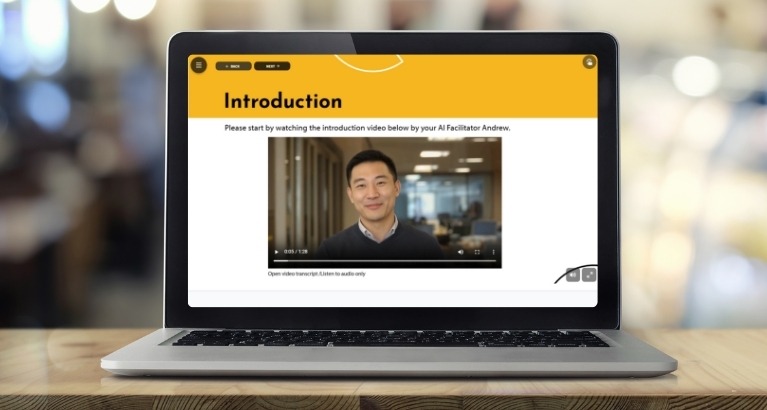
A new interactive platform driven by AI allows Executive Education participants at Cambridge Judge Business School to chat electronically with the CEO, CFO and other top executives of a fictional battery-making company. Their candid answers provide insight in a way the printed page cannot, and the system has proved very popular at the Advanced Leadership Programme at the Business School.

As series 1 of the Executive Education podcast – Journey to Regeneration with Christopher Marquis draws to a close, we reflect on the lessons learned from our guests. We were lucky enough to welcome some of the world’s most forward-thinking leaders in sustainability, business and policy, where their insightful conversations highlighted that integrating regenerative practices into business is no longer a lofty aspiration – it is rapidly becoming the blueprint for how resilient and purpose-driven businesses will thrive.