

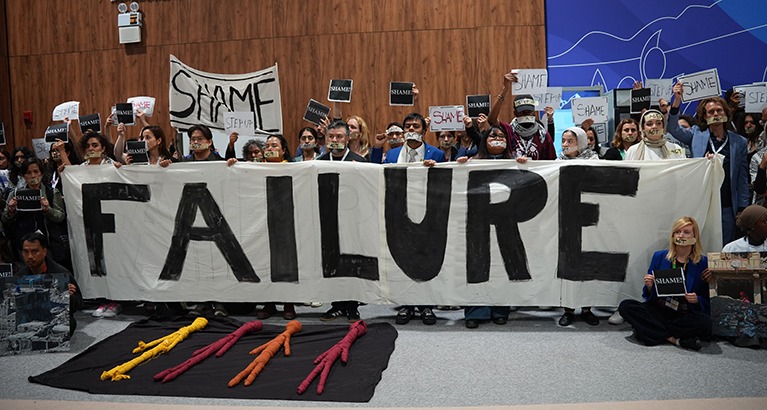
The talks in the city of Antalya collapsed on 22 November when nations including those in the European Union objected to a final proposal that did not mention fossil fuels, and poorer countries objected to the lack of financial commitment to help them adapt to climate change.
This is certainly not an encouraging development, “but one should question some of the hyperbolic rhetoric over the nature of the failure”, says David Reiner, Professor of Technology Policy at Cambridge Judge Business School, who adds that the “handwringing over the inability to agree on a final communique” needs to be considered in a longer-term perspective.
Daunting challenge to get diverse nations to agree on wicked problems
“First and foremost, climate change, and in particular, assigning responsibility for taking action, has always been what has been described as a ‘wicked problem’. The default assumption should therefore be that any agreement requiring consensus among parties ranging from OPEC nations to small island states threatened by inundation from sea level rise will inevitably be daunting (verging on feeling impossible at times!),” David says.
“What is perhaps more remarkable is how resilient the UN system has proven over these past 3 decades despite the tendency to unravel at times. COP6 in late 2000 also ended in failure. The election of George W Bush that same year led to the US withdrawal from the Kyoto Protocol, but this actually strengthened international resolve leading to agreement the following year in Marrakech in 2001. Similarly, COP15 in Copenhagen in 2009 did not formally fail but was widely judged a failure and it was not until COP21 in 2015 that the Paris Agreement established the rules for the current system.”
Alternative route involves EU, UK and some other nations
Michael Pollitt, Professor of Business Economics, offers an alternative route to the United Nations negotiations reflected at COP summits.
“There is another way forward on climate change policy which does not allow fossil fuel countries to derail globally significant climate action,” says Michael. “This is the emerging climate club around nations which limit and price their own greenhouse gas emissions. These nations which include the EU, UK, Switzerland, Norway and China can proceed with deep emissions reductions combined with carbon border adjustment mechanisms (CBAMs).

There is another way forward on climate change policy which does not allow fossil fuel countries to derail globally significant climate action.
“Carbon markets combined with CBAMs offer the possibility of a globally significant race to the top on climate action, which encourages other nations to join the climate club or face having their exports taxed at the club border on the basis of non-members’ failure to enact sufficiently robust domestic climate policies.
“The failure of COP reinforces the leadership role of the EU and its climate allies in setting the agenda for global action. With respect to climate – as in other areas of best practice regulation – the EU continues to demonstrate that it is a United Nations that works,” says Michael.
US withdrew from talks several times, but other nations did not follow
David notes that previous failures at COP meetings have not led to a domino effect at subsequent meetings. “The United States, the largest economy in the world, has withdrawn 3 times from the international process, but what is most notable is that virtually no other country has followed. Moreover, recent US elections indicate how even the US itself cannot even be relied upon to simply abandon climate action.
“Samoa and Saudi Arabia will never see eye to eye over climate change and yet, Saudi Arabia’s Vision 2030 and the Saudi Green Initiative championed by the Crown Prince focus on the need to rapidly scale up climate action and diversify the Saudi economy. Fossil fuel producers, which are highly reliant on export revenues, inevitably view the path to action differently from oil importers as reflected in the current debates over language over the role of fossil fuels in the final text at COP31 (a debate that began in earnest 5 years ago at COP26 in Glasgow).”
Best not to overstate the current moment

Massive cost reductions in solar energy, batteries and electric vehicles means that the shift away from fossil fuels will be much easier than would have been envisioned even a decade ago.
“Taking a longer view does not mean that one should be complacent about the ability of the international community to once again find a way to make progress but the grim reality is that climate damages will continue to mount over time, bringing more calls for action,” David adds. “Massive cost reductions in solar energy, batteries and electric vehicles means that the shift away from fossil fuels will be much easier than would have been envisioned even a decade ago. These longer-term trends redouble efforts to shift away from fossil fuels (viewed from the consumer side) and to lessen the impacts of fossil fuels (viewed from the producer side). The proven dangers of reliance on Russian gas and Gulf oil over the past 5 years draws the need for shifting away from fossil fuels into even sharper relief. But in the short term, any such shifts remain challenging for consumers and producers alike.
“The path to climate action was never going to be easy or linear, and climate activists will rightly decry these further delays, but it is important not to overstate the current moment, which is better described as an unsurprising bump on a very long, winding road rather than any sort of more fundamental deadlock.”

Related articles
A new report from the International Universities Climate Alliance (IUCA) for this month’s COP31 climate conference in Turkey focuses on misinformation about climate issues and how this can be combated through the role played by universities and their researchers on climate change. The report is titled Advancing truth: university contributions to a trusted information environment.

Student and alumni news
Cambridge study rethinks power and meaning at COP summits
A new study by a recent graduate of the Master of Studies in Social Innovation degree programme at Cambridge Judge Business School sheds new light on how power operates in global climate negotiations, not only through bargaining over outcomes but through contests over meaning at the annual COP climate-change summits.

Business Schools for Climate Leadership, a group of eight European business schools including Cambridge Judge, launches a second series of webinars to accelerate climate-change action.