


In financial markets, everyone wants alpha. Asset managers spend billions trying to find it. Hedge funds promise it. Investors search for it relentlessly. Academics and practitioners build models designed to explain it away.
If alpha exists, it may be due to several reasons – including exceptional skill, a flaw in our understanding of how markets work and inefficiencies in the functioning of financial markets. The latter reason is why policymakers and regulators are also interested in deepening our understanding of how alpha can be identified in the data.
Given this backdrop, one of the central objectives of empirical asset pricing is to determine whether observed returns in financial assets or portfolio strategies are consistent with a proposed model of risk premia. The standard approach is straightforward: estimate the model, compute the resulting pricing errors (‘alphas) and test whether they are jointly equal to zero.
For nearly 4 decades the profession’s benchmark for evaluating alpha-explaining models has been a test introduced in 1989 known as the the Gibbons-Ross-Shanken (GRS) test (named after its 3 authors). This standard is, however, showing its age in an era in which there is now an explosion of financial data that didn’t exist in the late 1980s – as researchers now routinely analyse hundreds or thousands of assets simultaneously. In addition, the rapid growth of factor investing, anomaly testing and machine learning-based asset pricing has significantly expanded the scale at which asset pricing models are evaluated.
A new test for alpha in an era of volatility and crises

A proposed new test for the existence of alpha directly addresses this issue, as it has been designed for high-dimensional asset-pricing applications. The proposed test is labelled ‘MSTV’ after the names of 4 co-authors of a new research paper: Daniele Massacci, Professor of Finance at King’s Business School, Lucio Sarno, Professor of Finance at Cambridge Judge Business School, Lorenzo Trapani, Professor of Econometrics at Universita’ di Pavia and University of Leicester and Pierluigi Vallarino, Postdoctoral Researcher at Universita’ della Svizzera Italiana. Their paper is published in the Journal of the American Statistical Association, a premier journal in statistics.
The research proposes a methodology to test for the ‘null hypothesis’ that the alphas of a panel of asset returns are jointly equal to zero in a linear factor pricing model with observable and tradable factors – referring to the null of ‘zero alpha’. The test does not require estimating any covariance matrix, a task that becomes difficult when the number of assets is large.
New test reflects today’s datasets
The test proposed by MSTV addresses 3 features that increasingly characterise modern financial datasets:
1
It remains feasible in high-dimensional environments where traditional methods of estimation and inversion of the covariance matrix are impossible.
2
It accommodates strong cross-sectional dependence in residuals, allowing for co-movement across assets that is not captured by the model’s risk factors.
3
It remains robust to time-varying volatility and skewed return distributions, both of which characterise financial data and become particularly important during episodes of market stress.
The test works well in simulation experiments
Any new testing procedure must demonstrate that it performs well in realistic environments. To evaluate its statistical properties, the research introducing MSTV conducts an extensive simulation analysis covering a range of processes and structures – and 2 broad findings emerge: the test exhibits satisfactory properties across a wide variety of specifications and it performs well in environments that challenge conventional approaches and are typical of periods of heightened financial uncertainty.
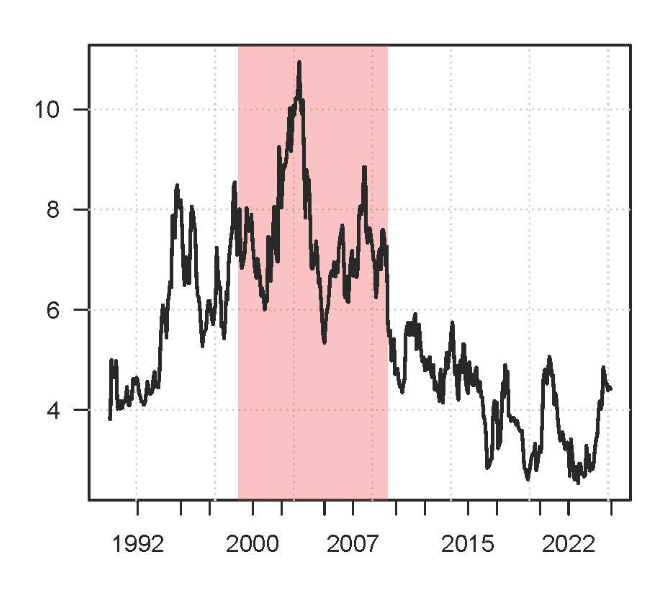
Methodological advances matter most when they help answer substantive economic questions. To illustrate the usefulness of the new framework, the MSTV research applies it to leading asset-pricing models using large cross-sections of S&P 500 stocks observed over rolling windows of length.
During relatively tranquil periods, several models provide a reasonable description of returns. However, their performance deteriorates significantly during episodes of financial turmoil – showing a rejection of traditional model hypotheses during episodes of market stress including the Asian Financial Crisis, the bursting of the Dot-Com bubble, the Global Financial Crisis and the Covid-19 pandemic.
These findings suggest that explaining returns remains particularly difficult during periods when financial markets are under strain. While existing models capture average return patterns reasonably well under normal conditions, they struggle to account satisfactorily for return dynamics during major economic disruptions.
Figure 1 visualises these findings by plotting the time series of the largest estimated absolute alpha for each rolling window. The degree of mispricing varies over time, with the period January 1999-December 2009 (the red shaded area) characterised by particularly large and persistent pricing errors. This is clear evidence that common asset-pricing models appear most vulnerable precisely during periods in which understanding risk is most important.
Implications for empirical finance
The contribution of MSTV is methodological, but its implications are broader. The growth AI-based investing and other new developments have dramatically expanded the dimensionality of empirical asset-pricing applications. Yet many of the profession’s benchmark specification tests were developed for a much lower-dimensional world.
As the literature increasingly embraces richer datasets and more sophisticated modelling techniques, reliable high-dimensional inference becomes a first-order concern rather than a technical afterthought. The question of whether asset-pricing models successfully explain expected returns remains one of the defining questions in finance. The proposed new test broadens the range of applications where this fundamental question can be addressed rigorously.
More broadly, the findings underscore a simple point: finance has entered an era of increasingly large and complex datasets, so as empirical methods evolve to exploit these data, inference procedures must evolve alongside them.
Featured faculty
Lucio Sarno
Professor of Finance
Featured research
Massacci, D., Sarno, L., Trapani, L., & Vallarino, P. (2026). “A general randomized test for Alpha”. Journal of the American Statistical Association, 1–75.
References
Fama, E F and K R French (1993), ‘Common risk factors in the returns on stocks and bonds’, Journal of Financial Economics 33(1): 3–56.
Fama, E F and K R French (2015), ‘A five-factor asset pricing model’, Journal of Financial Economics 116(1): 1–22.
Gibbons, M R, S A Ross and J Shanken (1989), ‘A test of the efficiency of a given portfolio’, Econometrica 57(5): 1121–52.
Massacci, D, L Sarno, L Trapani and P Vallarino (2026), ‘A general randomized test for alpha’, forthcoming in the Journal of the American Statistical Association.
Related articles

Finance and accounting
Integrated digital finance regulation: lessons from Kigali
Fragmentation between data protection and financial regulatory frameworks is increasing compliance burdens and slowing the development of safe, data-driven financial services. Learn what joined-up oversight would look like in practice.

Finance and accounting
Where AI meets blockchain: assets, agents and blind spots
An analysis of AI and blockchain convergence, covering compute infrastructure, crypto assets, autonomous agents and emerging policy challenges by Wenbin Wu, Research Associate at the Cambridge Centre for Alternative Finance.

Finance and accounting
How high-status moral endorsement can sway consumers
Research on Islamic finance by Lionel Paolella of Cambridge Judge Business School finds that bond buyers will accept a lower rate of return when the bonds are endorsed by high-status Shariah scholars, or skeikhs, underlining the importance of moral reassurance on products whose moral acceptability may be contested.