
Alumni such as Lee Cortez (Executive MBA 2023), Gunnar Droescher (Executive MBA 2020), Anyu Gao (Executive MBA 2022) and Anna Hoff (Executive MBA 2019) have taught alongside faculty on topics ranging from leadership and culture to AI, responsible innovation and supply chain strategy. Their stories show how the Executive MBA experience continues after the degree, sustained by ongoing connections and shared learning.
Gunnar says: “As a student, I enjoyed learning from people who came back as guest lecturers as they made the concepts more tangible through sharing practical examples. Coming back myself, I am always amazed by the level of questions and challenges I receive from the students. It is a lot of fun.”
As a student, I enjoyed learning from people who came back as guest lecturers as they made the concepts more tangible through sharing practical examples.
From participant to teacher: why alumni return to teach
Although their paths differ, these alumni are often driven by similar things: a wish to give something back to the Cambridge Judge community, to keep learning and to help connect theory with what happens in real organisations.
For some, the starting point was work they had already done on the Executive MBA. Anna was keen that her individual project should not sit on a bookshelf, so she turned it into a case study on responsible innovation. Gunnar, who had learned a great deal from case studies during his Executive MBA, wanted to see what it would be like to write one himself, using his own experience in supply chain management.
Others were drawn in by the feel of the classroom. Anyu remembers how interactive Executive MBA teaching felt as a participant, with faculty, students and other contributors shaping the sessions together. When he was invited to teach a case study he had written during his Executive MBA, he found it both enjoyable and energising. That first session led to more teaching, and eventually to becoming a Fellow of Cambridge Judge, with a deeper role in teaching, assessment, research and partnerships.
For Lee, coming back to teach, and now to pursue a PhD, feels like an aspiration realised. He sees Cambridge Judge as a community built around sharing knowledge, and teaching as a way to contribute while also stretching his own thinking. Like many alumni who return to the classroom, he has discovered that you often understand a topic most clearly when you are trying to explain it to someone else.
How alumni in the classroom enhance the Executive MBA experience
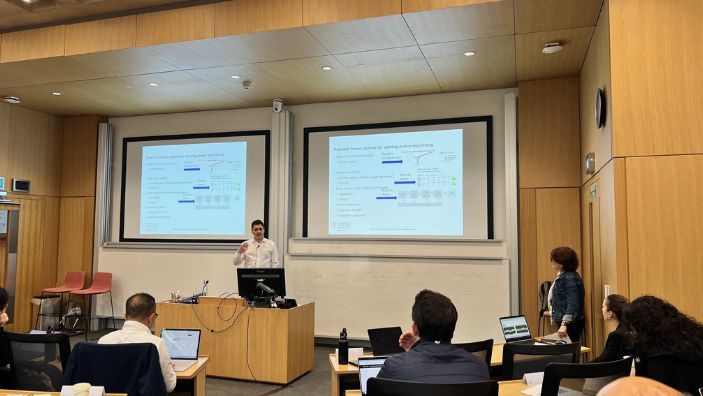
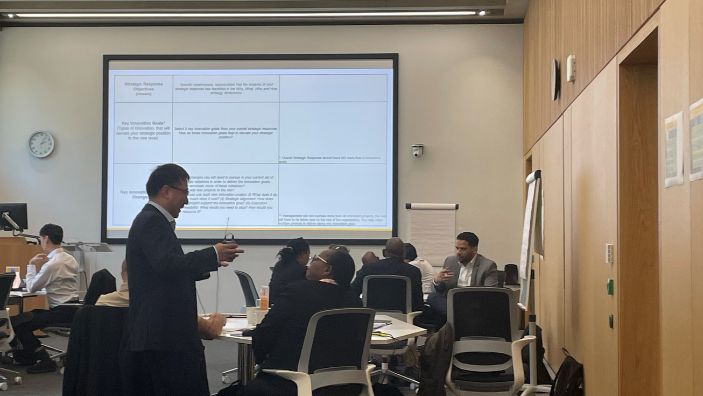
Alumni who come back to teach bring a perspective that feels quite special. As Anyu puts it, alumni understand the direction of the Executive MBA curriculum from their own lived experience and have a good sense of what participants may be thinking or feeling at different points in the programme. This makes it easier for them to link classroom discussion to real leadership responsibilities.
The learning runs both ways. Alumni often describe the classroom as a space where they continue to grow: through the questions participants ask, the challenge they receive from faculty and the effort involved in turning their own experience into something they can share.
Faculty, in turn, benefit from close collaboration with alumni who bring contemporary organisational challenges directly into the classroom. Lee Cortez’s work with Dr Lidia Mishchenko, Senior Teaching Associate at Cambridge Judge, on the Organisational Behaviour course is a good example. Together, they developed and refined a case on implementing a new parental leave policy, turning abstract theories of change and culture into something concrete, personal and analytically rich for students.
Reflecting on this collaboration, Lidia Mishchenko says, “Alumni bring something genuinely distinctive into the classroom. Having completed the programme themselves, they are insiders and outsiders at once, fluent in the language of both practice and academia. Research often describes the lecturer and student as occupying different worlds separated by institutional role, language and different reference points. Alumni dissolve that gap. Lee Cortez did exactly this: he translated the realities of practice into a language and voice the students recognised as their own.”
What alumni teach: leadership, innovation and real-world complexity
The topics alumni teach reflect both their professional expertise and the evolving context in which executives operate:
1
Leadership, culture and change
Lee has taught change management in complex environments, contributed to the Equality, Diversity and Inclusion module and has led sessions on microaggressions and coaching. His case study on parental leave policy change starts from principles and metrics such as OKRs and KPIs but ultimately focuses on values and identity. He calls these identity capital. He encourages participants to see how individual experiences, organisational culture and wider societal forces interact at the micro, meso and macro levels, and how even small policy shifts can trigger far reaching consequences for inclusion and fairness.
2
Supply chain strategy in a disrupted world
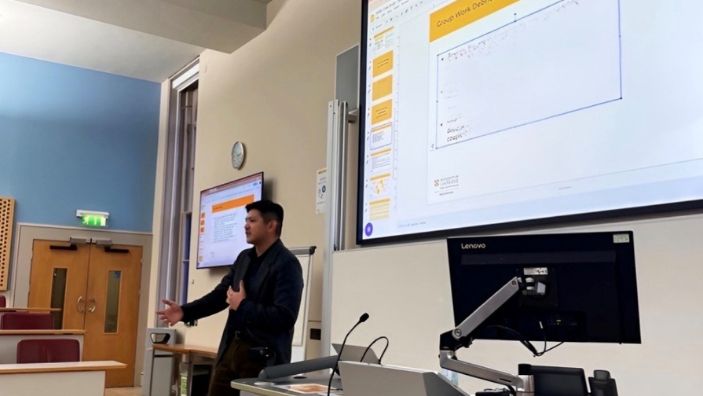
Gunnar co-authored a case study on supply chain management with Professor Feryal Erhun, Professor of Operations and Technology Management, and has taught a session on it alongside her. He believes every executive should have some understanding of what makes supply chains work and where the main challenges lie. In a world marked by pandemics, trade tensions and military conflicts, he argues that these disruptions have important implications for how supply chains will need to function in the future.
3
Leadership, innovation and artificial intelligence
Drawing on 17 years of experience in data and AI across financial services and life sciences, Anyu has taught leadership, innovation and AI in both executive education and degree programmes. He argues that in a world shaped by disruption and rapid technological change, the fundamentals of leadership and innovation have become more important, not less. Alongside teaching, he has also contributed to executive learning design at Cambridge Judge, including the development of an AI-powered executive learning platform with Professor Stelios Kavadias and Abigail Crowther, now used across several leadership and degree programmes and recently highlighted by the Financial Times.
4
Responsible innovation and scaling for impact
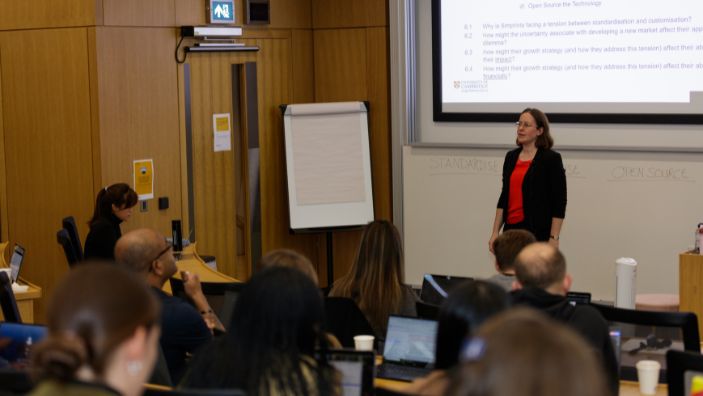
Anna has taught the strategic challenges of responsible innovation and scaling for impact, using the journey of Simprints, a social enterprise that deploys biometric technology in vulnerable communities, helping to provide reliable health and other records in developing countries. Teaching alongside Professor Matthew Grimes, Professor of Entrepreneurship and Sustainable Futures, her sessions focused on the tension between standardisation for efficiency and scale, and customisation for ethical relevance and local effectiveness. These are real-world trade-offs without simple textbook answers. Her aim is to equip executives with a framework to navigate growth and mission integrity without losing sight of their core purpose.
Across these areas, alumni share a common approach to teaching: complex ideas need to be made usable. They want participants to leave with fresh ways of thinking, but also with tools, frameworks or questions they can take back into their own organisations.
A continuing Cambridge journey
For these alumni, coming back to Cambridge Judge feels both professionally rewarding and personally meaningful. It keeps them connected to the Business School, gives them an opportunity to support current executives and offers a way to bring together research, practice and the challenges they encounter in their own work.
Their experiences highlight a distinctive aspect of the Cambridge Judge Executive MBA: learning does not end at graduation. For some, it comes full circle, as they move from participant to teacher and help shape the very experience that once shaped them.
Anna says: “It is a privilege and a joy to return to Cambridge Judge. Finding that balance between student and lecturer to bridge the gap between theory and practice truly makes me smile.”
It is a privilege and a joy to return to Cambridge Judge. Finding that balance between student and lecturer to bridge the gap between theory and practice truly makes me smile.
The Executive MBA
Be part of the journey towards inclusive leadership. Explore our ongoing gender research, download the latest reports, and discover how our Executive MBA programmes are shaping change.
Related articles
Student and alumni news
When a Cambridge Executive MBA makes sense for Academics
We spoke to student Umut Gurkan to find out why, despite already having an impressive academic career, he chose to study a Cambridge Executive MBA to enhance his management and leadership skills.
Programme news
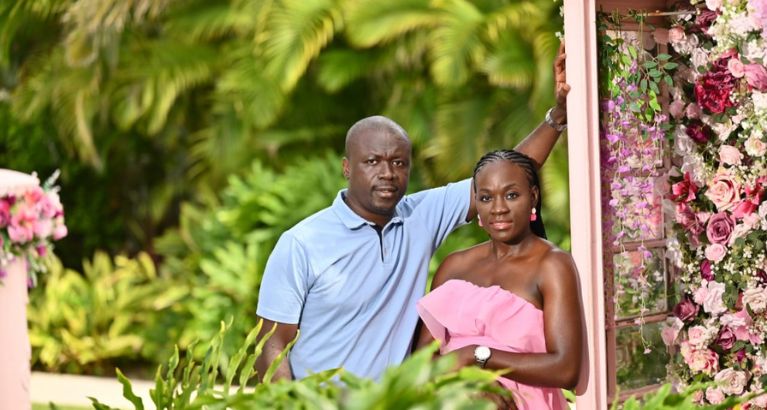
Partners in life and learning: 2 Executive MBAs, one journey
Stephen and Yvonne Amponsah share their Cambridge MBA journey, balancing 2 Executive MBA programmes, careers, family life and a growing business.
Student and alumni news
From courtroom to track: redefining ‘elite’ at Cambridge Judge
Balancing a corporate legal career, national level para-athletics coaching and the Cambridge Executive MBA, Jason Sewanyana is challenging traditional ideas of ‘elite’ by putting people, purpose and inner strength at the heart of performance.