
Belonging is one of those words that gets used a lot in business. It appears in values statements, in diversity reports and in hiring language. But the difference between saying it and building it is where most organisations quietly struggle.
For LGBTQ+ professionals, that gap is often felt before it is named. It shows up in the small calculations people make about what to share and what to hold back, who to mention and who not to. It is not always dramatic. But it is constant, and it takes up space that could go somewhere else entirely.
Pride Month creates a moment to surface those conversations. Not to celebrate prematurely, but to ask honestly whether the environments being built in business today are ones where people can genuinely show up and what is lost when they cannot.
The difference between welcome and belonging
There is a meaningful distinction between being welcomed into a space and truly belonging in it. Welcome is transactional. Belonging is structural. It requires that the environment itself – its norms, its leadership, its everyday interactions – does not ask people to leave parts of themselves at the door.
Vilibald Farkas, Cambridge MBA student in the class of 2025, captures this precisely. “It is important to realise that if people cannot be authentic and cannot be themselves, if they do not feel safe, then they will not fully exploit their potential.” he says. “It is really crucial to make people feel at home.”
The concept of feeling at home carries more weight than it might first appear. Home is not a place where you perform. It is a place where you do not have to. And in a professional context, the ability to stop performing and start contributing fully is exactly what unlocks the kind of thinking, risk-taking and creativity that organisations say they want.
The question Pride Month should prompt is not “do we have LGBTQ+ employees?”, it is “do our LGBTQ+ employees feel at home?”

It is important to realise that if people cannot be authentic and cannot be themselves, if they do not feel safe, then they will not fully exploit their potential.
What gets lost when people cannot be themselves
The cost of inauthenticity is rarely measured directly, but it is real. When people spend energy managing how they are perceived, monitoring what they say, who they mention and how they present, that is energy not going into their work. It is a tax on potential that falls disproportionately on those who are already navigating more.
Shipra Jha, another Cambridge MBA student in the class of 2025, reflects on what genuine inclusion has meant in her own experience. “Queer professionals have always brought so much to the table.” she says. “But now, selfishly, diversity should matter to businesses more than ever.”
Selfishly. That one word reframes the conversation in a very important way. It moves inclusion away from the language of charity or compliance and towards something more honest: organisations that build genuinely inclusive cultures are not doing LGBTQ+ employees a favour. They are doing themselves one.
The perspectives that come from navigating difference, from understanding intersectionality, from having had to develop resilience and adaptability in environments that were not always designed with you in mind, these are not incidental qualities. They are leadership qualities.

Queer professionals have always brought so much to the table. But now, selfishly, diversity should matter to businesses more than ever.
Intersectionality and what it teaches
Shipra speaks about what she has learned not just from LGBTQ+ peers, but from the broader diversity of her cohort. “I have learned so much from the cohort, from the Pride SIG (Special Interest Group) and from the women.” she says. “They have taught me how to deal with the intersectionality of when different cultures come together.”
This is the dimension of LGBTQ+ inclusion that is least often discussed in business contexts: what it teaches everyone, not just those directly affected. Environments where people from genuinely different backgrounds, identities and experiences engage seriously with each other produce a different quality of thinking. They build the capacity to hold complexity, to find common ground across difference and to lead in ways that work across cultures and contexts.
That is not a diversity talking point. It is a description of what good leadership actually requires in a global, interconnected economy.
What honest inclusion looks like
The organisations doing the most meaningful work on LGBTQ+ inclusion are not necessarily the most vocal in June. They are the ones asking harder questions year-round: questions about psychological safety, who gets promoted and why and whether their culture rewards authenticity or quietly penalises it.
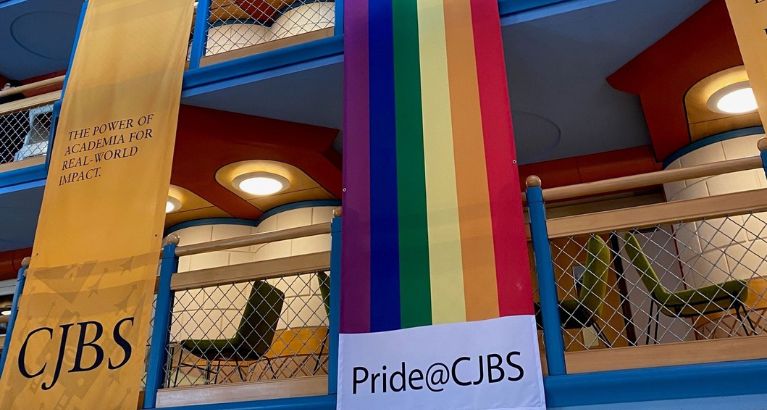
For Cambridge MBA students, these are not abstract questions. The cohort itself, diverse in nationality, background, sector and identity, is where much of the learning happens. The everyday experience of working, debating and building alongside people who see the world differently is incredibly valuable. The Cambridge Judge Business School Pride SIG, run by students, is one part of that. This month, the Pride SIG will take part in the Cambridge Pride Parade, which is a reflection of the community that has been built and the values that it stands for.
The MBA year is short. But the habits of thinking it builds, around inclusion, intersectionality and what it means to lead across difference, last considerably longer.
Pride student insights session
Hear directly from LGBTQ+ students and allies at Cambridge Judge at the Pride student insights session on 26 June for MBA and EMBA applicants. Hear personal experiences, ask questions and find out more about what belonging looks like at Cambridge Judge.
Related articles
Programme news
LGBTQ+ diversity and innovation in business leadership
This LGBTQ+ History Month, we explore how diverse perspectives, including those from the LGBTQ+ community, drive innovation in business education and why creating inclusive environments isn't just the right thing to do, but essential for solving complex challenges.

Career and personal development
LGBTQIA+ scholarship for the Cambridge MBA: why was it launched and what does it entail?
As we celebrate Pride Month in the UK, we find out more about The Cambridge MBA ROMBA Fellowship for the LGBTQIA+ Community – as well as the financial aid, these awards come with community membership and hopefully a lifelong involvement in ROMBA as you progress through your career.
Programme news
Diversity and inclusion: our everyday MBA experience
We speak to some of our LGBTQ+ community across Cambridge Judge Business School as we reflect on inclusion and diversity, in time for the UK's LGBTQ+ History month.