
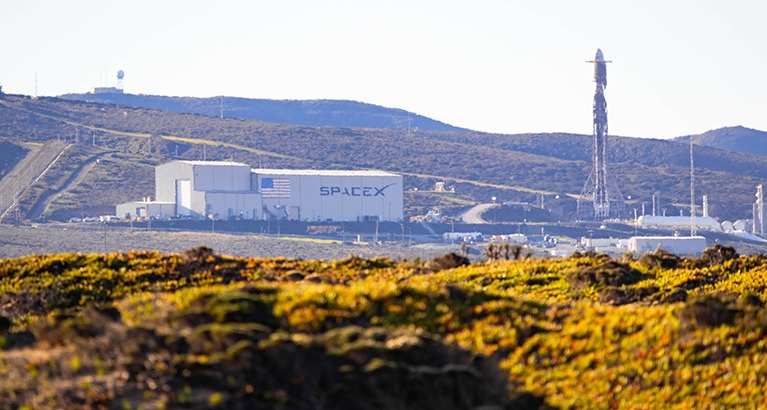
The paper traces the economics of the launch industry – from high fixed costs during the expendable era, to NASA procurement rules enabling fixed-price commercial spaceflight, to a reusable model that lowered the advertised cost of reaching orbit by a factor of about 20.
The launch business is too small to support the valuation of SpaceX, argues the paper – entitled The $1.8 Trillion Question: Inside the Economics of SpaceX – but investors are instead betting on such second-order consequences as a dominant satellite-broadband utility in Starlink, the promise of fully reusable heavy lift in Starship and orbital computing following last year’s acquisition of artificial intelligence-focused xAI by SpaceX.
A valuation near $1.8 trillion against about $18.7 billion of 2025 revenue implies a price-to-sales multiple in the mid-90s, the paper notes, adding that SpaceX reported a consolidated net loss of roughly $4.9 billion in 2025 due to heavy investment.
The 4 key assumptions behind SpaceX’s $1.8 trillion valuation
“No conventional aerospace or telecom valuation framework gets close to justifying that number on current financials. To make sense of it, you have to identify the specific assumptions the market is pricing in, and then ask how likely each is to hold,” the paper says, breaking down these assumptions to:
- Starlink becomes a globally dominant broadband utility, which is the foundation for the valuation
- Starship works, and works cheaply
- the AI and orbital computing story is real
- the competitive ‘moat’ keeping out rivals holds for a decade or more
Can SpaceX deliver? The conditions that must hold for its valuation to stand
“The honest answer to the $1.8 trillion question is conditional,” the paper concludes. “The valuation can be justified if a demanding sequence of things goes right: if Starlink continues to compound and expand its margins, if Starship crosses the gap from promising test vehicle to cheap, fully reusable workhorse, if the orbital-AI thesis turns into revenue, and if no competitor closes the gap for a long time. Remove any one of those and the number looks stretched. Remove two and it looks indefensible.
“The company changed the economics of getting to space. Whether it has correctly priced the economics of being in space is the question its new public shareholders have just agreed to answer with their money. The engineering case is closed. The financial case is still in flight.”
Space Economy Initiative
The Space Economy Initiative within the Centre for India and Global Business at Cambridge Business School brings together researchers across engineering, economics, governance and policy to make space activity more accessible – particularly for emerging economies and public-interest missions.
Featured research
Sathiaseelan, A. (2026) The $1.8 trillion question: inside the economics of SpaceX. Cambridge: Space Economy Initiative, Centre for India and Global Business, Cambridge Judge Business School
Related articles
Research centre news
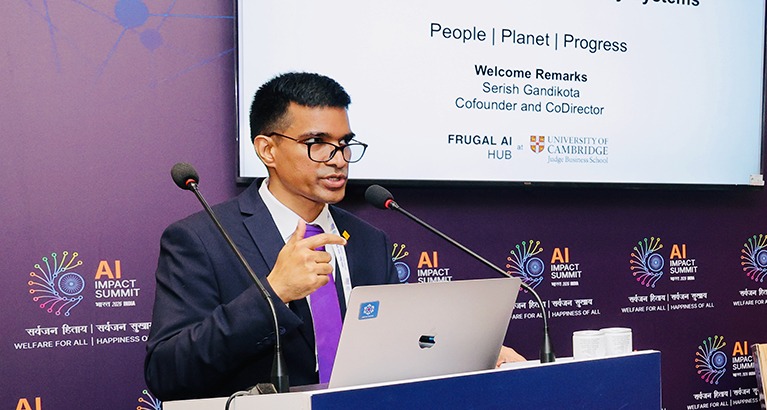
Frugal AI takes the stage at India AI Impact Summit 2026
The Frugal AI Hub at Cambridge Judge Business School hosted a session at the India AI Impact Summit 2026, an important global event for AI policy and innovation, contributing to a high-profile dialogue with global policymakers and industry leaders.
Research centre news
Research shows efficiency of India’s low-cost space missions
Recent missions by India’s space programme have shown that major milestones such as a 2023 soft Moon landing can be achieved on relatively modest budgets in the 10s of millions of dollars, says a just-published academic paper co-authored at Cambridge Judge Business School that demonstrates the scope of frugal innovation. For countries that have not ventured into space or fully reaped the benefits of space activity because they are held back by notions of extreme expense, these Indian examples chart a practical way forward.

Programme news
Top 10 reads of 2025
Articles about artificial intelligence and sustainability were among the most popular stories on the Cambridge Judge Business School website in 2025, reflecting a year in which AI capabilities expanded apace and the November COP30 climate-change summit in Brazil focused attention on the environment.