


By Weilong Zhang, CERF/CCFin Fellow, University of Cambridge
Imagine you have £1,000 in savings. One investment fund pays a slightly higher return. Another pays a lower return but lets you spend the money instantly through your payment app whenever you need it.
Millions of people choose the second option. Why?
A naive look at the financial system might suggest people choose these blended accounts purely for the day-to-day transactional convenience of shopping or paying utility bills. However, by analysing China’s multi-trillion RMB Yu’ebao money market fund (MMF) sector – the world’s largest payment-integrated wealth management ecosystem – our research team uncovered a much more surprising, behavioural reality.
We find that households are willing to give up roughly 0.4 percentage points (40 basis points) of annual return just to keep this payment feature. Surprisingly, most of this value does not come from making everyday purchases. It comes from a precautionary ‘peace of mind’ – knowing that their savings can be turned into frictionless spending power instantly if an unexpected shock or emergency arises.
Combining savings and the digital wallet: the Yu’ebao universe
Over the past decade, traditional banks and fintech giants have actively innovated to integrate real-time transaction features directly into non-deposit investment assets. The prime global sandbox for this trend is Yu’ebao, Alipay’s flagship wealth management product launched in 2013.
Yu’ebao combines a savings product and a payment wallet. Users earn investment returns on their underlying fund balances, but they can still spend the money instantly for retail purchases, peer-to-peer transfers, or bills directly out of Alipay without first enduring the friction of manual redemption to a bank account.
However, this instant transactional flexibility comes with a distinct economic catch: payment-integrated Yu’ebao funds typically charge higher operational fees and offer lower average net yields than regular, non-payment-integrated MMFs hosted on the exact same platform. By looking closely at how retail investors navigate this transparent yield-versus-convenience trade-off, we can structurally isolate exactly how much households truly value embedded payment infrastructure.
Cutting through platform frictions
Measuring the true value of a payment innovation is highly challenging. Relying purely on aggregate market-level data risks severely overstating consumer demand due to limited product awareness. For instance, survey data from the 2019 Chinese Household Finance Survey (CHFS) reveals that 64% of Yu’ebao holders have absolutely no other financial investment experience. Their cash sits in Yu’ebao heavily guided by default platform visibility and marketing placement rather than an active, informed valuation of payment features.
To isolate genuine consumer preferences, we utilise an extensive administrative panel of 100,000 users from Alipay and implement a strict filtering criterion: we restrict our primary analysis to investors who have simultaneously held both Yu’ebao MMFs and regular MMFs at some point in time. This guarantees that the individuals in our sample are fully aware of both financial choices, ensuring their shifting allocations reflect true behaviourally grounded preferences rather than digital platform biases.
Core findings: peace of mind beats convenience
Our structural demand estimations yield 3 major insights into how households value payment innovation:
1
Significant willingness to pay
The average household is willing to pay approximately 40 basis points (bps) annually in additional fees to access integrated payment services within a fund. Given that typical MMF fees range between 50 and 60 bps, households are effectively willing to pay nearly two-thirds more in asset management fees just to unlock instant transaction capability. For a typical investor, this amounts to only a few RMB per month, yet when aggregated across a multi-trillion RMB industry, it represents massive economic value.
2
Pronounced demographic heterogeneity
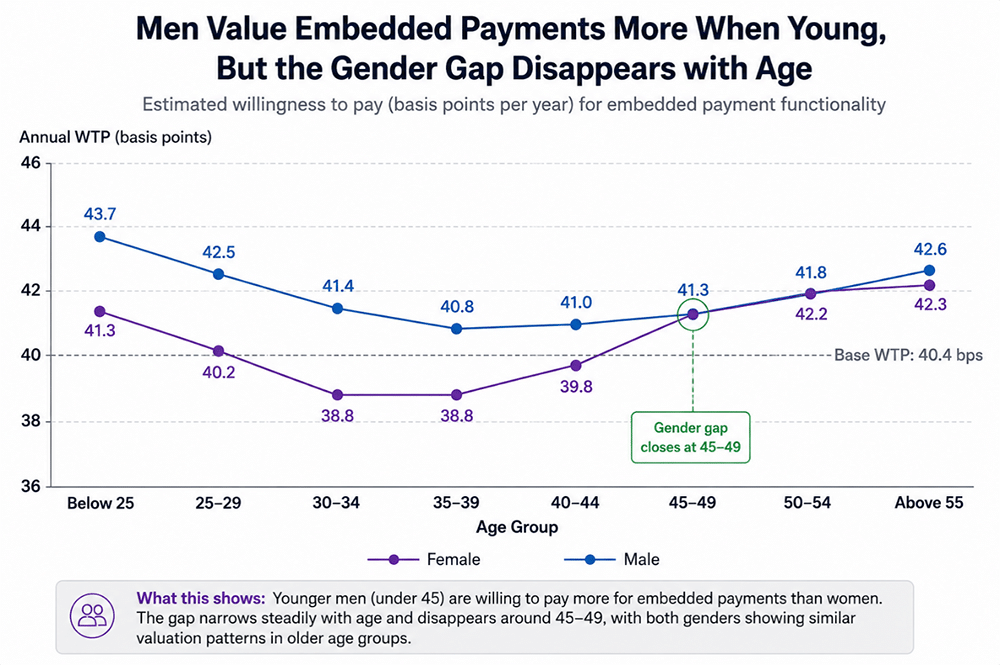
This valuation is far from uniform across the population. Wealthier individuals and cohorts with higher baseline consumption levels place a substantially higher valuation on embedded payment capabilities. Intriguingly, younger males (under 45) exhibit a significantly higher willingness to pay than younger females, though this gender gap completely converges and disappears as demographics age.
3
The power of ‘peace-of-mind’ value
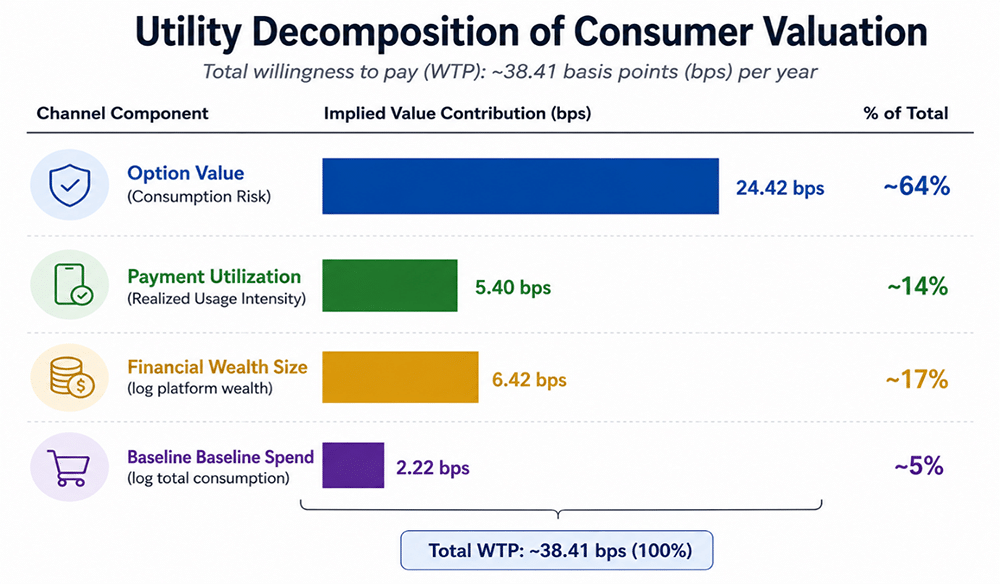
To pinpoint exactly why households tolerate lower returns for instant access, we implemented an empirical decomposition of the total utility flow. Economists typically split this value into 2 distinct behavioural channels:
- Convenience value (Utilisation): The direct utility gained from actively using the asset to execute daily retail purchases or bill transfers. This scales proportionally with transaction intensity.
- Peace-of-mind value (Precautionary Option Value): The psychological insurance benefit. Even if the money is rarely spent, keeping capital in a payment-integrated asset provides an immediate safety net to convert savings into spending power on demand during unforeseen shocks.
As the breakdown illustrates, nearly two-thirds of the total household valuation is driven entirely by consumption risk (the unpredictability of unexpected spending shocks like medical bills or family emergencies). Meanwhile, direct everyday payment usage accounts for a mere 14% of the value. This structurally proves that the dominant driver of investor demand is the precautionary liquidity option – the simple reassurance of immediate fund access during emergencies – rather than the functional convenience of making active transactions.
Shifting the blueprint for future fintech innovations
Ultimately, these findings offer a vital quantitative blueprint for the broader global monetary system as it undergoes digital modernisation.
When traditional payment alternatives like credit or debit cards are already widely available, households still assign a substantial premium to investment vehicles that seamlessly remove the operational barrier between saving and spending. As central banks and private innovators design the next generation of money-like digital assets (including stablecoins and Central Bank Digital Currencies) long-term retail adoption and market success will not just hinge on minimising daily transaction fees or maximising merchant convenience. Instead, the digital currencies that succeed will be those that maximise the psychological, precautionary peace-of-mind value of instant, flexible liquidity management.
Featured research
This blog post is based on the working paper “The value of payment innovation to households: evidence from a fintech platform” co-authored by Weilong Zhang (University of Cambridge), Yapei Zhang (ShanghaiTech University) and Junli Zhao (City St George’s, University of London).
Related articles

Research centre news
Monetary policy’s hidden conduit: who gets your deposits?
Trillions of dollars sit in bank deposits. Banks compete for savers' money, but not all banks can put it to equally good use. This article explains why healthy competition steers deposits to the banks that can do the most with it, and how monetary policy can throw sand in the wheels.

Research centre news
CERF at 25: milestone is celebrated at Cambridge Judge
The 25th anniversary of the Cambridge Endowment for Research in Finance (CERF) was celebrated at a 2-day conference at Cambridge Judge Business School that highlighted the research and scholars that CERF has supported over the last quarter-century. Founding benefactors William and Weslie Janeway were among the distinguished guests, who also included Professor Deborah Prentice, Vice-Chancellor of the University of Cambridge, and Professor Gishan Dissanaike, Dean of Cambridge Judge.

Research centre news
How monetary policy affects firm investment
Central bank decisions do more than change interest rates: they also shape how firms see the future. This article explains how this matters for the transmission of monetary policy to firm investment.