About the project
Helping children learn how to spot scams, false claims and manipulation online.
Children receive information from many sources, both online and offline. Some of this information may be inaccurate or misleading. Critical thinking helps children decide what is accurate and trustworthy.
Research involving University of Cambridge researchers has found that an online game can help adults and teenagers recognise common misinformation techniques. We have adapted this approach to create a short online game for pupils in Years 5 and 6.
The game teaches children to spot common tricks used to make misleading content seem trustworthy. It is designed to make learning clear and engaging.
Why this matters
Early lessons may help children pause before they trust or share a claim. The project will test whether an established method that works well for adults and teenagers can also help primary school pupils.
of UK children aged 10 to 12 had their own mobile phone
of UK children aged 10 to 12 had their own social media profile
What will the pupils do?
1
The pupils will take part in one school session. It will last up to one hour.
2
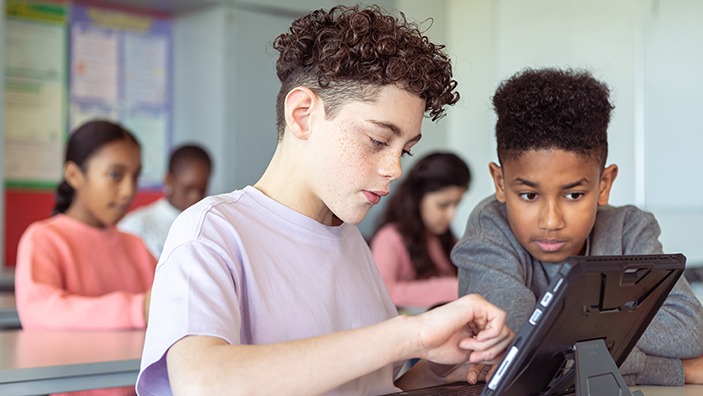
They will play the Bad News Junior game on a tablet or computer. The game uses a simulated social media feed.
3
A narrator explains common ways that people try to mislead others online. The game covers the use of emotional language, ambiguous and misleading phrasing, and false identities.
4
The pupils will also answer a short quiz to spot false or misleading social media posts before and after the game. They will also answer a few questions about their use of social media.
5
Researchers will compare the answers to see whether the game made a difference.
Who can take part?
The study is for children aged 9 to 11 in Years 5 and Year 6. Sessions will take place during or after the school day.
Taking part is voluntary. A parent or carer must give written consent. Each child must also agree before the session starts.
A child can skip a question, take a break or stop at any time.
Research ethics and privacy
The University of Cambridge Research Ethics Committee reviewed the study. The project reference is PRE.2026.058.
Information collected during the study will be kept confidential and stored securely. Each child will be identified by a code.
Names will not appear in papers, presentations or shared research data. Parents and carers will receive full information before giving consent.
Project team
Professor Sander van der Linden
Lead researcher and key adviser to CFRA, based in the Department of Psychology at the University of Cambridge
Anastasija Loncarevic
PhD Candidate, Cambridge Judge Business School
Professor Jenny Chu
Deputy Director of CFRA and Professor of Financial Accounting, Cambridge Judge Business School
Eilis Egan
Visiting Associate at CFRA, Cambridge Judge Business School
Advisory board
Professor Alan Jagolinzer
Co-Director of CFRA and Professor of Financial Accounting, Cambridge Judge Business School
Professor Sarah-Jayne Blakemore
Professor of Psychology and Cognitive Neuroscience, Department of Psychology, University Cambridge
Dr Hanne Duindam
Assistant Professor of Forensic Child Care, Utrecht University, NL
Professor Thomas Nygren
Professor of History and Civics Education, Uppsala University, Sweden
Dr Ili Ma
Assistant Professor, Developmental Psychology, Leiden University, NL
Dr Jon Roozenbeek
Associate Professor, VU University Amsterdam and Director, Technology and Influence Lab, University of Cambridge
Media coverage
BBC Panorama | May 2026
Prebunking misinformation in UK schools
Professor Sander van der Linden talks to the BBC’s Marianna Spring about testing the Bad News game in UK schools to help students identify misinformation techniques.
Contact
If you are a school administrator and are interested in partnering with us, please contact Eilis Egan at e.egan@jbs.cam.ac.uk.
For general CFRA enquiries, contact cfra@jbs.cam.ac.uk.
Featured school partners
Waterbeach Community Primary School
St Bernadette Catholic Primary School (Diocese of Westminster Academy Trust)
Funding
The project is funded by an anonymous gift to the University of Cambridge and the BIC Corporate Foundation. The Foundation supports education projects for children and young people.