

Overview
The Cambridge Centre for Risk Studies (CCRS) researches the causes, development and consequences of geopolitical risk for businesses, financial institutions and the global economy.
Our work combines academic research with applied geopolitical risk analysis and the development of methods for assessing and forecasting geopolitical threats. We undertake commissioned research with external organisations to help them understand how geopolitical developments could affect their operations, investments and risk exposures.
We also train the next generation of analysts through the Cambridge Applied Geopolitical Risk Analysis (CAGRA) Programme, which includes:

Research in geopolitical risk
CCRS undertakes research into the nature of geopolitical risk, with particular attention to the threats that structural changes in the international system can pose to businesses, financial institutions and the wider economy. Our goal is to develop analytical frameworks that can help corporations and public institutions assess the likelihood of adverse geopolitical phenomena – from interstate war to grey-zone warfare, economic warfare, terrorism, civil conflict and adverse changes in government policy – and think through the potential consequences of these to economic activity and business operations.
Among the topics we study are the causes and structural conditions associated with geopolitical instability; the mechanisms through which geopolitical crises develop; indicators of changing geopolitical risk; and pathways of escalation and de-escalation. We also research scenario analysis, probability estimation and calibration, and methods for evaluating and forecasting geopolitical risk under conditions of inherent uncertainty.
A distinctive feature of our recent work is the exploration of artificial intelligence as a tool for geopolitical risk assessment and forecasting. Existing approaches commonly draw on expert judgement, quantitative models or combinations of the two. Each has strengths, but also limitations arising from incomplete information, cognitive bias, model specification and the difficulty of incorporating rapidly changing developments.
Our approach explores how AI can be combined with analytical frameworks derived from academic research into the causes, indicators and escalation pathways associated with specific geopolitical threats. These frameworks guide the identification and interpretation of relevant evidence and provide a structured basis for generating and updating probabilistic assessments as new information becomes available.
Working with organisations
CCRS works with external organisations ranging from governments and central banks to companies in sectors including finance, insurance, energy, logistics and security. We apply the Centre’s research to help organisations understand how geopolitical developments could materially affect their operations, investments and wider risk exposures. Projects can include bespoke analytical frameworks, evaluation and forecasting of specific geopolitical threats, scenario development and stress testing, and country-, regional- and city-level risk analysis. To enquire about commissioning standalone research or establishing longer-term research partnerships, please contact Dr Timothy Less at tgl26@cantab.ac.uk.
The Cambridge Applied Geopolitical Risk Analysis (CAGRA) programme
The Cambridge Centre for Risk Studies organises the Cambridge Applied Geopolitical Risk Analysis Programme, sponsored by the Mackinder Forum, for University of Cambridge students interested in developing practical skills in political and geopolitical risk analysis. The Programme combines seminars, teaching in analytical methods, research projects and discussions with practitioners. It enables participants to practise geopolitical analysis while developing contacts with organisations working in the field and exploring internships and other professional opportunities.
CAGRA seminars
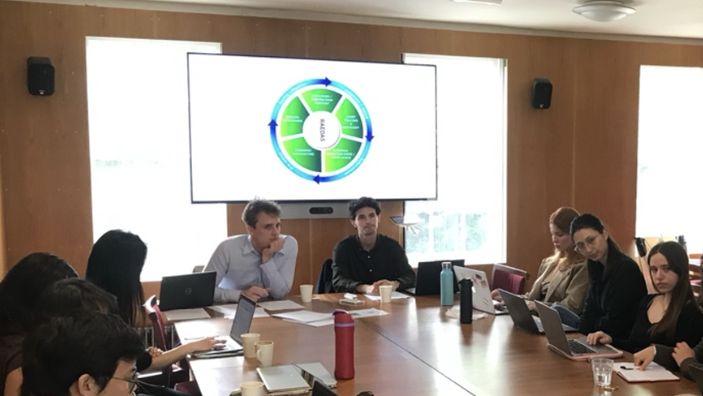
The central element of the CAGRA Programme is a seminar series in which participants practise different forms of applied political and geopolitical risk analysis. During the academic year, the seminars progress through 3 forms of analysis:
Michaelmas term: Event analysis
Participants analyse significant national and international political developments from the preceding fortnight.
Dates:
- 9 October 2026
- 23 October 2026
- 13 November 2026
- 27 November 2026
Lent term: Country risk analysis
Participants produce analysis and forecasts concerning political and geopolitical risks affecting individual countries.
Dates:
- 22 January 2027
- 5 February 2027
- 26 February 2027
- 12 March 2027
Easter term: Bespoke risk analysis
Participants analyse the political and geopolitical risks associated with a hypothetical or actual investment in a particular country or region.
Dates:
- 30 April 2027
- 14 May 2027
- 28 May 2027
- 11 June 2027
Before each seminar, participants research and draft a piece of analysis on which they receive written feedback. They then discuss and defend their findings during the seminar which, in recent years, have generated lively discussion about politics and geopolitics.
The seminar groups meet at:
- 12:30-14:00
- 14:30-16:00
- 16:30-18:00
CAGRA methodology lectures
The CAGRA Programme includes a 9-lecture online series introducing participants to important concepts, techniques and methodological problems in geopolitical risk analysis.
Michaelmas term 2026: The material of geopolitical risk analysis
- What is geopolitical risk analysis?
- Structures and constraints
- Actors and their decisions
Dates:
- 16 October 2026
- 6 November 2026
- 20 November 2026
Lent term 2027: Forecasting the future
- Mapping scenarios
- The limits of forecasting
- A glimpse at the future
Dates:
- 29 January 2027
- 12 February 2027
- 5 March 2027
Easter term 2027: Extending the analytical toolkit
- Game theory and strategic simulation
- Modelling geopolitics
- Harnessing AI to forecast geopolitics
Dates:
- 7 May 2027
- 21 May 2027
- 4 June 2027
Lectures take place from 12:30-14:00.
CAGRA speaker series
The CAGRA Programme’s speaker series gives participants the opportunity to meet practitioners in the field of political and geopolitical risk analysis, learn about their work and career paths, and discuss contemporary geopolitical issues.
For the Michaelmas term 2026, the speaker series is as follows.
22 October 2026
Ms Emily Mansfield
Regional Director, Europe, Economist Intelligence Unit
12 November 2026
Mr Sean Withington
Senior Manager, Geopolitical Risk, PricewaterhouseCoopers
26 November 2026
Mr Chris Coppock
Head of Geopolitical and Economic Risk Analysis, Marsh Credit Specialties
CAGRA research projects
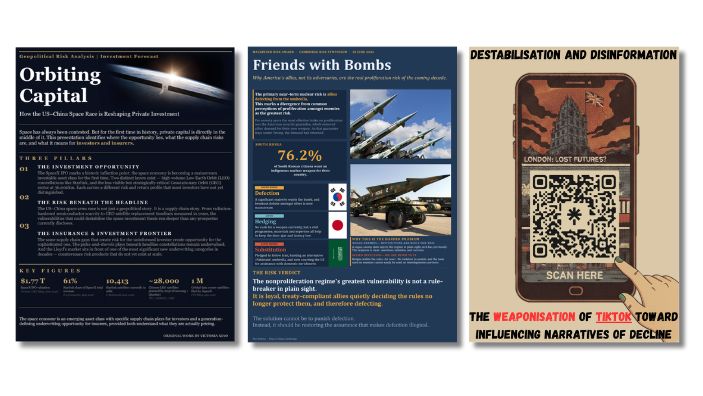
Participants in the CAGRA Programme have the opportunity to work on applied geopolitical research projects for external organisations. These projects involve research, analysis and practical problem-solving and are designed to give participants experience of applying geopolitical analysis to questions faced by organisations in the corporate and financial sectors, as well as an opportunity to develop professional networks and gain practical experience.
The following organisations have commissioned projects from the CAGRA Programme for the 2026/27 academic year, with further projects to be announced:
Cambridge-Mackinder Forum Award in Geopolitical Risk Analysis
The Programme will hold the Cambridge-Mackinder Forum Award in Geopolitical Risk Analysis, which is sponsored by the Mackinder Forum, in June 2027. Participants will have the opportunity to present and defend an argument relating to contemporary geopolitics before a panel of experts drawn from business, academia and diplomacy. The competition also provides an opportunity for participants to present their work to executives and other professionals at the Cambridge Centre for Risk Studies’ annual Risk Symposium.
Cambridge Political Risk Forum
The CAGRA Programme has close connections to the insurance sector, which is one of the main applications of political and geopolitical risk analysis. Participants in the Programme are invited to attend an annual Cambridge Political Risk Forum, organised by Mosaic Insurance and hosted by Lloyd’s of London, in which they have the opportunity to learn about political risk insurance, develop professional contacts in the insurance sector and hear about career opportunities.
Enrolment
The CAGRA Programme welcomes applications from final-year undergraduate and postgraduate students at the University of Cambridge.
Students interested in participating should contact Dr Timothy Less at tgl26@cantab.ac.uk, briefly explaining how participation in the Programme would benefit them and indicating their preferred seminar times in order of preference.
Participation is limited to 51 students, with a maximum of 17 participants in each seminar group.
Please note, the CAGRA programme for 2026/27 is now full. If you would like to join a waiting list for enrolment, please contact Dr Less.
Support for the CAGRA programme
The Programme’s work is made possible through the support of its donors. Individuals and organisations interested in making a one-off donation or developing an ongoing relationship with the Programme are invited to contact Ms Bet Brooke at b.brooke@jbs.cam.ac.uk.
Contact
Research and organisational collaboration, and the Cambridge Applied Geopolitical Risk Analysis Programme
Dr Timothy Less
Senior Advisor for Geopolitics
Administrative enquiries
Ms Bet Brooke
Subject Group Administrator
Acknowledgements
The Cambridge Centre for Risk Studies is grateful to Dr Michael Hochberg and the Mackinder Forum for their ongoing support for the Programme, to Mosaic Insurance and Lloyd’s of London for organising the Cambridge Political Risk Forum and to Darwin College for hosting the CAGRA seminar series.