

The top 5 articles that people have viewed on our website in 2025

Research authored by various Cambridge Judge faculty examine a question that people around the world are asking: has AI advanced so far that it is actually smarter than human beings? As the article outlines, it’s not a simple query to answer: studies by our faculty look at where AI outperforms humans, where it fails, and offers direction to business leaders on how to get the most out of AI.
Faculty and other Cambridge Judge experts whose studies are featured or cited in the article include Professor Michael Barrett, Professor Lucia Reisch, Fellow Hamza Mudassir, Professor Shahzad Ansari, Assistant Professor Virginia Leavell, Professor David Stillwell and Associate Professor Yeun Joon Kim.

The Centre for Risk Studies at Cambridge Judge developed an extensive taxonomy to classify risks during this period of climate transition. Importantly, the Centre chose to include physical risks such as flooding as well as policy, legal and market risks. “A broader systemic approach that includes physical risks was needed to reflect the challenging transition that businesses and all of us must face,” says Daniel Ralph, Professor of Operations Research at Cambridge Judge and Academic Director of the Centre for Risk Studies. The 6 classes of risks in the taxonomy include financial, geopolitical and technology risks, as well as environmental, social and governance risks.
Read 'How firms can prioritise risks in the low-carbon transition'
As in past years, an article related to Bitcoin mining was among the most-read articles in 2025. While the huge energy use for Bitcoin mining is well known, the Cambridge Centre for Alternative Finance (CCAF) found that the use of sustainable energy sources in this mining has grown to 52.4% as natural gas surpassed coal as the most-used fossil fuel in Bitcoin mining energy use. “This report directly addresses a persistent data gap by relying on direct practitioner insights rather than abstractions,” said Alexander Neumueller of the CCAF. “By offering a granular perspective based on data covering nearly half the global mining activity, we aim to anchor the debate on robust, transparent evidence and inform grounded policy discussions about this rapidly evolving industry.”
Read 'Cambridge study: sustainable energy rising in Bitcoin mining'

A new Frugal AI Hub at the Centre for India and Global Business at Cambridge Judge aims to boost inclusivity for AI while also finding more sustainable solutions in the computing, energy and complexity angles of AI. “The principles of frugal AI apply to both high-income and lower-income countries,” says Serish Venkata Gandikota, Co-Director of the Frugal AI Hub and a Visiting Fellow at the Centre for India and Global Business. “For developed economies frugal AI can be practiced through lower-carbon infrastructure for AI, while in emerging markets and lower-income countries frugal innovation can help enable accessibility and inclusion for AI.”
Read 'Frugal AI Hub at Cambridge Judge supports sustainability'

An article by Bryan Zhang and Kieran Garvey of the Cambridge Centre for Alternative Finance outlines how agentic AI capable of autonomous decision-making may transform everything from workflows to roles in the financial services sector.
“The first set of sectors in financial services perhaps to feel the substantial impact of Agentic AI are likely to be consulting, accounting, and auditing – professional services that have historically depended on armies of analysts and associates,” says the article. Yet the challenges are also huge: “Overreliance on AI-driven decision-making without robust oversight could undermine trust, introduce new risks, amplify biases, exacerbate discrimination and create volatility and systemic instability in financial markets.”
Read 'From automation to autonomy: the agentic AI era of financial services'
Other top-read stories in 2025 involve topics ranging from megatrends to fighting disinformation

In this article, Associate Professor Michael Kitson outlines the importance of understanding megatrends and how they differ from sudden impact caused by shocks. “Such shocks usually call for an immediate reaction, such as the global vaccination effort triggered by the COVID-19 pandemic. Megatrends, in contrast, are global forces such as climate change and inequality that usually need a longer-term response.”
This examination of megatrends by Michael and colleagues in the Cambridge Journal of Regions, Economy and Society, identifies 5 key megatrends affecting the 21st century:
- technological change
- climate change
- demographic change
- persistent inequality
- globalisation and fragmentation

The Global Investment Returns Yearbook 2025, co-authored by Professor Elroy Dimson of Cambridge Judge, found that over the past 125 years the annualised real returns were 5.2% for worldwide equities versus 1.7% on bonds and 0.5% on bills. While stock returns have been lower in the first quarter of this century than over the 20th century, global equity investors still saw annualised real returns of 3.5% in the 21st century.
The report is published by investment bank UBS, and it “once again teaches that a long-term perspective matters, and not to underestimate the value of a disciplined investment approach,” says Mark Haefele, Chief Investment Officer at UBS Global Wealth Management.
Read 'Report: stocks have far outperformed over the past 125 years'

The cost of inaction to limit global warming to 2°C by 2100 is equivalent to 11% to 27% of cumulative GDP, says a report by Boston Consulting Group, Cambridge Judge Business School and the University of Cambridge’s climaTraces Lab. The report urges rapid and sustained investment in mitigation and adaptation measures to minimise the economic damage from climate change, saying that “the return on this investment is compelling”.
Adds Associate Professor Kamiar Mohaddes, a co-author of the report: “Research on climate change impacts across all regions and sectors is expanding rapidly. What stands out is that productivity loss – not merely capital destruction – is the primary driver of economic damage.”
Read 'New report from BCG and Cambridge on climate-change investment'

The 2nd Cambridge Disinformation Summit, in April, focused on efforts to fight the harm from intentionally shared false or misleading information – and explored how effective are efforts to fight such harm. The conference organiser, Professor Alan Jagolinzer, said that legislative action must be coordinated across nations to have the desired effect. “The technology companies’ ability to bypass legislation is greater if they see enforcement as a localised issue,” he says.
The Summit heard from Professor Deborah Prentice, Vice-Chancellor of the University of Cambridge, who said in a keynote address that it’s important that people are not silent in the face of harassment and other problematic behaviour. “Transgressions that are not punished are tolerated,” she said. “Inaction speaks about our values and who we are as a group.”
Read 'Summit explores effectiveness of steps to fight disinformation'

Professor Jochen Menges discusses his research on how awe-inspiring leaders can inspire employees but can also create a harmful cult of personality and loss of critical thinking in an organisation.
“Our research argues that these benevolent aspects of awe are valuable and may indeed be uplifting, but there are big open questions about how we understand the many types of leaders who inspire awe in their followers, and the multifaceted effects of awe in social contexts,” says the research by Jochen.
News from Cambridge Judge
Stay updated with the latest news and announcements from Cambridge Judge, get programme details from our admissions team, and read commentary on current affairs and success stories from our expert faculty, students, and alumni.
Insights from Cambridge Judge
Explore articles showcasing business thought leadership and expert opinions from our community, covering topics like sustainability, technology, economics, and leadership, and featuring innovative research and practical insights to tackle global challenges and advance business practices.
Related articles

Business School announcements
New partnership with Bain on women in finance
Bain and Cambridge Judge Business School partner for Stratos Global Executive Symposium for women chief executives in financial services.
Research centre news
Royal Economic Society Prize win for Dr Robert Ritz
Dr Robert Ritz, Associate of the Energy Policy Research Group at Cambridge Judge Business School, has been awarded the 2025 prize from the Royal Economic Society for his paper ‘Overlapping Climate Policies’.
Faculty news
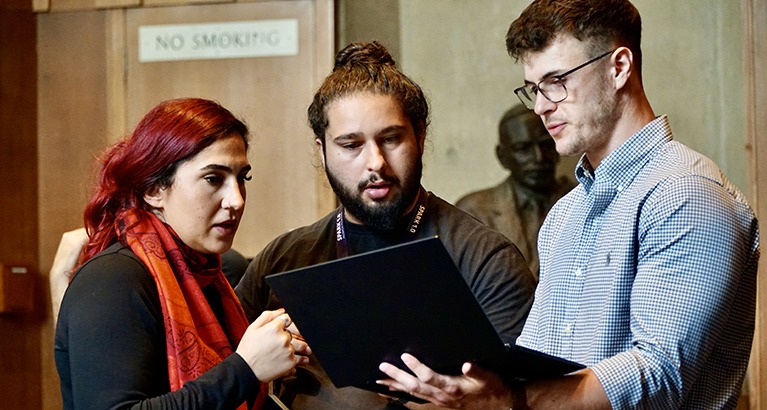
SPARK incubator revs up for second cohort
The new cohort of SPARK, an intense incubator at King’s College, Cambridge, is being run by 3 people closely associated with Cambridge Judge Business School. We get perspectives from the programme’s Incubator Programme Director, Coordinator and King’s E-Lab Director Kamiar Mohaddes.