

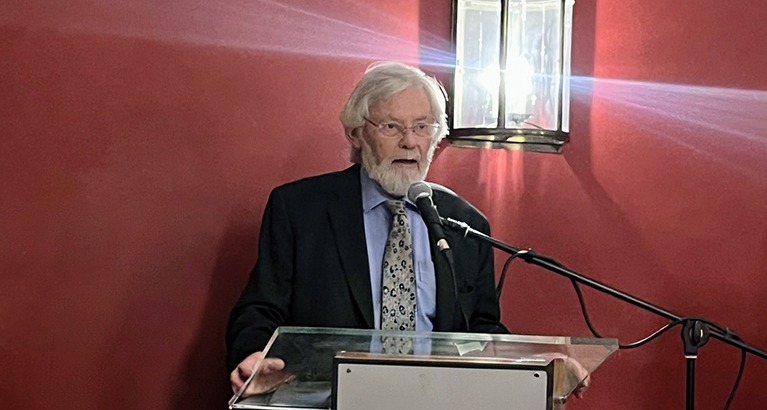
The event also featured an introduction to ‘The case of the Stephen Littlechild AI Agent’ – these papers will feature in a special edition of the Energy Journal to be published in the autumn. Bruce Mountain, Director of the Victoria Energy Policy Centre who has collaborated with Stephen since the early 1990s, hosted the seminar.
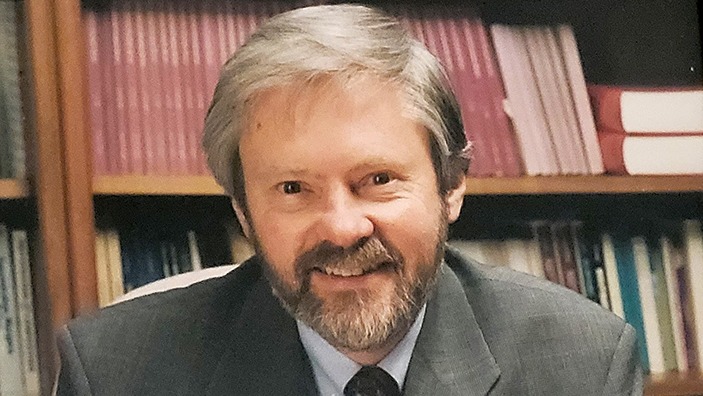
Stephen Charles Littlechild was the founding Director General of the Office of Electricity Regulation (OFFER), serving from 1989 to 1998 (after which OFFER merged with the gas regulator to become Ofgem). Stephen is a Fellow of Cambridge Judge Business School, an Associate of EPRG and Emeritus Chair of the Energy Policy Forum.
From shirt sales to Stanford: an unlikely path
Stephen spoke at the seminar dinner, and we learnt of many roads explored. At the age of 15 his plan was to be a millionaire by selling men’s shirts with cutaway collars. Whilst he studied Shakespeare, Caesar’s Gallic Wars and learnt about the Hanoverians at school, he researched markets and economics in his free time. After a Commerce degree he stumbled upon an occupation he had not been aware of: operational research, the use of maths, statistics and problem-solving to help improve decisions in work and society. This almost took him to Kansas and the National Coal Board but instead took him to Stanford, Northwestern and Texas Universities for a PhD.
Shaping privatisation and regulation policy
After acting as an adviser to HM Treasury on marginal cost pricing in nationalised industries, Stephen wrote a discussion paper entitled Controlling the Nationalised Industries. The subtitle of the paper was ‘Quis custodiet ipsos custodes?’ He thought the material was so sensitive that he had to speak in Latin. It means ‘Who guards the guardians?’ It reflected his realisation that for the Treasury to specify marginal cost pricing doesn’t mean that policy will be enforced.
After Margaret Thatcher was elected Prime Minister in 1979 sales of public assets were publicly mooted, to raise revenue to meet the public sector borrowing requirement. In ‘Ten Steps to Denationalisation’, Stephen suggested that “the real task is not to control the industries but to control government itself”.
Advocating for the RPI-X model for telecoms
The UK Government invited Stephen to adjudicate on competing plans to regulate British Telecommunications after privatisation. In February 1983, whilst Professor of Commerce at the University of Birmingham, he wrote the report Regulation of British Telecommunications’ Profitability for the Department of Industry. This report critically appraised the 2 proposed schemes, and suggested a third scheme, now familiar as the RPI-X approach.
This report was perhaps the first public discussion of economic regulation in the UK. It provided a crash course in the relevant economics, such as public choice, property rights, the economics of regulation, etc. It emphasised the importance and feasibility of promoting competition in telecoms and indicated the potential case for ‘no explicit constraints’, which could be relevant if sufficient steps were taken to increase competition. It was also an attempt to position the debate and policy for future privatisations.
Becoming electricity’s first regulator
In 1987, Cecil Parkinson, Secretary of State for Energy, appointed Stephen as an economic adviser for the privatisation of the electricity sector. Stephen successfully advocated the concept of competition in retail electricity supply and was subsequently invited to be the first regulator. Stephen recalled this time: “I didn’t really want to do it, because I didn’t like the idea of setting price controls and monitoring company behaviour and nagging the companies. Regulation sounded like an awful job. But then I thought: ‘What about retail competition? No one else is interested in that. If I don’t do the job, retail competition might not happen… so I’d better accept’.”
Featured academic
Stephen Littlechild
Fellow, Cambridge Judge Business School
Associate Researcher, Energy Policy Research Group
Related content
Download the programme for the Stephen Littlechild Festschrift.
Related articles

Research centre news
AI used to help identify at-risk social housing tenants
An AI-supported system that could help identify social housing tenants most at risk is being developed by Cambridge researchers, including Dr Ramit Debnath of the Energy Policy Research Group at Cambridge Judge Business School.

Research centre news
EPRG Spring Summit focuses on UK and EU energy policies
The Spring Seminar of the Energy Policy Research Group included a panel on the potential convergence of energy and climate policies of the European Union and the UK, against a backdrop of ongoing bilateral negotiations. A decade after Britain voted to leave the EU, negotiating teams from the UK and EU are preparing to meet to discuss details of re-aligning carbon and energy policies including the key issue on whether and, if so, how the UK should rejoin the EU’s emissions trading scheme (ETS).

Research centre news
EPRG appoints new Co-Directors and 3 Assistant Directors
The Energy Policy Research Group (EPRG) today announced changes to its leadership team.