

Stepping into the Equity Research Project
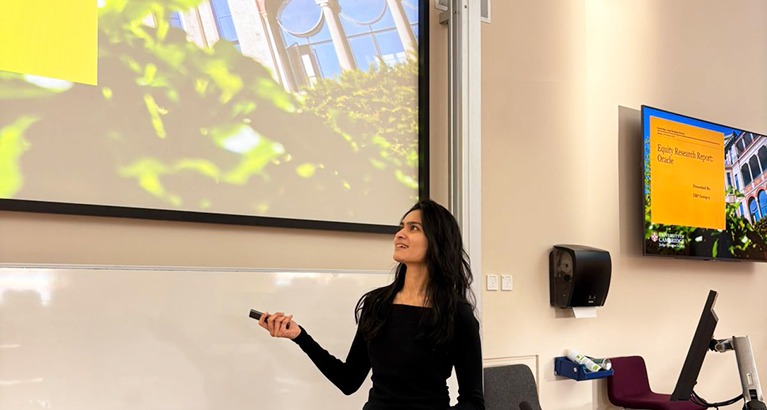
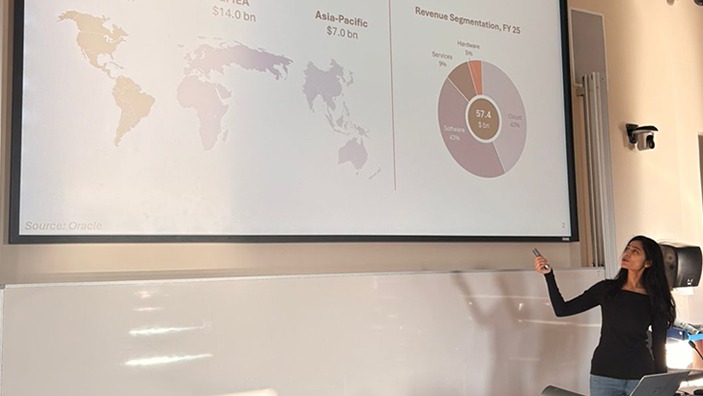
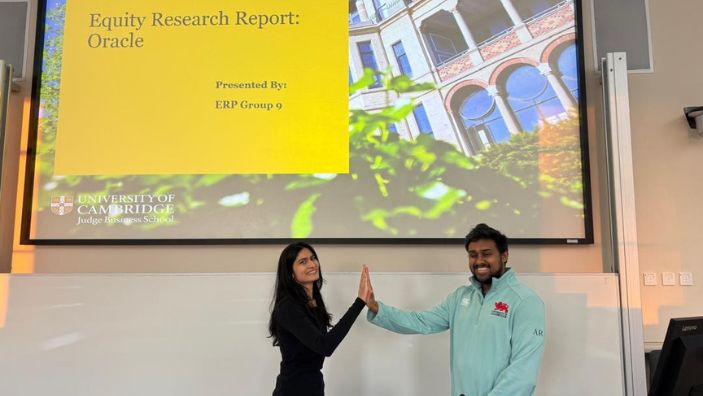
At the beginning of January, my teammate, Abhilash Ravi and I stood in front of what felt like a live investment committee: a panel of buyside professionals, Dr Simon Taylor and the entire Cambridge MFin cohort. In 4 intense minutes, we delivered an overweight recommendation on Oracle. That short presentation was the culmination of the Equity Research Project (ERP), one of the most applied and stretching components of the Cambridge Master of Finance.
Coming from an audit background, I was used to asking whether financial statements are true and fair. The ERP required a different question: given these numbers, this strategy and this market context, would I commit capital to this company today? It marked a shift from assurance to conviction, from checking past performance to taking a view on future value.
Learning a new sector: Cloud, SaaS and Oracle
Our assigned company was Oracle, which meant diving into cloud infrastructure and software as a service, an area I had not previously worked in. At the outset, I felt like a newcomer to a complex and fast-moving industry. Over the December break, that unfamiliarity became a driver of learning.
My days filled with Oracle’s earnings calls, investor presentations and annual and quarterly reports. I read industry analysis on cloud computing, competitive dynamics and the positioning of major players. I started tracking the ORCL ticker daily, watching how the market responded to news and guidance. This habit helped me start thinking less like an auditor and more like an investor, constantly asking why prices moved and what information the market was reacting to.
The MFin programme underpinned this work with workshops on equity research, valuation and modelling, which gave us the structure to turn raw information into a coherent investment case.
Valuation in practice: assumptions, not just models
Technically, our recommendation on Oracle rested on a Discounted Cash Flow (DCF) valuation, supported by market multiples. We projected future cash flows, discounted them at an estimated Weighted Average Cost of Capital (WACC) and cross-checked our results against how the market valued comparable companies.
However, I quickly realised that the real challenge was not building the model but choosing the assumptions. Within the team, our most intense discussions focused on revenue growth, margin potential and Capital Expenditure (CapEx). Could Oracle sustain strong growth in its cloud segment in such a competitive environment? How much capital investment in data centres would that require and what would it mean for free cash flow?
We used sensitivity analysis extensively, flexing assumptions around WACC, terminal growth and CapEx intensity to see how the intrinsic value moved. This exercise reinforced a key lesson: valuation is less about a single correct number and more about understanding which drivers truly matter and how robust your investment thesis remains when those drivers shift.
Presenting to practitioners: 4 minutes and tough questions
All of this work then had to be compressed into a 4-minute presentation. That constraint forced us to focus on the essence of our thesis: what the opportunity was, why we believed the market was mispricing Oracle and why it mattered now. There was no room for every detail of the model, so clarity and prioritisation became just as important as technical accuracy. That constraint forced us to focus on the essence of our thesis: what the opportunity was and why we believed the market was mispricing Oracle.
The real test came in the Q&A. The panel challenged our assumptions on Oracle’s cloud growth, questioned our margin projections and dug into how we linked CapEx to capacity needs. They pressed us on the consistency between our DCF outputs and market multiples. In that moment, the spreadsheet could not speak for us; we had to explain and defend our logic in real time.
For someone with an audit background, this was a significant shift. Instead of scrutinising others’ figures, I was standing behind my own, accepting that uncertainty is inherent but decisions still have to be made.
Teamwork and the wider MFin journey
The ERP was also a powerful lesson in teamwork under pressure. Working through the December break, our group had to reconcile different professional experiences, working styles and levels of risk appetite. Arriving at a single recommendation required debate, compromise and trust. It felt like an accelerated version of life in a real investment team.
Within the broader MFin journey, the ERP sits alongside the Group Consulting Project and the optional Individual Project as part of a suite of applied experiences. Together, they ensure that the programme is not just about learning finance theory, but about practising how to think and act as a finance professional in real situations.
Reflections: a shift in mindset
Whatever my final grade for the ERP turns out to be, the project has already delivered something more important. It has shown me that I can step into a sector I do not know, learn quickly, construct a rigorous investment argument and defend that argument in front of experienced investors. For me, that shift in mindset, from assurance to investment, is the ERP’s true return on investment.

About the blog author: Manisha Chuttoor
Manisha is a Chartered Accountant (ACCA) with 5 years of work experience in financial statement audit at KPMG. She holds a Bachelors degree in Finance (minor Law) from the University of Mauritius and has worked with multiple clients in the financial services, private funds and airline sectors. Manisha also did a virtual one-year secondment to KPMG San Francisco, where she contributed to the audit of venture capital funds.
Currently pursuing a Master of Finance at Cambridge Judge Business School, she is financially supported by a scholarship from the Government of Mauritius. Post MFin, she intends to transition into financial due diligence with a long-term objective of moving into corporate finance.
Master of Finance
Engage with the world’s best financial minds and skilled professionals. Open doors to exciting new career possibilities with a Cambridge Master of Finance (MFin).
Related articles

This past year, I stepped far outside my comfort zone and took paths that a younger version of me would never have dared to imagine. The Master of Finance (MFin) at Cambridge Judge Business School and everything that came with it, transformed not only my career trajectory, but also my sense of who I am and what is possible.

In her first few weeks at Cambridge Judge Business School, Aaryani Dogra reflects on the powerful beginning of her Master of Finance journey. From walking the historic courtyards to hosting celebrated speakers and finding community through student groups, she shares how the MFin programme is already shaping her into a thoughtful leader and global citizen.

Nita transitioned from strategy consulting to sustainable finance, driven by a personal mission to protect the planet for future generations. At Cambridge, she deepened her expertise in climate finance and circular economy, while balancing motherhood and study with resilience and community support.