



The research, which focuses on the English Premier League (EPL) over 19 seasons, suggests that for clubs in threat of relegation (ejection from the Premier League via demotion to the lower Championship tier of English football) selecting the right manager can significantly improve a team’s chances of escaping the dreaded ‘drop’ and its huge financial consequences. By contrast, replacing the manager of an already successful club offers a much smaller probability of delivering transformative gains.
“Managers’ value depends not only on their abilities, but also on how well they fit a particular organisation,” says Liang Zhao, a PhD student in Marketing at Cambridge Judge, who has developed a model powered by artificial intelligence examining how football clubs and managers match with one another – and why a manager who succeeds spectacularly at one club can struggle at another. “A better question than ‘who is the best manager?’ is ‘best for whom?’”
Managerial changes help struggling clubs more than those near the top
The research conducted counterfactual simulations that reassign managers across clubs within each season, and then recomputes match values and league rankings. Among teams in the relegation zone (18th to 20th place), these resulted in 969 simulated managerial inward swaps involving a manager from a higher-ranked club, and 58.2% of them lift the host club clear of the relegation zone. For clubs in 5th to 7th place, within striking distance of a top-4 finish guaranteeing entry into the following year’s Champions’ League (which carries huge financial value to the club), only 18.6% of the 285 comparable managerial swaps achieved entry into the top 4. For clubs in second to fourth place, the study’s model finds that only 17.5% of the 114 upward swaps produced an EPL title.
“Applying the model to the English Premier League, we find priorities vary sharply: tactical expertise is most valuable to elite clubs, interpersonal skills matter most outside the top tier, and misconduct is especially costly for weaker clubs, even outweighing tactical gains,” says the study, titled A Model of the Market for Managerial Talent: Identification and Estimation with an Application to the English Premier League.
The study covers the period between the 2004-05 and 2022-23 seasons, in which an average of 8.7 of the EPL’s 20 clubs changed managers each season. “Hiring a manager is not an isolated decision,” Liang says. “Once one club hires a particular manager, that affects the options available to everyone else in the market.”
Matching implications for executive recruitment, Uber and other businesses
There is no one-size-fits-all solution. What matters is understanding your own strengths, needs and objectives, and then finding the person who matches them best.
Stemming from Liang’s PhD thesis, the research develops a model that examines managerial fit, and that model is detailed in a paper by Liang and Ahmed Khwaja, Professor of Marketing, Business and Public Enterprise at Cambridge Judge. Liang’s research sits within the field of matching markets – the study of how 2 sides come together to form successful partnerships – so the findings carry over from football into wider business including the matchmaking aspects of executive recruitment, venture capital firms joining with entrepreneurs, manufacturers and parts suppliers, digital platforms like Uber and Airbnb (matching drivers and homeowners with customers), and the selection of influencers to promote a company’s brands.
“The hiring of senior executives is governed by the same matching process as the hiring of football managers,” the paper says. “Firms compete for desirable leadership talent, and candidates weigh organisational culture, resources, and career prospects.”
Liang adds: “There is no one-size-fits-all solution. What matters is understanding your own strengths, needs and objectives, and then finding the person who matches them best.”
LLM evaluates tactics, morale, player development and misconduct
To better understand managerial performance, the research drew on publicly available, unstructured information – including news reports, biographies and football analysis – applying a Large Language Model (LLM) to evaluate managers across 4 key dimensions:
1
Tactical acumen
How effectively a manager designs and implements game strategy.
2
Morale management
How well they build cohesion and maintain team spirit.
3
Player development
Their ability to nurture young talent.
4
Misconduct risk
Whether they tend to create controversy, disciplinary issues or reputational challenges.
Regarding the fourth dimension, it’s perhaps not surprising that José Mourinho, the recently hired new manager for Real Madrid, features several times in the paper. The Portuguese known for no lack of self-confidence (“I think I’m a special one,” he famously told a news conference) who previously managed at Chelsea, Inter Milan, Tottenham and elsewhere, usually departing quickly amid reported clashes. It may come as some relief to powerhouse Real Madrid that the study finds larger clubs are often better able to absorb the risks associated with controversial managers – as stronger finances, larger fan bases and greater organisational resources can cushion the impact of misconduct or public disputes, while smaller clubs have less room for error.
Players still matter, whoever the manager
In simulations conducted as part of the research, around one in 4 high-profile managerial appointments backfired, harming rather than helping team performance. The reason, Liang argues, is that football clubs have different needs. A tactically gifted manager may thrive with an elite squad packed with international stars, but the same manager may struggle at a club fighting relegation – where leadership, motivation and team cohesion can matter more than sophisticated tactical systems.
“You can have a brilliant strategy,” says Liang. “But if the players cannot execute it, that ability creates less value.”
Featured research
Zhao, L. and Khwaja, A. (2026) “A model of the market for managerial talent: identification and estimation with an application to the English Premier League.”
Related articles

Student and alumni news
From courtroom to track: redefining ‘elite’ at Cambridge Judge
Balancing a corporate legal career, national level para-athletics coaching and the Cambridge Executive MBA, Jason Sewanyana is challenging traditional ideas of ‘elite’ by putting people, purpose and inner strength at the heart of performance.

Student and alumni news
Football charity kicks off fight for global water crisis
A dinner in London is raising money for a rehydration project in India and to shine a spotlight on the growing threat of water pollution across the UK. A participant on the Cambridge Peaceshaping and Climate Incubator programme at Cambridge Judge Business School outlines how football can help tackle some of the world’s most pressing problems like pollution, drought and floods.
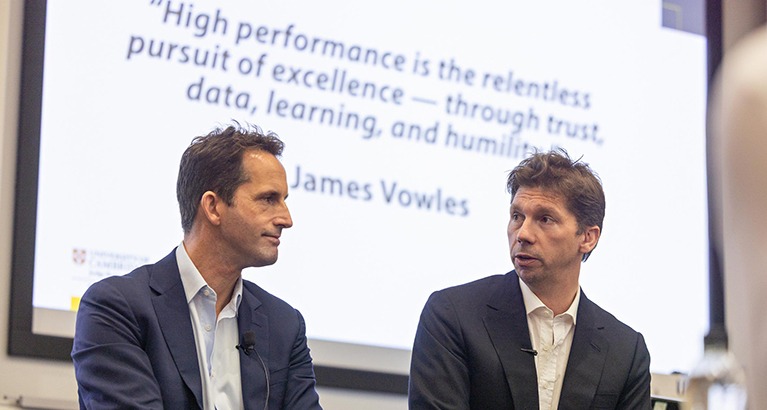
Leaders from across global business joined a special event at Cambridge Judge Business School – Unpacking High Performance: From the Racetrack to the Boardroom – in which the connection between high performance in sport and business was explored by guests including James Vowles, Team Principal of the Formula 1 Team Atlassian Williams Racing, and Sir Ben Ainslie, the world’s most successful Olympic sailor with 4 Gold and one Silver medal and winner of the America’s Cup in 2013.