

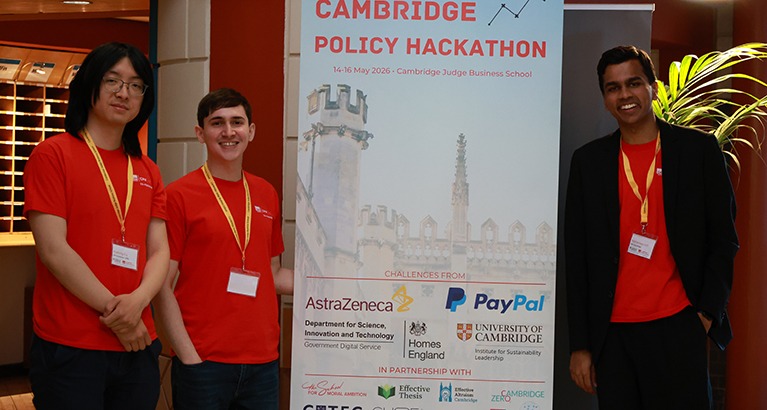
The event held 14-16 May at Cambridge Judge, with input from the Centre for Science and Policy (CSaP) at the University of Cambridge, combined the concept of a traditional hackathon (which tends to be technical in nature) with a broader focus on creating policy with an emphasis on what the organisers termed “innovative, evidence-based and impactful policy proposals”.
Participants were welcomed on the first day by Professor Gishan Dissanaike, Dean of Cambridge Judge, and Professor Tim Minshall, Head of the Institute for Manufacturing at the University of Cambridge. Advisors for the event included David Reiner, Professor of Technology Policy at Cambridge Judge, and Christian Neubacher, Policy Engagement Planning Coordinator for CSaP. Key sponsors included AstraZeneca and PayPal.
Student organisers inspired by diversity of teams
The student organisers were Adam Herold, Mohamad Arif Baker and Xuelong Fu (all MPhil in Technology Policy 2025).
“One of the most inspiring aspects to see was the diversity in the teams, with participants delving into disciplines they don’t usually think about, such as someone from a legal background focusing on a data challenge,” says Xuelong, who organised a similar policy hackathon event in the Netherlands in 2025.
“We saw the advantage of having people from these various backgrounds working on a common problem, as policymakers often struggle with these fast-moving topics,” adds Adam.
“We were really impressed by the amount of interest – we had almost 200 applications,” says Mohamad. “I initially thought the interest would be from students and researchers, but it also came from working professionals in a variety of fields.”
Adam and Xuelong have created a nonprofit, Data for Public Impact Network, to host similar events worldwide.
The 5 Hackathon cases
There were 5 cases in the Cambridge Policy Hackathon, each with a first-prize winner and a finalist:
AstraZeneca case
Improving UK health equity and outcomes: innovation, investment and treatment access
Challenge statement: In light of the geopolitical pressure, what policy mechanisms can the UK adopt to improve pharmaceutical investment and timely, equitable patient access to innovative medicines?
First place went to a policy proposal for 2 interlocking policy reforms: a tiered Voluntary Scheme for Branded Medicines Pricing, Access, and Growth (VPAG) clawback system that rewards domestic investment, and a Clinical Implementation Acceleration Network (CIAN) to anchor late-stage drug development and strengthen the clinical research talent pipeline.
The finalist team created an opt-in NHS access framework called Fairer by Design.
Cambridge Institute for Sustainability Leadership case
Stress-testing current business models against future nature scenarios
Challenge statement: Design and demonstrate a stress-testing method that shows how real-world business models become unviable (or must transform) under a 2040 nature positive scenario.
First place went to a group that provided an in-depth case study on nickel mining in Indonesia, introducing a human rights synergies framework that refines regulation into a stress-testing tool integrating Indigenous rights, biodiversity and circular economy transition risks.
The finalist team looked at UK agri-food business models and disclosure frameworks, putting forward a sustainability governance tool.
Department for Science, Innovation and Technology, Government Digital Service case
Making data match: connecting public sector data holders with data users
Challenge statement: How might we design a mechanism that creates visibility of shared interests between public sector data holders and potential data users visible and actionable – enabling mutually beneficial data partnerships to form more easily?
The winning team developed Match, a dynamic demand-signalling platform centred on problem clusters. Match groups users by shared problems, creating opportunities for cross-sector partnerships between data users and holders, while offering demand forecasting tools to accommodate emerging data needs.
The finalist team proposed a system that proactively matches partners through a 3-layer system.
Homes England case
Designing a Housing Data Lab integrating housing data to support better delivery, investment and learning
Challenge statement: How might a Housing Data Lab help integrate housing data to support better delivery, investment and learning across the housing system?
First place went to a team that envisioned a Housing Data Lab (HDL) that is a national decision-support platform integrating fragmented housing and related datasets into a single interactive system. It generates actionable insights through an integrated data layer, enabling place‐based diagnostics.
The finalist team developed a geospacial platform that helps identify where housing investment is most aligned with strategic goals and social value.
PayPal case
Fighting fraud in an interconnected global ecosystem: designing cross-border solutions to tackle global economic crime
Challenge statement: Design a cross-border policy and intelligence-sharing framework capable of disrupting the global fraud ecosystem, addressing both authorised push payment (APP) fraud and unauthorised fraud across sectors and jurisdictions.
The winning team proposed the Fraud Signal Exchange (FSX), a centralised privacy-preserving protocol through which payments providers can detect and share verifiable, encrypted fraud risk signals.
The finalist team designed a fraud reimbursement liability framework that incentivises coordination.
MPhil Technology Policy
An intensive, 9-month professional practice masters programme designed for people with a background in science or engineering who are interested in developing the skills needed to meet the challenges of integrating technology, management, economics and policy.
Related content
Adam and Xuelong have created a nonprofit, Data for Public Impact Network, to host similar events worldwide.
The Centre for Science and Policy at the University of Cambridge improves public policy through the more effective use of evidence and expertise.
Related articles

Student and alumni news
When a Cambridge Executive MBA makes sense for Academics
We spoke to student Umut Gurkan to find out why, despite already having an impressive academic career, he chose to study a Cambridge Executive MBA to enhance his management and leadership skills.

Programme news
Practical learning on the Cambridge MFin: a competitive edge
From real-world consulting projects to Q&As with senior executives, practical learning on the Cambridge Master of Finance (MFin) will give you a competitive edge in the industry. This article explores the practical learning experiences on offer.

Student and alumni news
Meet the Cambridge MBA class of 2026
In September 2026, Cambridge Judge Business School welcomed a new cohort to its one-year MBA programme. The class of 2026 brings together 222 students representing 43 nationalities, with an average of 6 years’ professional experience.