


Every transaction on a public blockchain is permanently visible. This transparency creates legitimate privacy concerns: commercial confidentiality, personal financial privacy and protection from surveillance. Early attempts at privacy on Bitcoin relied on centralised mixing services that pooled and redistributed funds, but these required trusting an operator who could maintain logs or cooperate with authorities [1], [2].
Tornado Cash, launched in August 2019, brought decentralised mixing to Ethereum using zero knowledge proofs – a cryptographic technique that allows verification without revealing underlying data [3]. Users deposited fixed amounts into a smart contract, a self-executing program on the blockchain, and later withdrew to a fresh address. The system generated a cryptographic proof confirming a valid deposit had been made, without revealing which one. Privacy improved as more users participated: if 1,000 people had deposited 1 ETH, any withdrawal could plausibly belong to any of them.
Illicit use of Tornado Cash and the impact of the 2022 sanctions
The Tornado Cash protocol attracted significant illicit use. In March 2022, attackers exploited the Ronin Bridge for $625 million, the largest decentralised finance (DeFi) hack at that time and routed hundreds of millions through Tornado Cash [4]. Similarpatterns followed other major exploits. Blockchain analytics estimated that mixer usage peaked in April 2022, with Tornado Cash holding over $445 million in total value locked by late July [5].
In August 2022, the US Treasury’s Office of Foreign Assets Control (OFAC) sanctioned Tornado Cash. The US government cited $7 billion in laundered funds, including hundreds of millions from major DeFi exploits [6]. Within days, a developer was arrested in Amsterdam. Infrastructure providers blocked access. The protocol’s cryptocurrency collapsed in value.
Our analysis of blockchain transaction data shows the sanctions’ immediate impact in Figure 1. Tornado Cash itself was hit hardest, with daily transactions on Tornado Classic falling by 97% and Tornado Nova declining by 91%. But the effects extended beyond the sanctioned protocol. Comparing the entire pre-sanctions period with the sanctions period, average daily transactions across all Ethereum privacy protocols dropped by 48%, as legal uncertainty deterred users from the entire sector.
A US Federal Reserve Bank of St Louis study estimated that approximately 70% of pre-sanctions Tornado Cash volume was non-illicit [7]. Yet a 2025 study analysing post-sanctions data found that attackers continued to use the protocol in 78% of Ethereum related security incidents through to mid 2025 [8]. The sanctions did impose operational costs: illicit actors initially migrated to alternative mixers, which were subsequently sanctioned or seized [9]. By 2025, the most sophisticated actors had largely abandoned mixers altogether, shifting to cross chain bridges and decentralised exchanges [10]. The pattern is clear: legitimate users, deterred by legal risk, fled. Criminals adapted faster than enforcement could follow.
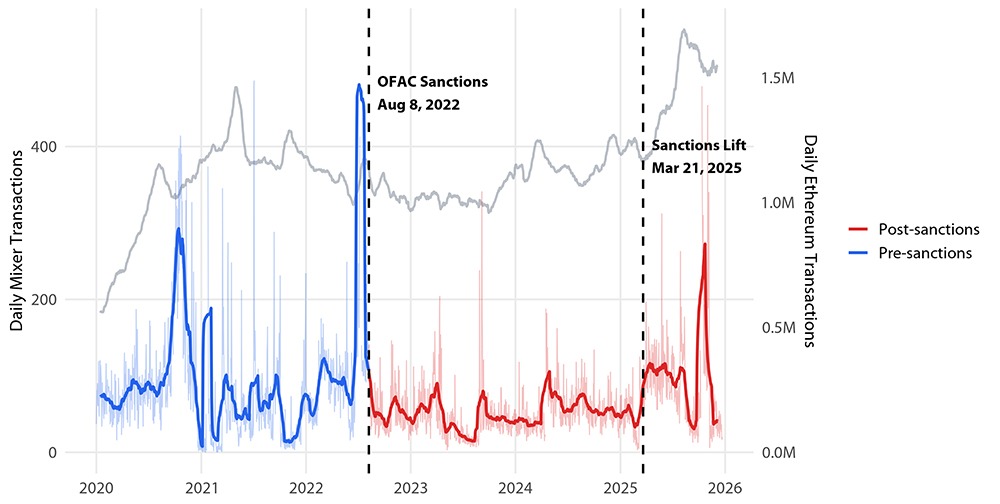
Figure 1 shows total Ethereum mixer transactions declined sharply following August 2022 sanctions, with a 48% reduction in average daily transactions.
The shifting protocol landscape
The sanctions reshaped the mixer ecosystem. As shown in Figure 2, Tornado Cash Classic accounted for nearly all mixer activity in 2020. By early 2022, the market had diversified: Aztec held 33% share, Tornado Nova 32%, and Umbra 21%. After sanctions, users migrated to protocols that offered what Tornado Cash couldn’t: a way to prove their funds weren’t tainted. Railgun emerged as the dominant protocol, growing from 13% in 2022 to 71% in 2025.
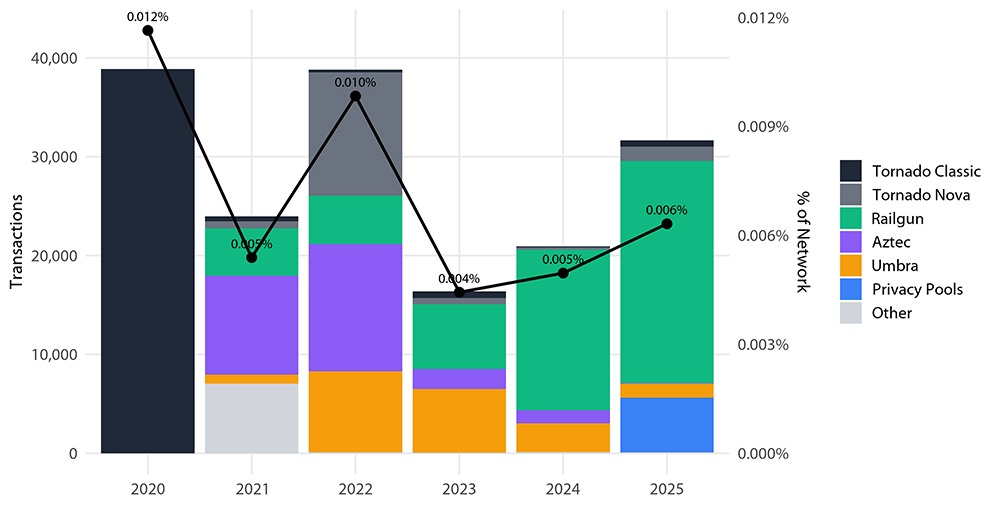
The black line in Figure 2 shows mixer activity as a percentage of total Ethereum network transactions.
Railgun’s rise reflected demand for a new category of protocol. In May 2023, Railgun adopted a proof of innocence system [11]. The approach screens funds at entry: when users deposit, the system checks their funds against blacklists maintained by blockchain analytics firms. If the deposit is linked to known hacks, scams, or sanctioned addresses, it’s rejected. Users whose funds pass the screening can later prove to exchanges or counterparties that their funds entered through this filter, without revealing any other transaction details.
Privacy Pools, proposed in a September 2023 paper [12], approaches the problem differently. Rather than screening at entry, it screens at exit. The pool accepts all deposits, but when users withdraw, they must prove their funds came from a clean subset of deposits that passed screening by trusted third party providers. The protocol launched on Ethereum mainnet in March 2025 [13].
Both designs share a tradeoff. They rely on external providers to maintain lists of flagged addresses. These lists are updated dynamically as new exploits are identified, rather than being hardcoded into the smart contracts. Users must trust these third parties to be accurate and not to censor legitimate activity, a centralisation point in otherwise decentralised systems.
| Protocol | Launched | Compliance | 2025 Tx share |
|---|---|---|---|
| Tornado Cash | Aug 2019 | None | 25% |
| Railgun | Jul 2021 | Proof of innocence | 70% |
| Privacy Pools | Mar 2025 | Association sets | 5% |
The migration to compliant protocols also extended to Layer 2 networks – secondary system
The migration to compliant protocols also extended to Layer 2 networks – secondary systems that process transactions off the main Ethereum blockchain to reduce fees. Before sanctions, nearly all mixer activity occurred on Ethereum’s main network. Afterwards, mixers gained significant traction on Layer 2 networks like Arbitrum and Polygon. By 2025, these networks accounted for nearly half of total mixer volume, as shown in Figure 3.
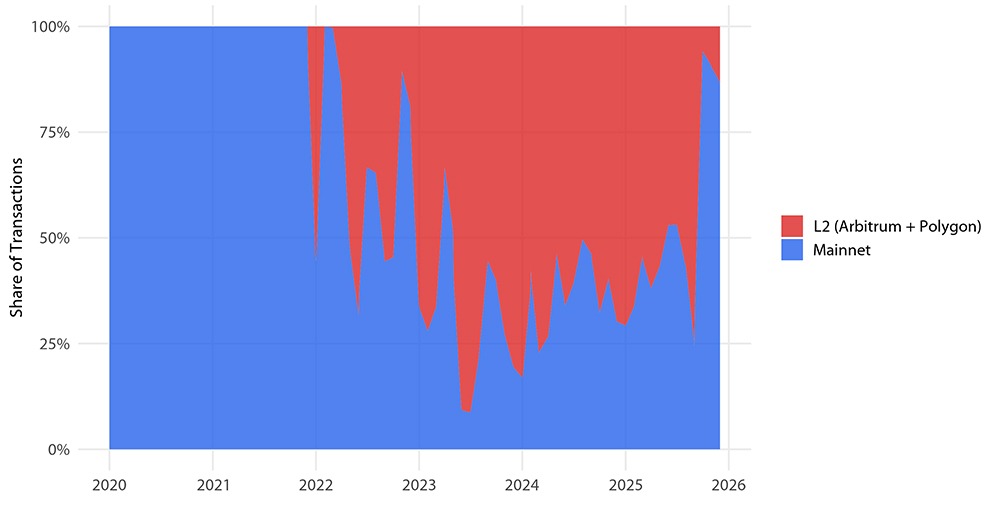
Figure 3 shows activity on Layer 2 networks grew substantially after 2022, reaching nearly half of total mixer volume.
These shifts in protocol choice and network infrastructure point to a clear conclusion: sanctions did not eliminate demand for privacy tools. As shown in Figure 4, both Tornado Cash and Railgun show persistent net inflows throughout the post sanctions period. Users continue to deposit more than they withdraw, and the total value locked in these protocols has grown rather than contracted. The market adapted rather than disappeared.
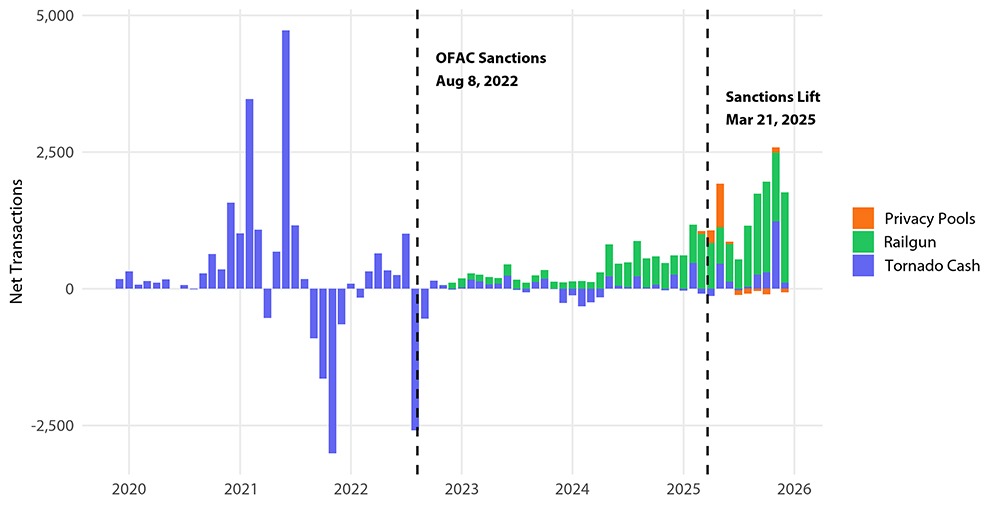
Figure 4 shows monthly net mixer flow (deposits minus withdrawals) by protocol where positive values indicate net inflows.
The composition of Tornado Cash demand, however, has changed. Using labeled address data from eth labels [14], Figure 5 reveals the shift. Before sanctions, approximately 14% of depositors received funds from centralised exchanges, institutions that maintain compliance programmes. After sanctions, this dropped to under 3%. The proportion of depositors funded by unlabeled sources, addresses with no known entity association, rose from 76% to 95%.
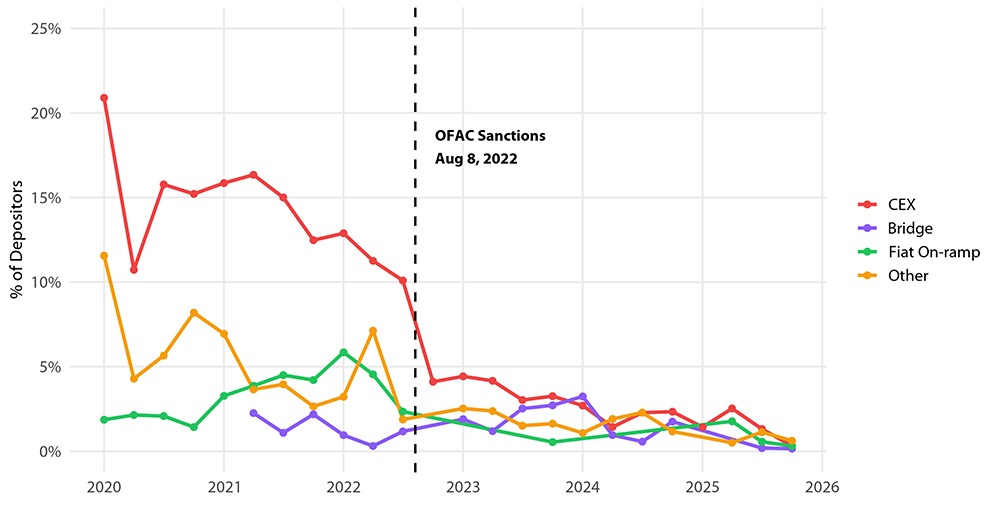
Figure 5 shows CEX funded depositors dropped from 14% pre sanctions to 3% post-sanctions.
This pattern extends to deposit timing behaviour. As Figure 6 shows, pre-sanctions users funded by CEX predominantly deposited slowly, taking more than 24 hours from wallet creation to first deposit. Post sanctions, CEX funded users nearly disappeared, and the remaining users shifted dramatically toward fast deposits under 24 hours. Notably, the few remaining CEX funded users post sanctions still predominantly take the slow path, while fast deposits show almost no CEX funding. The fast behaviour is consistent with users seeking to avoid identification, a profile more likely to include illicit actors.
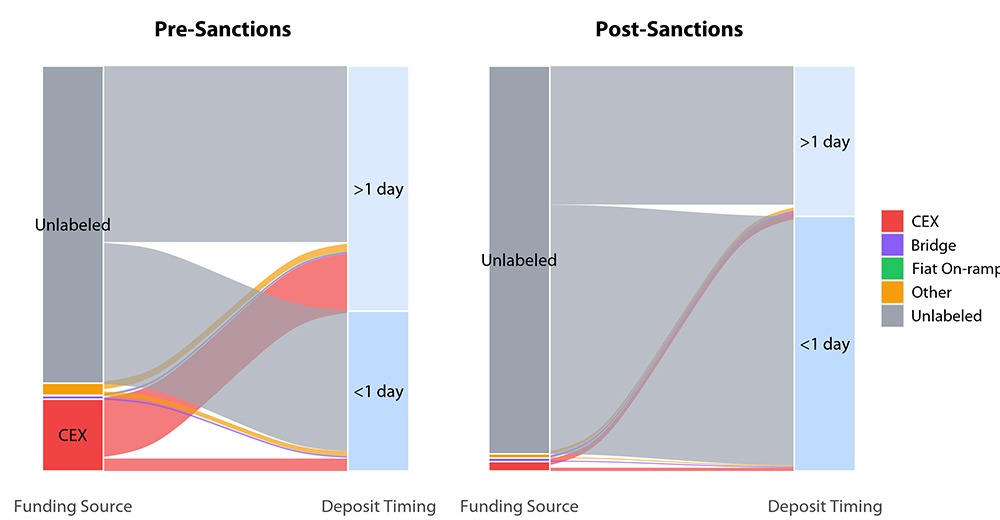
Figure 6 showsTornado Cash depositor flow from funding source to deposit timing. CEX funded users nearly disappeared post sanctions; remaining users deposit faster.
Outlook: how sanctions, regulation and new privacy tools are reshaping the sector
Overall, the data suggests sanctions achieved a partial goal: they pushed compliant users away from unscreened protocols and imposed real operational costs on criminal infrastructure. But they did not eliminate mixer demand, and the remaining Tornado Cash users appear more sophisticated and harder to trace.
The regulatory landscape is now shifting. In March 2025, the US Treasury removed Tornado Cash from the sanctions list [15]. The delisting followed a US federal appeals court ruling that immutable smart contracts cannot constitute ‘property’” under sanctions law [16]. Yet the legal picture remains incomplete: in August 2025, Tornado Cash co-founder was convicted of operating an unlicensed money transmission business, though the jury deadlocked on more serious money laundering charges [17].
The underlying policy dilemma persists: banning privacy tools deters legitimate users, while criminals adapt. The compliant protocols discussed above attempt to resolve this by building compliance into the technology itself. Privacy Pools, launched only in March 2025, is yet to gain significant traction. Railgun continues to dominate, and in October 2025 saw a substantial usage spike following the Ethereum Foundation’s integration of the protocol into its Kohaku privacy wallet toolkit [18].
Meanwhile, enterprise interest in transaction privacy is growing. EY has continued in vesting in privacy infrastructure, releasing Nightfall_4 in April 2025, a zero knowledge system enabling private transactions on public Ethereum [19]. Yet a significant gap remains between interest and adoption. A 2025 analysis found that while institutions transferred $1.22 trillion in stablecoin transactions over 2 years, only 0.013% entered privacy protocols [20]. Whether compliant privacy can bridge this gap and satisfy both privacy advocates and regulators, or whether it represents an unstable compromise that satisfies neither, remains the central question for the next phase of this technology.
Featured authors
Wenbin Wu
Research Associate, Cambridge Centre for Alternative Finance, Cambridge Judge Business School
Keith Bear
Fellow, Cambridge Centre for Alternative Finance, Cambridge Judge Business School
Related articles
Industry leaders face a choice: act now or risk the integrity of blockchain-based markets and digital currencies, says Wenbin Wu, Research Associate at the Cambridge Centre for Alternative Finance (CCAF), Cambridge Judge Business School. Here we reveal regulators’ and policymakers’ bridging roles for quantum-resilient blockchains, and the importance of collaboration by technologists, economists, and regulators in the quantum age of financial technology.

AI and technology
How can AI in finance realise its full potential?
Kieran Garvey, AI Research Lead at the Cambridge Centre for Alternative Finance (CCAF), and Bryan Zhang, Co-Founder and Executive Director of CCAF, explore why banks struggle to turn AI efficiency into growth.

AI and technology
From innovation delta to regulatory singularity: how innovative regulatory systems can help regulation keep pace with financial innovation
The global financial system is undergoing a profound transformation driven by digital innovation. Yet, the pace of regulatory innovation and the scale of digital transformation within public authorities remain uneven and comparatively insufficient. This article, by Bryan Zhang, Co-Founder and Executive Director of the Cambridge Centre for Alternative Finance, examines the widening innovation gap between innovators and regulators, and outlines potential strategies to foster and accelerate system-level innovation within central banks and financial regulators across both developed and developing economies.
References
[1] US Department of Justice, “Individual Arrested and Charged with Oper ating Notorious Darknet Cryptocurrency Mixer.” [Online]. Available: https:// www.justice.gov/archives/opa/pr/individual arrested and charged operating notorious darknet cryptocurrency mixer
[2] US Department of Justice, “Ohio Resident Charged with Operat ing Darknet Based Bitcoin ‘Mixer’ Which Laundered Over $300 Mil lion.” [Online]. Available: https://www.justice.gov/opa/pr/ohio resident charged operating darknet based bitcoin mixer which laundered over 300 million
[3] Zellic, “How Does Tornado Cash Work?.” [Online]. Available: https://www.zellic.io/ blog/how does tornado cash work/
[4] US Department of the Treasury, “US Treasury Issues First Ever Sanctions on a Virtual Currency Mixer.” [Online]. Available: https://home.treasury.gov/news/ press releases/jy0768
[5] TRM Labs, “Tornado Cash Volume Dramatically Reduced Post Sanctions, But Illicit Actors are Still Using the Mixer.” [Online]. Available: https://www. trmlabs.com/resources/blog/tornado cash volume dramatically reduced post sanctions but illicit actors are still using the mixer
[6] US Department of the Treasury, “US Treasury Sanctions Notorious Virtual Cur rency Mixer Tornado Cash.” [Online]. Available: https://home.treasury.gov/news/ press releases/jy0916
[7] M. Nadler and F. Schär, “Tornado Cash and Blockchain Privacy: A Primer for Econo mists and Policymakers,”Federal Reserve Bank of St. Louis Review, 2023.
[8] Anonymous, “Evasion Under Blockchain Sanctions,” arXiv preprint, 2025, [Online]. Available: https://arxiv.org/abs/2507.11721
[9] US Department of the Treasury, “Treasury Sanctions Mixer Used by the DPRK to Launder Stolen Virtual Currency.” [Online]. Available: https://home.treasury.gov/ news/press releases/jy1933
[10] Chainalysis, “2024 Crypto Crime Report: Money Laundering.” [Online]. Available: https://www.chainalysis.com/blog/crypto money laundering 2024/
[11] CoinDesk, “Privacy Project Railgun DAO Adopts Chainway’s ‘Proof of Innocence’ Tool.” [Online]. Available: https://www.coindesk.com/tech/2023/05/08/privacy project railgun dao adopts chainways proof of innocence tool
[12] V. Buterin, J. Illum, M. Nadler, F. Schär, and A. Soleimani, “Blockchain Privacy and Regulatory Compliance: Towards a Practical Equilibrium,”SSRN Electronic Journal, 2023, doi: 10.2139/ssrn.4563364.
[13] Cointelegraph, “Privacy Pools Launch on Ethereum, with Vitalik Demoing the Feature.” [Online]. Available: https://cointelegraph.com/news/privacy pools launches ethereum support vitalik buterin
[14] D. Botsford, “eth labels: A Public Dataset of Labeled Cryptocurrency Ad dresses.” [Online]. Available: https://github.com/dawsbot/eth labels
[15] US Department of the Treasury, “Treasury Removes Tornado Cash from Sanctions List.” [Online]. Available: https://home.treasury.gov/news/press releases/sb0057
[16] Fifth Circuit Court of Appeals, “Van Loon v. Department of the Trea sury.” [Online]. Available: https://law.justia.com/cases/federal/appellate courts/ ca5/23 50669/23 50669 2024 11 26.html
[17] CoinDesk, “Roman Storm Guilty of Unlicensed Money Transmitting Conspir acy in Partial Verdict.” [Online]. Available: https://www.coindesk.com/policy/ 2025/08/06/roman storm guilty of unlicensed money transmitting conspiracy in partial verdict
[18] A. Gilbert, “Railgun Token Soars as Ethereum Foundation Integrates Protocol Into Kohaku.” [Online]. Available: https://www.dlnews.com/articles/defi/railgun token soars as ethereum foundation integrates protocol into kohaku/
[19] Ernst & Young, “EY upgrades Nightfall, a zero knowledge roll up enabling private transactions on the Ethereum blockchain.” [Online]. Available: https://www.ey. com/en_gl/newsroom/2025/04/ey upgrades nightfall a zero knowledge roll up enabling private transactions on the ethereum blockchain
[20] Aleo, “The Privacy Gap Report 2025.” [Online]. Available: https://aleo.org/privacy gap report 2025/