

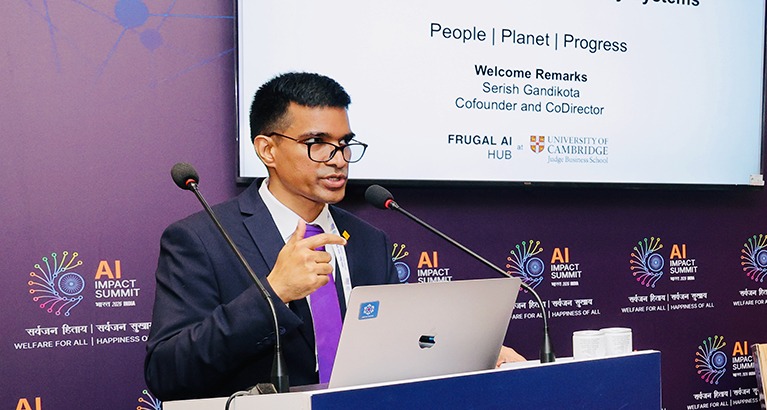
Cambridge Judge Business School’s Frugal AI Hub took a significant step onto the global stage in leading a full session at the India AI Impact Summit 2026 in New Delhi. The 17 February session, Frugal and Quantum-Ready AI for Nations, featured in the Summit’s main programme and attracted strong interest from policymakers, technologists and industry representatives.
The scale and guest list of the Summit made clear not only the urgency of the global AI agenda, but also the significance of this event itself. As Tess Buckley of TechUK observed, it “was by any measure the largest gathering of its kind” – inaugurated by Indian Prime Minister Narendra Modi and drawing heads of state, ministers and AI leaders from more than 100 countries, in addition to more than half a million visitors to the public exhibition.
Building national AI infrastructure: practical challenges and expert insights
The Frugal AI Hub’s session focused on how nations can move beyond isolated pilots and begin treating AI as a core component of public infrastructure. The discussion explored the practical considerations involved in this shift, including issues such as energy requirements, institutional capacity, long-term total cost of ownership and the need for systems resilient to future technological change.
Panel members were:
- Sameer Chauhan, Director (CEO) of the United Nations International Computing Centre
- Anusha Dandapani, Head of AI Hub at the United Nations International Computing Centre
- CV Sridhar, Mission Director of the Andhra Pradesh State Quantum Mission
- Aditya Chhabra, Chief Data Scientist at Kenpath
The Summit provided a rare forum where policymakers, technologists and industry leaders could converge around these systemic challenges. Delegates from across sectors were keen to explore how nations can avoid locking themselves into highcost AI infrastructures that are difficult to scale, govern or adapt.
Growing interest in AI that works for the long-term
For the Frugal AI Hub, which recently launched at the Centre for India and Global Business at Cambridge Judge, the invitation to deliver a session signalled the rising international appetite for AI frameworks that emphasise long-term value and operational sustainability. The strong engagement throughout the Summit reflected a broader shift: governments and organisations are increasingly looking for approaches that balance ambition with practical constraints and the Hub’s work aligns directly with that need.
As the Hub’s Co-Director Serish Venkata Gandikota, who chaired the session, reflects:

If we treat AI as infrastructure, we have to govern it with the same discipline. Frugal AI isn’t about limiting ambition – it’s about designing for reality. Systems must be affordable, energy-aware, governable and genuinely citizen-serving, or scale becomes noise.
Frugal AI Hub
Acting as a catalyst and connector for advancing frugal AI principles and practices, the Frugal AI Hub fosters a vibrant ecosystem, bringing together researchers, industry leaders, policymakers and innovators to champion responsible and resource-efficient AI solutions.
Related content
Related articles

Recent missions by India’s space programme have shown that major milestones such as a 2023 soft Moon landing can be achieved on relatively modest budgets in the 10s of millions of dollars, says a just-published academic paper co-authored at Cambridge Judge Business School that demonstrates the scope of frugal innovation. For countries that have not ventured into space or fully reaped the benefits of space activity because they are held back by notions of extreme expense, these Indian examples chart a practical way forward.

News
Top 10 reads of 2025
Articles about artificial intelligence and sustainability were among the most popular stories on the Cambridge Judge Business School website in 2025, reflecting a year in which AI capabilities expanded apace and the November COP30 climate-change summit in Brazil focused attention on the environment.

Research centre news
Frugal AI Hub at Cambridge Judge supports sustainability
The promotion of sustainable data centres that maximise energy efficiency are among the key focus areas of a recently launched Frugal AI Hub at the Centre for India and Global Business at Cambridge Judge Business School. Frugal innovation, an area of research pioneered at Cambridge Judge, embodies doing more with less – and this applies to the computing, energy and complexity angles of artificial intelligence in order to make them more efficient and sustainable.