

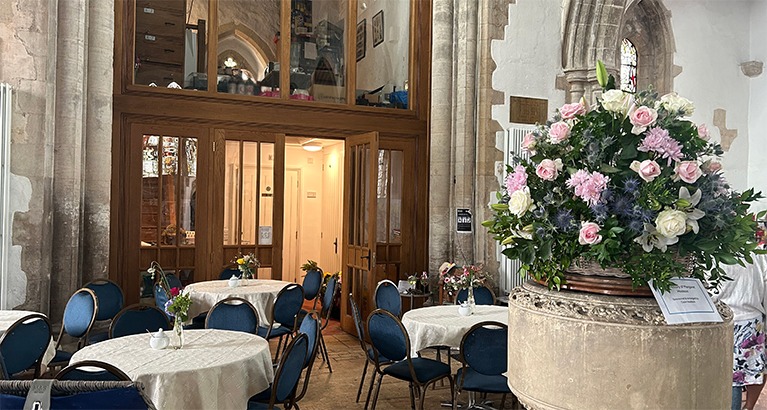
Around the world, local and national governments make decisions on a regular basis on changes to houses, land and other physical places: these range from planning approval for house extensions that may block light to a neighbouring property, to building new homes on areas of natural beauty, to where to lay tracks for a new high-speed railroad. These cases can provoke bitter feuds between next-door neighbours, fierce lobbying by pro- and anti-development groups, and government U-turns when voter opposition to a plan grows too heated.
But a house is merely a home, as meaningful as that address may be to an individual or family. A church building, by contrast, is a sacred place of worship.
Research at Cambridge Judge Business School, in association with the Diocese of Ely, examines the role that congregations and communities play in reconciling the history and religious context of historic church buildings with the fact that church attendance has long been in steady decline (in the UK and elsewhere) – and the financial impact that a dwindling number of worshippers has on church coffers, church maintenance and the very future of these soaring structures. The research showcases the impact of Cambridge Judge engagement with partner organisations on key issues of the day.
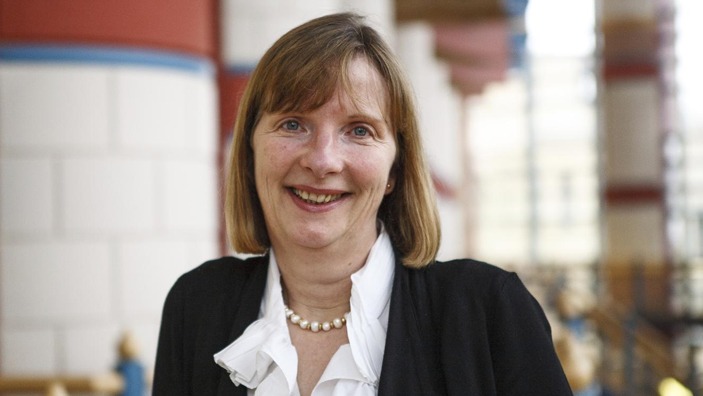
“Church buildings are an ever-present feature of the English landscape. Travelling around the country, for even the smallest villages, the church spire can usually be seen from a distance. The question ‘who looks after the church building?’ is, however, rarely considered,” says Helen Haugh, Associate Professor in Community Enterprise at Cambridge Judge. Helen conducted the research published in the Journal of Management with Thomas Roulet, Professor of Organisational Sociology and Leadership, and Timur Alexandrov, a former Research Associate at the Cambridge Centre for Social Innovation, where Helen is Research Director.

Defining custodianship and institutional decline
The research examines these issues through the prism of custodianship, which is defined in their research (based on a prior study from 2008) as “vested actors who seek to maintain institutionalised practices”.
Another key definition in the research centres on institutional decline. “We acknowledge that institutional decline is something that lacks absolute empirical measure, and understandably so as it is really difficult to quantify,” says Thomas. “But we use a definition based on prior studies to define institutional decline as the ‘diminution in beliefs in established and accepted norms, values, and practices’ – and the steep decline in attendance at Christian churches in the UK certainly fits this definition even though a survey found that 83% of British adults believe church buildings serve an important societal role.”
We use a definition based on prior studies to define institutional decline as the ‘diminution in beliefs in established and accepted norms, values, and practices’ – and the steep decline in attendance at Christian churches in the UK certainly fits this definition even though a survey found that 83% of British adults believe church buildings serve an important societal role.
Looking at the role of social enterprise in maintaining church buildings
A related study by Helen looks at how congregation-led social entrepreneurship demonstrates care for their community, welfare and the environment, as well as raising money to help maintain church buildings. The study adopts a broad definition of social entrepreneurship to include “any kind of activity, organisation or initiative that has a particularly social, environmental or community objective”.
Based on data related from congregations and communities at 12 church buildings in Eastern England, Helen develops the novel concept of ‘sacred-entrepreneurial hybridity’, in which “the primary function of religious worship is accompanied by religious congregation social entrepreneurship”.
As Helen notes in the study, social entrepreneurship is oriented towards helping other people and, likewise, religious congregations guided by the Holy Bible have long shown “compassion for the ostracised” through programmes such as free meals and food banks aimed at helping people suffering from alcoholism, drug addiction, homelessness and other conditions. The study also explores tensions and practical problems for congregations when social enterprise activities cause anxiety among some congregants or clergy about “squeezing out faith values”.
“Members of a religion subscribe to a set of beliefs in the sacred and spiritual that are unquestioned, and perform rituals, privately, and/or collectively as part of a religious congregation, to practice their faith,” says Helen, in the study published in the journal Entrepreneurship & Regional Development. Accordingly, the broader use of religious buildings can help increase church membership and “spread the Gospel by growing religious faith” while increasing the accessibility of such structures to the local and wider communities.
Members of a religion subscribe to a set of beliefs in the sacred and spiritual that are unquestioned, and perform rituals, privately, and/or collectively as part of a religious congregation, to practice their faith.
Academic papers follows work with Diocese of Ely on reimagining church buildings
The 2 strands of research, which both focus on churches in the Cambridge and surrounding East of England area, follow a project conducted with the Diocese of Ely, supported by Allchurches Trust and Historic England. The project found that one-third of church buildings cost more money to operate than the congregation and community are able to raise, and only one in 5 is financially sustainable. Based on survey responses from 73% of the 334 churches in the Diocese of Ely (which includes churches in Cambridgeshire and West Norfolk), the report encouraged churches to find innovative ways to achieve financial stability by, for example, organising events that generate a high football, reaching wider audiences through social media and partnering with local organisations and schools.
Helen says her interest in church buildings, and the tensions created through declining attendance, stems from her long engagement with community enterprise teaching and research. “People are the bedrock of communities,” she says. “Individually they are acutely aware of their locality, and collectively they can strive to employ their strengths to respond to the challenges they face.”
The research focused on custodianship – which ties into the findings of the 2022 report – looks at the tension between preservation efforts at churches and the need for adaptation in order to attract new and younger congregants and visitors, and to accommodate new uses that help to raise much-needed funds for church building maintenance, repair and preservation.
A model of how churches respond to heritage and decline
The custodianship research is based on observation and interviews with custodians at 26 rural church buildings in the England counties of Cambridgeshire and Norfolk, and develops a model based on 3 distinct outcomes:
- place augmentation, such as reordered interiors and external renovations
- practices augmentation, such as new variants of religious services and new community and income-generating practices
- no augmentation, in a few cases
The research explains how “custodians are torn between preserving the institutional role of place and the need to find resources to maintain such places,” and finds that “custodians manage these tensions by deliberatively evaluating materiality alterations and adopting innovative practices within the bounds of institutional appropriateness and resource constraints.”
While the concept of place is a “powerful construct that signifies more than a geographical location, building, or historical landmark”, the authors say, such places are inevitably impacted “when belief in an institution declines, as is the case for Christian religion in the UK” – as shown by dwindling Church of England attendance which diminishes the “resources available to maintain church buildings, rendering them at risk of closure, deconsecration and repurposing”.
Advancing scholarship on church custodianship
The authors explain how the research contributes to custodianship theory and literature on place in 3 ways:
1
Divergent custodian responses
Showing divergence in custodian responses when institutional decline impacts institutionally significant places, including divergence in the tensions experienced by custodians.
2
Non‑augmentation as a meaningful response
Explaining how some custodians may respond to these tensions by augmenting neither place nor practice, suggesting that absence of a response is in effect a response in itself.
3
Deepening understanding on place and buildings
Elaborating on the role of place, and specifically buildings, thus adding to literature on place custodianship.
Using diverse contexts and artifacts to understand custodianship
Custodianship insights from natural beauty to dining traditions
While the study focuses on buildings, it also draws more widely on custodianship in other contexts, such as the natural beauty of the Grand Canyon (and how custodians encourage visitors to limit their environmental impact) and the formal dining traditions at the University of Cambridge (the subject of a 2017 study co-authored by Kamal Munir, Professor of Strategy and Policy at Cambridge Judge, and Paul Tracey, Professor of Innovation and Organisation at Cambridge Judge, that examined how such formal dining rituals contributes to the maintenance of the British class system).
The authors comment that “Custodians face critical tension when institutional decline impacts institutionally significant places: They want those places to continue fulfilling their institutional role, yet preserving those places may require custodians to innovate new practices within them.”
Using artifacts from Medieval graffiti to stained glass
The research team worked closely with the Diocese of Ely, collecting data on artifacts ranging from stained glass to Medieval wall graffiti, parish population and congregation statistics, interviews with custodians, participant observations in churches, church newsletters and social media, and minutes of parish council meetings held in places ranging from village halls to local pubs. Interviews with 26 custodian groups included 53 clergy, congregants and volunteers, augmented by 44 informal conversations with congregants and community members.
As the authors outline:
“The aim (of the interviews) was to stimulate custodian narratives about Christian religion and how church buildings had been used over time, and the interview schedule included questions about the history and condition of the church building, its management (activities organised in church buildings, fundraising), community (engagement, events, volunteers, community values), and challenges associated with, and lessons learned from looking after a sacred building.
“We ensured that the informants provided retrospective and longitudinal accounts of how they contemplated change, and we interviewed participants at different points in time over a 4-year period.”
As for observation, this included 86 hours of participant study at worship services and community events such as church festivals, drama performances and choral concerts. “To better understand how congregations and communities actually use their church buildings, I visited churches across the Diocese and both observed and participated in a wide range of activities,” says Helen. “Even at the smaller, rural churches it was fascinating to talk to people at lively coffee mornings, observe how food banks served their communities, and attend community-sponsored plays and concerts.”
To better understand how congregations and communities actually use their church buildings, I visited churches across the Diocese and both observed and participated in a wide range of activities… Even at the smaller, rural churches it was fascinating to talk to people at lively coffee mornings, observe how food banks served their communities, and attend community-sponsored plays and concerts.
Interviews reveal tensions for church building custodians
The research includes excerpts from interviews with custodians and others, which illustrate the tensions that the authors examine.
For example, one churchwarden said: “Removing the pews might make it open to a bigger range of things, and improving the heating might help, but some of the activities I have thought of are not really compatible with our wall paintings. I thought about, perhaps we could put a ping pong table in there, so younger people could make use of the space, but you do not really want ping-pong balls whacking into limed plaster with wall paintings on it.”
Adds another churchwarden, who notes that one person at the church “does not really want any change, ever”: “We need to be careful to keep the pace of change, keep a consensus around an appropriate pace of change, which is neither too fast to carry people with us, nor too slow to be relevant to the 21st century and it is a bit of a balancing act.”
A clergy member, commenting on a proposed removal of some pews to accommodate new uses of the church building, said: “When people come into a little village church like this, they expect to see pews. I think if there was a plan to take out the pews there would be huge opposition to that… People come into the church on a daily basis. They will often sign the Visitor’s Book, and the Prayer Tree that we are sat next to has got lots of prayer cards on it suggesting that people come in and use it as a spiritual place.”
The organisation Historic England recently published a report entitled Heritage Works for Creative Businesses. The report acknowledged that regeneration of historic buildings for creative purposes can face logistical and financial obstacles, while identifying ways to help organisations navigate the process successfully. Some historic churches “have become successful homes for creative businesses”, the report says, while cautioning that churches have “very strong ecclesiastical character, which does not always sit easily with alternative uses.”
Understanding the key tensions in church custodianship
In examining these various responses, the authors identify several types of tension:
1
Materiality tensions
As custodians grapple with how far they could deviate from historic, architectural designs and interior layouts while still honouring the religious integrity of the church building.
2
Relational tensions
These stem from when institutional decline surfaces differences between custodians and other stakeholders about activities organised in church buildings. For example, the study notes tension over the core institutionalised practice of Sunday Christian worship: “Why does the service have to be on Sunday?” asked one church custodian: “Why could it not be on a weekday?”
3
Practices tensions
These arise in connection with differences in custodian views relating to preserving traditional Christian worship or introducing more modern services that could bring more congregants to the church, and also relating to the introduction of novel activities in church buildings.
Applying custodianship insights to urban and other settings
Beyond the walls of churches, the author connect their findings to managerial implications for other contexts impacted by institutional decline. These include central urban areas, which face calls to repurpose landmark commercial structures (such as historic bank buildings, in this era when few visit a bank branch) into housing, and converting buildings into places for new commercial, such as the conversion of the historic Tower Theater in downtown Los Angeles, built in 1927 and the city’s first theatre to be wired for talking pictures, into an Apple retail store where people buy iPads and the like.
“Our findings on reimagining how church buildings are used connects important discussions on repurposing old buildings and regenerating communities,” says Helen. “We have travelled a long way from the era when developers were quick to tear down old buildings that were deemed to be neither valued nor useful. The heritage value of church buildings is a community asset that can be protected and leveraged by local custodians to reanimate worship, regenerate buildings and build communities.”
We have travelled a long way from the era when developers were quick to tear down old buildings that were deemed to be neither valued nor useful. The heritage value of church buildings is a community asset that can be protected and leveraged by local custodians to reanimate worship, regenerate buildings and build communities.
Featured faculty
Helen Haugh
Associate Professor in Community Enterprise
Thomas Roulet
Professor of Organisational Sociology and Leadership
Featured research
Haugh, H., Alexandrov, T. and Roulet, T. (2026) “Custodians at the crossroads: managing change at institutionally significant places.” Journal of Management (DOI: 10.1177/01492063251390855) (published online Jan 2026)
Haugh, H.M. (2026) “Religious congregation social entrepreneurship in sacred church buildings.” Entrepreneurship and Regional Development (DOI: 10.1080/08985626.2026.2627624) (published online Feb 2026)
Related articles
A new report from a World Economic Forum (WEF) panel co-chaired by Thomas Roulet, Professor of Organisational Sociology and Leadership at Cambridge Judge Business School, calls for a series of measures to future-proof leadership for the 21st century. The report highlights the current lack of trust in leadership around the world, and recommends action to inject “fresh thinking and an intergenerational perspective” to safeguard future leadership models.
Faculty news
Honours for impactful reach and significance
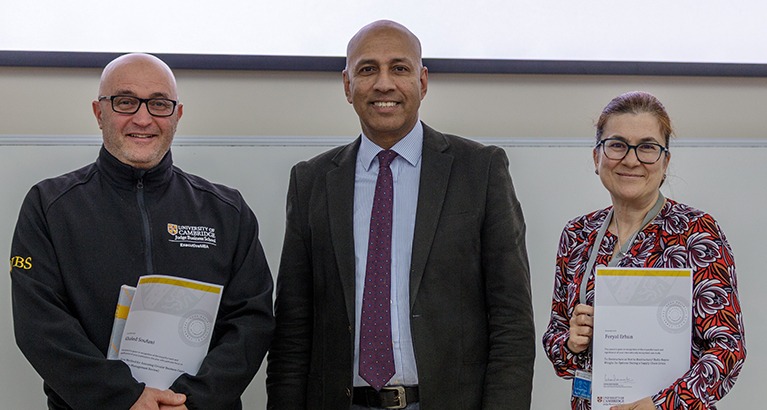
Faculty members Helen Haugh, Feryal Erhun and Khaled Soufani win impact awards from Cambridge Judge Business School.

Organisations need to do a better job of preventatively tackling workplace mental health rather than only dealing with them after symptoms are evident, Thomas Roulet, Professor of Organisational Sociology and Leadership at Cambridge Judge Business School, told a World Economic Forum (WEF) young leaders panel.