
Embracing and using LAIKS requires “thinking differently about the relationship between nature and society” as LAIKS prioritise long-term survival and deep sustainability, says the 27-page report, which joins the expanding research portfolio of the Cambridge Peaceshaping and Climate Lab at the CCSI.
The report’s co-authors include Neil Stott, Management Practice Professor of Social Innovation at Cambridge Judge and Co-Director of the CCSI, Michelle Darlington, Head of Learning Design and Content Development at the CCSI, and a team from BCG – Torsten Kurth, based in Germany; Santino Lacanna, Brazil; Dean Muruven, South Africa; and Julia Chabariberi, France. Dean Muruven is an alumnus of the Master in Social Innovation programme (2021) at Cambridge Judge and is an Honorary Fellow of the CCSI.
“LAIKS can serve as the basis for a hybrid approach to managing and governing natural resources,” the report says. “Using LAIKS to address environmental challenges could create economic opportunities with an estimated value of $150 billion annually.”
From floating gardens to pits dug in degraded soil
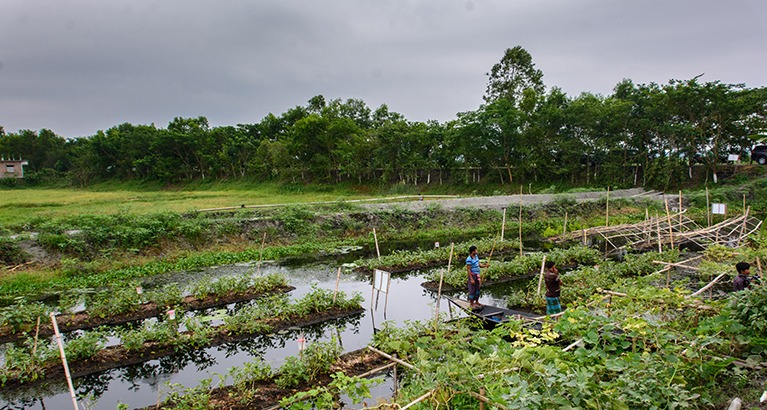
Examples of using LAIKS practices include floating gardens in Bangladesh to provide food security while controlling flooding, and the zaï pits dug in degraded soil by West African farmers to capture rainwater.
Local, Indigenous and ancestral knowledge systems represent an alternative way of knowing and acting in the world and have much to offer organisations working on solutions to address environmental challenges.
Such local and Indigenous techniques are especially crucial at this time when global humanitarian systems face extreme pressure given shrinking aid budgets in key donor countries such as the US, UK, France and Germany, coupled with rising numbers of people involuntarily displaced from their homes or otherwise needing humanitarian assistance.
“For the wellbeing of the planet and people everywhere – both Indigenous and non-Indigenous – current systems must change,” the report concludes. “LAIKS represent an alternative way of knowing and acting in the world and have much to offer organisations working on solutions to address environmental challenges.”
Cambridge Centre for Social Innovation
The Cambridge Centre for Social Innovation (CCSI) is one of the research centres at Cambridge Judge Business School. The centre builds best practices across business, civil society, policy and academia for a more sustainable world.
Featured research
Kurth, T., Lacanna, S., Muruven, D., Chabaribeni, J., Stott, N. and Darlington, M. (2026) How local, ancestral and Indigenous knowledge systems aid sustainability and create value. BCG and the Cambridge Centre Social Innovation.
Related content
Related articles

Student and alumni news
Cambridge Judge venture leader Valerie Lolomari earns MBE
Valerie Lolomari, Founder of the Women of Grace social enterprise that advocates against gender-based violence, was named a Member of the Order of the British Empire (MBE) in the New Year’s Honours list for “services to the prevention of violence against women and girls”. Women of Grace is in the current cohort of Cambridge Social Ventures, the incubator of the Cambridge Centre for Social Innovation at Cambridge Judge Business School.

Student and alumni news
Cambridge study rethinks power and meaning at COP summits
A new study by a recent graduate of the Master of Studies in Social Innovation degree programme at Cambridge Judge Business School sheds new light on how power operates in global climate negotiations, not only through bargaining over outcomes but through contests over meaning at the annual COP climate-change summits.

Student and alumni news
MBE for graduate of Master of Social Innovation programme
Bill McHugh, an alumnus of the Master of Social Innovation degree programme at Cambridge Judge Business School (MSt 2017), was named an MBE (Member of the Order of the British Empire) for services to local government, heritage and the community in South Yorkshire in the recent King’s Birthday Honours.