
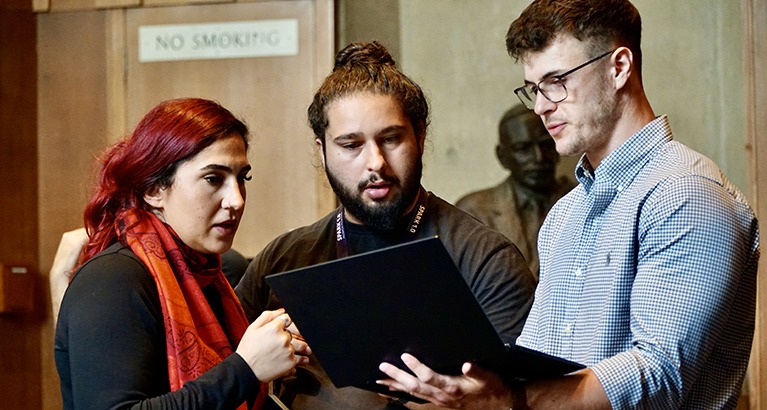
In the summer of 2025, a new 4-week summer incubator programme for alumni and students of the University of Cambridge – called SPARK – was launched by the King’s Entrepreneurship Lab (King’s E-Lab) at King’s College, Cambridge, and Founders at the University of Cambridge.
A key role from the start has been played by Kamiar Mohaddes, Associate Professor in Economics and Policy at Cambridge Judge Business School, who is Director of the King’s E-Lab and co-founded the E-Lab in 2021 with Thomas Roulet, Professor of Organisational Sociology and Leadership at Cambridge Judge.
The initial incubator programme, SPARK 1.0, supported 30 individuals and 24 co-founding teams, and has helped numerous nascent ventures on their way. The programme is a full-time residential incubator hosted at King’s College, in which participants take part in masterclasses with commercialisation experts, entrepreneurs and investors, and receive dedicated guidance from Entrepreneurs in Residence. Teams focus on clarifying their value proposition, testing market assumptions and refining their approach ahead of Demo Day, where they present their ventures and pitch for funding.
Second SPARK programme is run by 3 people connected to Cambridge Judge
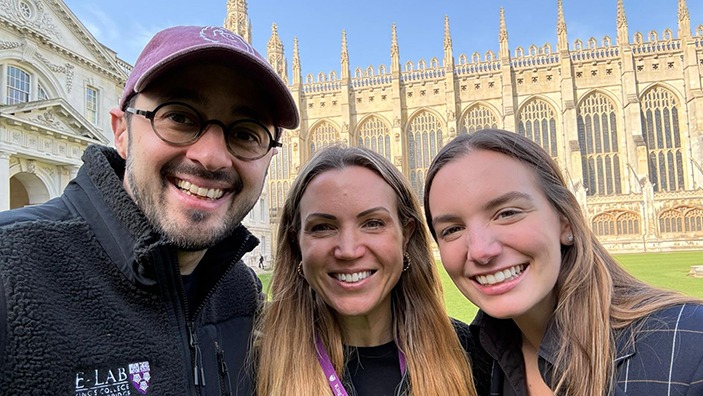
SPARK 2.0 is being run by 3 people associated with Cambridge Judge Business School: SPARK Incubator Programme Director Francesca Hodgson, an investor and fintech founder who is a graduate of the Executive MBA programme at the Business School (EMBA 2020); SPARK Coordinator Petra Scalamandré, a private equity practitioner who is an alumnus of the Master of Studies in Entrepreneurship programme (MSt Entrepreneurship 2025) at Cambridge Judge and was a member of the SPARK 1.0 cohort; and Kamiar Mohaddes as King’s E-Lab Director.
As applications opened for SPARK 2.0, we asked Francesca, Petra and Kamiar to give their perspectives on the SPARK journey so far and what may lie ahead.
Francesca Hodgson (EMBA 2020), an exited fintech founder, investor, executive coach and entrepreneurship mentor, who sees her mission as supporting founders in building strong entrepreneurial ventures
As a Cambridge EMBA graduate from Cambridge Judge, an investor, entrepreneurship coach and an exited fintech founder, looking at SPARK 1.0 has been particularly meaningful for me. I’ve experienced the founder journey firsthand, the uncertainty, the intensity, the pivots, and now I have the privilege of supporting others as they navigate those same early stages.
What struck me most about the first cohort was how quickly capability can compound when founders are challenged in the right way. Early-stage ventures rarely fail because of a lack of intelligence or ambition. More often, they stall because of blurred focus. The most significant progress we saw came when founders clearly define the problem they are solving, niche down on their customer segment and became disciplined about execution.
As an investor, I pay close attention to 3 qualities: clarity of thinking, resilience under pressure, and commercial instinct. Can the founder articulate the problem in one sentence? Can they absorb feedback without defensiveness? Do they understand the difference between activity and progress? SPARK creates an environment where these traits are tested and strengthened quickly.
Looking ahead to the second cohort, I’m excited to meet founders who combine bold ambition with evidence-based thinking. Particularly in sectors like tech, climate and health, complexity is inevitable, but clarity is a choice. I’ll be looking for founders who demonstrate early validation, deep customer insight, and the stamina to build through ambiguity.
Petra Scalamandré (MSt Entrepreneurship 2025), who is building on 7 years of experience across growth equity and private equity to now start her own data-driven investment company focused on opportunities in developing markets
Four weeks. That is how long the first SPARK cohort had to sharpen an idea, stress-test it against seasoned mentors, and stand in front of Cambridge and London investors on Demo Day. It was intense, messy, and exactly what early-stage fundraising preparation should feel like.
SPARK 1.0 was not a polished curriculum or a set of slide templates. It was the energy in the room. Our cohort pushed each other. Every session was designed to provoke. By the time demo day arrived, the teams had been genuinely pressure-tested. That hands-on intensity is what I want to protect and amplify as coordinator of the second cohort. Having been through the programme as a participant, I know which elements mattered most: the tight 4-week structure that creates urgency, the quality of one-on-one coaching that forces founders to confront weak spots, and the cohort dynamic where teams learn as much from each other as from any formal session.
My experience in SPARK taught me what founders actually need in those critical early weeks. And the MSt gives me the language and structure to connect the 2. SPARK sits at this intersection, and I intend to make the second cohort even more focused, more intense and more useful for the founders who come through it.
Kamiar Mohaddes says SPARK helps create the next generation of entrepreneurs
At the E-Lab our objectives are to encourage entrepreneurial thinking, to build venture acumen, to nurture a social ethic and to create a space for students, researchers and other stakeholders to explore innovation for positive social and environmental change. In 4 years, the E-Lab has developed a core set of activities to support these objectives, structured under distinct pillars: Education; Research, Community and Incubation.
Through our incubator programme SPARK we are not only able to materialise early-stage ideas into investable ventures through practical learning, fast feedback and community, but we are also aiming to create the next generation of entrepreneurs who will ignite economic growth, benefitting not only Cambridge and the UK but the wider world.
Featured faculty
Kamiar Mohaddes
Associate Professor in Economics and Policy
Director of the Global Executive MBA Programme
Related content
Visit the King’s Entrepreneurship Lab website for further information and the application form for the incubator.
Related articles

News
Top 10 reads of 2025
Articles about artificial intelligence and sustainability were among the most popular stories on the Cambridge Judge Business School website in 2025, reflecting a year in which AI capabilities expanded apace and the November COP30 climate-change summit in Brazil focused attention on the environment.
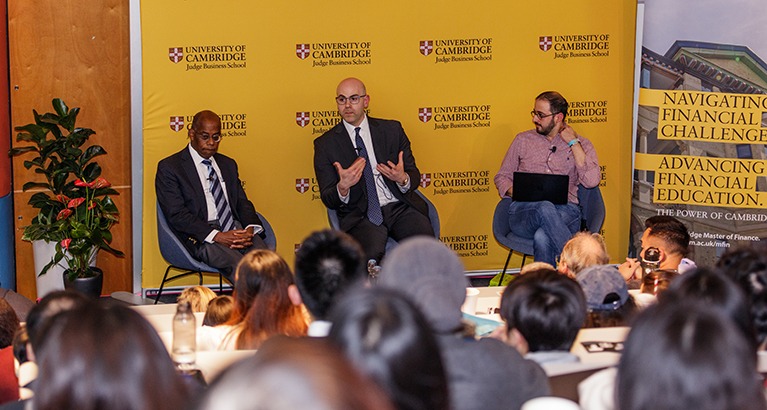
Fed Governor Stephen Miran and former Fed Vice Chair Roger Ferguson speak at a fireside chat at Cambridge Judge Business School about the US central bank and the effect of housing and immigration on monetary policy.

Research co-authored by Dr Kamiar Mohaddes of Cambridge Judge Business School provides granular information for policymakers and businesses aiming to deal with the effects of global warming.