

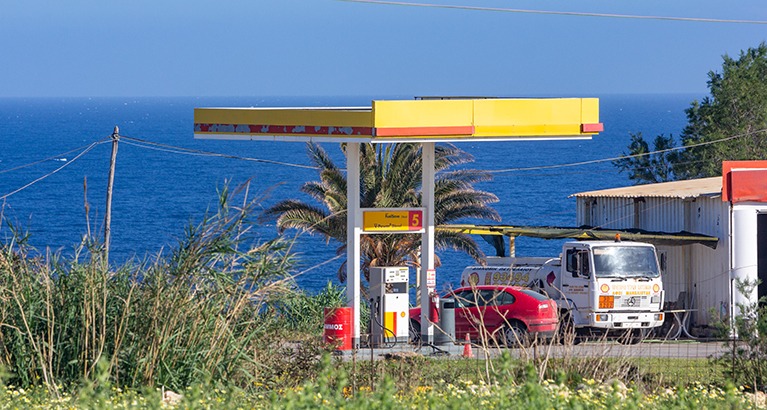
When consumers do their grocery shopping every week, they typically shop somewhere locally. Similarly, when people want to fill up their car, they will not travel to the next town to do so. Same with the pharmacy and almost any other retail business, as there is a sense that we always shop in a so-called local market.
But how local are these markets, really? How should we draw their geographical boundaries? This is important, because unless we can map out these supposedly local markets we cannot measure competition nor can we study either firm or consumer behaviour. Should antitrust officials allow a proposed merger between these 2 supermarkets or those 2 gas stations to go through or not? Geographic delineation of local markets is critical for market definition and is used routinely by policymakers as well as academic researchers.
From idyllic islands to sprawling Athens

As my name might betray, I know Greece very well, from my birthplace in Athens to wonderful Greek islands such as Aegina and Antiparos, and I have shopped in all these places for groceries, petrol and items from the pharmacy. These idyllic islands may be best known for sun and surf, but they are also ideal settings to study the problem of geographic market definition because, as small islands, they clearly define a local market. So we examined the market for petrol and diesel fuel on these small islands.
But I wasn’t expecting to find that, when we applied the study metrics on the market for petroleum products from these serene islands to bustling Athens, that the most common ways that we define local markets is (how can I put this politely) simply wrong.
The research referenced here are a 2022 study co-authored by myself and Mario Pagliero of the University of Turin that looked at the effect of 2010 Greek government-imposed excise-tax duties on fuel and diesel on the 33 smallest Greek islands, and a follow-up study I did with Themistoklis Kampouris of DIW Berlin that re-examines these tax rises and their effect on fuel shopping in Athens, the country’s capital and largest metropolitan area.
When we applied the study metrics on the market for petroleum products from these serene islands to bustling Athens, that the most common ways that we define local markets is (how can I put this politely) simply wrong.
Commonly used calculations of market closeness go back a century
Competition authorities typically apply the theoretical insights of so-called closeness by calculating the number of competitors located nearby using what are known as isodistance and isochrone measures: take an enterprise and draw a circle of X-kilometre radius or Y-minutes driving time around it, and that defines your local market. These benchmarks go way back to a venerable 1929 study that established a much-used line model, to a 1979 study that identified a complementary circle model – with these studies a half-century apart both concluding that stores located closer to a consumer are better substitutes than other retailers based farther away.
More recent studies have sensibly emphasised the role of incorporating consumers’ mobility, recognising that buyers of goods and services do not always start from home and that commuting flows and road connectivity matter. Yet these approaches still don’t guarantee the absence of substitution effects outside the specific geographic area considered.
Greek island study looks at tax-hike pass through
This is where our Greek island study jumps in. Using daily pricing data from petrol stations on these tiny Greek islands (median population 2,500), the study shows how these unanticipated tax hikes are passed through to consumers in various retail markets with different numbers of petrol sellers – using a scale that measures how much more consumers will pay based on the tax rise.
The findings: “Pass-through increases from 0.4 in monopoly markets to 1 in markets with 4 or more competitors and remains constant thereafter”, while “the speed of price adjustment is about 60% higher in more competitive markets”.
In other words, for every one euro increase in cost (owing to the excise-tax rises), final consumer prices will increase by 40 euro cents in monopoly markets, whereas they will increase by one euro in markets with 4 or more competitors. Retailers in less-competitive markets are more likely to absorb part of the cost increase (as they already charge very high prices), whereas retailers in more competitive markets are more likely to fully pass on any cost increases to consumers and to pass on coat increases faster than firms in less competitive markets.
Tax hikes provide a natural experiment
The 3 excise-tax rises implemented by the Greek government in 2010 were part of austerity measures linked to a 110 billion euro bailout loan from the European Commission, the European Central Bank and the International Monetary Fund, and these discrete tax hikes provided a natural experiment to study how new taxes are passed through to consumers. The beauty of these islands, from our weird academic and economic point of view, is that they provide an ideal benchmark since the islands’ naturally occurring variability in size and population delivers a clear external variable in the number of competing petrol stations within clearly defined local markets. Consumer substitution between islands is zero, as a vacationer or an islander is not going to hop to the next island to fill their tank.
So, we used the same tax changes featured in our island study and focused on Athens, a large, densely populated urban area that can be divided, in principle, into many local submarkets.
Geography, driving distance and driving times
We apply isodistance and isochrone market definitions similar to those used by competition authorities worldwide, and compute for each petrol station the number of competitors based on:
- different geographic radiuses by kilometre
- different kilometer driving distance based on road structure
- different driving times based on both road structure and geography
We then compare how these taxes are passed through to consumers depending on the number of competitors – using the Greek islands as our benchmark.
Key finding: much opportunity for substitution goes undetected
Overall, our results suggest that defining local geographic markets based on arbitrary distance or time metrics can be seriously misleading. Even though these metrics may define local markets with few competitors that look monopolistic, firms do not exhibit pass-through behaviour consistent with significant market power. This suggests that in retail markets, where sellers and consumers interact directly, there is a lot of scope for substitution that goes undetected, most likely due to consumer mobility and spatial integration.
In other words, the actual local markets are significantly broader and more overlapping than the current definitions of local markets are able to capture.
Overall, our results suggest that defining local geographic markets based on arbitrary distance or time metrics can be seriously misleading.
Study raises concerns about reliability of current market definition tools
As we say in the latest study, this key finding “contrasts with theoretical predictions and prior island-based evidence, suggesting that the entire metropolitan area functions as a single market. Our findings challenge standard isodistance- or isochrone-based market delineations used in academic research and competition policy.”
While the market for petrol and diesel may not be representative of oligopolistic markets for other consumer products, we chose the petroleum-products market because it is an area of great focus for antitrust authorities around the world, and a market where geography is believed to affect competition.
Given that isodistance and isochrone-based geographic market definitions are commonly employed by such regulators, our findings raise important concerns about the reliability of these tools and the policy decisions informed by them. The results of this study underscore the need to more thoroughly investigate and incorporate consumer travelling, commuting patterns and purchasing behaviour into market definitions. Additionally, it is crucial to deepen our understanding of how sellers perceive competition and the factors they prioritise when making pricing decisions.
The results of this study underscore the need to more thoroughly investigate and incorporate consumer travelling, commuting patterns and purchasing behaviour into market definitions.
Featured research
Genakos, C. and Kampouris, T. (2026) “What is the ‘right’ geographic market definition?” International Journal of Industrial Organization: 103266 (DOI: 10.1016/j.ijindorg.2026.103266)
Genakos, C. and Pagliero, M. (2022) “Competition and pass-through: evidence from isolated markets.”American Economic Journal: Applied Economics, 14(4): 35-57 (DOI: 10.1257/app.20200863)
Related articles

Insight
Sun, sea and economics
The 33 smallest islands of Greece are an idyllic place to examine the important link between competition and tax rise 'pass-through', says a new study co-authored by Christos Genakos of Cambridge Judge.

Insight
The EU single market at 25
A conference at Cambridge Judge marked the 25th anniversary of the European Union's single market, in advance of a special issue of the Review of Industrial Organisation journal. There has been much progress, but plenty of work remains to translate institutional change into greater consumer benefit. The European Union's border-free "single market" came into effect on 1 January 1993, and to mark its 25th anniversary a special issue of the Review of Industrial Organization journal will be published early next year with eight papers on a variety of topics related to the single market. The guest editors of the special journal issue are Cambridge Judge Business school faculty members Michael Pollitt, Professor of Business Economics, and Christos Genakos, University Senior Lecturer in Economics, who organised a conference at Cambridge Judge on 20 April entitled "Review of Industrial Organization Celebrating 25 Years of the EU Single Market". "Several presentations focused on how significant progress has been made in integration over the past quarter-century, but a lot of work remains to be done in certain areas," says Christos. "Some of the impressive institutional reform has not yet had a dramatic effect on consumers, so that's an area we'll look closely at in…

Paper co-authored by Dr Christos Genakos of Cambridge Judge is nominated as best article in the Antitrust Writing Awards. A research paper on mobile phone consolidation co-authored by Dr Christos Genakos, University Senior Lecturer in Economics at Cambridge Judge Business School, has been nominated as best article in the Antitrust Writing Awards organised by the Institute of Competition Law. The winning article will be announced at a dinner in Washington on 10 April. The article forthcoming in the journal Economic Policy finds that more concentrated markets lead to higher end-user prices and higher investment per mobile operator. The research is based on data from 33 OECD countries over a 12-year period (2002-2014). Entitled "Evaluating market consolidation in mobile communications", the article argues that regulatory authorities should take seriously the potential trade-off between market power effects and efficiency gains stemming from consolidation. The article is co-authored by Dr Christos Genakos of Cambridge Judge, Professor Tommaso Valletti of Imperial College London, and Professor Frank Verboven of the University of Leuven.…