
SLI, a company that makes batteries used in cars, motorcycles and ships, is facing really tough challenges: parent firm BAT Corporation has set an ambitious target to double revenue in 3 years, but SLI also needs to reassess its innovation plans to ensure these align with long-term growth. So what’s a top executive at SLI to do?
On its face, this is a typical case study that business schools have taught for decades: take a set of facts and devise strategies to grow the short- and medium-term top line while ensuring a prosperous and stable long-term future through a robust product line.
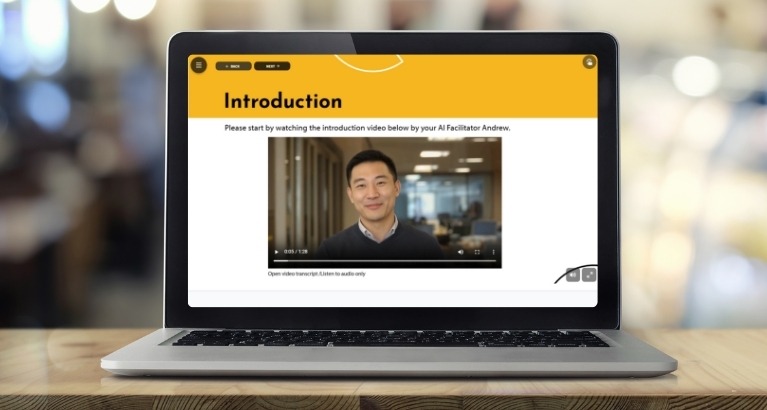
But there’s a twist this Wednesday for 26 participants of the Advanced Leadership Programme (ALP) at Cambridge Judge Business School: rather than devising plans based only on a static paper-based case study, these Executive Education learners are able through artificial intelligence to electronically talk to key characters involved in the company’s situation.
The promise and risks of lithium batteries
Take Sheng Qian, the Chief Financial Officer of SLI, who has a reputation for “making everything about money”. Asked via AI chat what innovation projects he is most receptive to, the CFO replies: “I am most receptive to innovation projects that have a clear financial rationale and predictable returns. Projects like lithium battery development, which align with our strategic goals and have the potential for strong financial returns, are particularly appealing.”
That’s useful information, but what’s the view on lithium batteries of other top executives?
Hao Zhuyi, Chief Product Officer of SLI, is broadly receptive to lithium battery development but says the firm must “avoid steps that focus solely on incremental improvements driven by existing customer requests”, while Chief Operating Officer Gao Xiaolv says there are risks in lithium battery development given the competitive and rapidly evolving nature of the sector – including China’s support for renewable energy that has “led to a proliferation of companies, making the market cutthroat”. Asked about such risks from Chinese renewable energy subsidies, SLI Chief Revenue Officer Duo Maidian diplomatically sidesteps the question: “I wouldn’t be able to tell you. Perhaps you should ask someone else that.”
Through obtaining various and sometimes conflicting views of key characters at SLI, these Executive Education participants get insight that a printed page cannot provide. For example, ALP participants in a group discussion said they detected a lack of alignment between SLI’s innovation strategy and that of parent BAT, and they identified an urgency in SLI’s situation. “They’re still profitable so there’s opportunity for them, but they have to get on with it,” said one group leader to the full cohort.
AI-powered system works for both in-person and remote learning
The AI-powered learning system (called Experiential Learning for Business and Executive Education on Leadership, Strategy and Innovation) was developed by Dr Anyu Gao, an alumnus of the Cambridge Executive MBA programme at Cambridge Judge (EMBA 2022), Fellow of the Business School and the lecturer on Strategy Execution for the ALP, and by Stelios Kavadias, Margaret Thatcher Professor of Enterprise Studies in Innovation and Growth at the Business School, both of whom teach on the 3-week ALP.
“This interactive technique works for both in-person and remote learning, and we know from participant feedback that it’s really enjoyable and popular,” says Anyu. “It’s much more immersive than traditional case studies, and allows students to engage with the material in really interesting and fun ways.” The post-class questionnaire revealed that 93% of the learners rated the learning to be “much more engaging” than traditional case studies, and 93% of them would recommend this novel way of learning to their peers.
What sort of fun? Participants were told that the CEO of SLI, Li Dianchi, joined the business just after graduating from university in 2005, and climbed quickly through the ranks. Asked through the AI simulation whether he thinks he rose too quickly through the organisation without proper grounding, the CEO replied: “Definitely not, would you expect a different answer though?” Touché.
This interactive technique works for both in-person and remote learning, and we know from participant feedback that it’s really enjoyable and popular,
Gaining knowledge on the interplay between executives
On the more serious side, participants after chatting to the characters are asked to put themselves in the role of an outside consultant in summarising the current situation of SLI, explaining the firm’s key challenges and outlining problems within the company’s innovation portfolio.
“I really wanted to get at the interplay between the executives,” said Allen Darrah, Chief Information Officer at law firm Spencer Fane, who is based in Kansas City, Missouri. “Are they acting as individuals or working as a unit? Does one of these executives have more sway with the CEO, or does one person really have the CEO’s ear? It seemed to me that the CEO listened equally to all opinions.”
I really wanted to get at the interplay between the executives. Are they acting as individuals or working as a unit? Does one of these executives have more sway with the CEO, or does one person really have the CEO’s ear?
Designing a system to reflect real-world business dynamics
The simulation was designed by a team headed by Abigail Crowther, Learning Design Consultant at Cambridge Judge, who says the key executive roles CEO, CFO, CPO, CRO and COO were chosen because “these roles reflect not only the strategic decision-making dynamics found in real-world organisations but also because they were central to the original paper-based case study on which the simulation is based. The simulation was designed through an iterative development process that allowed us to test and refine both the AI characters and the platform across multiple deployments with test users and live classes.”
Adds Anyu: “The simulation is designed to recreate how situational diagnosis happens in real-life business settings, by directly interacting with company officers who are purposefully trained AI characters with their own understanding of the problems their businesses face and their own perspectives of the root causes and solutions, together with their own personalities, goals and biases as individuals. Participants on the ALP overwhelmingly agree that the design mimics the real world closely.”
Looking ahead, there are plans to improve character realism through further conversational fine-tuning and to enhance instructors’ ability to gain deeper insight and offer more personalised feedback to participants.
Looking ahead, there are plans to improve character realism through further conversational fine-tuning and to enhance instructors’ ability to gain deeper insight and offer more personalised feedback to participants.
Straightforward answers not stifled by office politics
Several participants in the 26-member November ALP cohort (who represent 11 nationalities including Malaysia, Nigeria and South Korea, and 16 industries including banking, electronics and engineering) commented that the simulation provides very straightforward answers from the fictional characters, perhaps more forthright than executive replies in real life given the niceties of flesh-and-blood office politics.
“Getting different responses from the CEO and CRO brought helpful different perspectives,” says ALP participant Richard Hanrahan, CFO at Cambridge & Counties Bank in the UK. “Asking the characters these questions through AI provides answers that are not as political as you might get in real life, because in real life people hide things for certain purposes, so these non-political replies were refreshing. It was far more enjoyable than reading pages and pages of text.”
Adds Sharon Yeo, Divisional Director, Engagement and Research, at the Ministry of Education in Singapore: “The characters were so co-operative, and it was refreshing to get straight answers because in real life people will hold things back. We’ve talked a lot about AI as a disruptor so it was great to use AI in this interactive way.”
Interactive AI system reflects a new way of learning
Stelios, who is also Co-Director of the Entrepreneurship Centre at Cambridge Judge, says the interactive system reflects how learning has changed in recent years from being teacher-focused to involving interaction between teachers, learners and technology.
“As professors and teachers we may still be on stage, so to speak, but the focus is now much more multi-dimensional as content is delivered in a variety of ways. This AI driven case study illustrates that really well: our Executive Education participants engage with the key characters in this case study to understand the views and motivations of various people involved in this case, they discuss it among themselves, and then the teacher helps guide rather than dictate that discussion. And our learners have made it clear that they really like this innovation.
The interactive session with fictional executives occurred exactly halfway through the Advanced Leadership Programme, and Allen Darrah said he was having the time of his life engaging with fellow participants and learning from people such as an expert from the Scott Polar Research Institute, part of the University of Cambridge, who spoke to the ALP about climate change. “Human beings very rarely say they are exactly where they want to be and doing what they want to do, but this definitely applies to me for these 3 weeks,” he said.
As professors and teachers we may still be on stage, so to speak, but the focus is now much more multi-dimensional as content is delivered in a variety of ways. This AI driven case study illustrates that really well.
Advanced Leadership Programme
Delivered over 3 weeks, the Cambridge Advanced Leadership Programme (ALP) provides senior executives with the opportunity to pause, reflect, and explore fresh approaches to leadership thinking.
Related articles

Student and alumni news
Alumnus writes on the trends that change the face of banking
Five key trends may shape the banking world of tomorrow, says an article by Aleem Wallani, an alumnus of the Master of Studies in Entrepreneurship Programme at Cambridge Judge Business School (MSt Entrepreneurship 2021) in The International Banker magazine. The magazine is published by the Worshipful Company of International Bankers.

A new study led by the University of Cambridge introduces an ‘ability profile’ for artificial intelligence models to predict how they will perform on any tasks – including unfamiliar ones – greatly advancing understanding beyond current AI benchmarks that only tell how an AI model performs on a specific test.
Student and alumni news
Research grant on AI-assisted farming in emerging markets
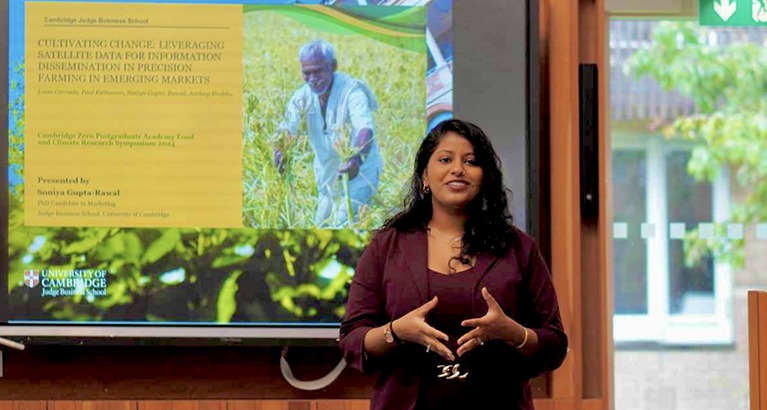
Soniya Gupta-Rawal, a PhD candidate at Cambridge Judge Business School, has been awarded a prestigious PEDL PhD Grant of £25,000 for her PhD research project under a special exploratory research grant (ERG) programme from the organisations Private Enterprise Development in Low Income Countries and the Centre for Economic Policy Research. Only 12 projects have been funded under this special call.