


Based on the high-hype history of disaster films ranging from Towering Inferno fires to Poseidon Adventure waves to San Andreas earthquakes, one might think that climate fiction movies (known as ‘cli-fi’ films) overwhelmingly feature emotional storytelling about impending doom. A just-published study in the Journal of Business Ethics shows such assumption to be wrong.
Using a novel database based on 35 cli-fi films released between 1982 and 2023 ranging from Blade Runner to Interstellar, academics from France and the UK find that the most dominant persuasive appeal across the sci-fi movie genre is rational appeal using data-driven discourse, problem-solving narratives and expert testimonies – rather than merely emotions and concerns about health and basic needs.
Less surprising, the research also finds that cli-fi movies with the highest box-office receipts are films with high-profile actors and directors based on action-oriented narratives that are authority-driven, while movies based on the representation of climate activists remain a niche category with far less commercial appeal. The researchers say the challenge is to reconcile climate storytelling’s ethical responsibility with the entertainment industry’s demand for mass appeal.
Ethical climate communication can be accurate and persuasive
“The findings show that there is a clear place for rational appeal in how cinema presents climate issues,” says Allègre Hadida, Associate Professor of Strategy at Cambridge Judge Business School, one of the study’s co-authors. “The research finds that reflexive and inclusive narratives can in fact engage film audiences on this crucial issue, and that ethical climate communication can be accurate and persuasive at the same time. Yet challenges remain in reconciling this with the commercial imperatives of moviemaking, and we hope our research helps in finding ways to meet this challenge.”
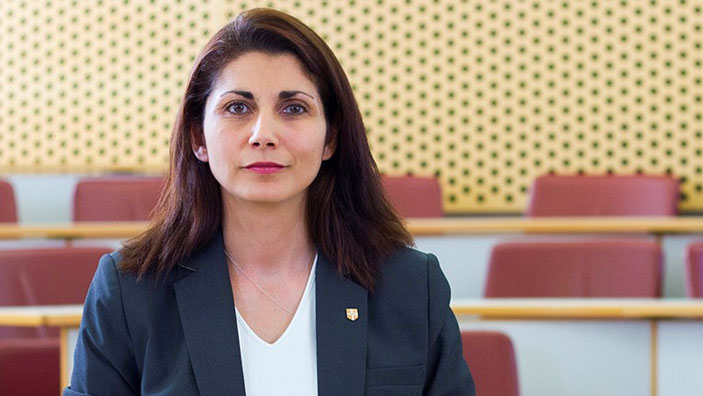
The research entitled Degrees of Persuasion: Ethical Communication in Climate Fiction Films is co-authored by Shirin Yazgulieva and Inna Lyubareva of IMT Atlantique in Brest, France, Allègre Hadida of Cambridge Judge Business School and Tom van Laer of SKEMA business school in France. Shirin Yazgulieva, an IMT Atlantique PhD candidate co-supervised by Allègre Hadida and Inna Lyubareva, is the lead author.
The study breaks down the 35 movies also including Blade Runner, The Day After Tomorrow, Twister and Geostorm to find that words reflecting rational appeal relating to climate issues accounts for 15% of total word frequency across these films, followed by appeal to a broad audience and appeal to power (both at 13%), appeal to social values (9%), appeal to emotions (8%), and appeal to nature and sensory system (each 7%). These were further followed by appeal to basic needs (5%), appeal to media and time (each 4%), appeal to action, sexuality and transport (each 3%), and appeal to aesthetics, damage, health and religion (each at 1%).
4 climate communication strategies in cli-fi films
Building on the 17 persuasive appeals identified in the study’s database, the authors used hierarchical clustering to group the 35 films according to how these appeals recurrently combine, yielding 4 communication strategies:
1
Eco-social immersion
This strategy is associated with the films that emphasise sensory engagement, nature appreciation and social values in fostering an “immersive experience that encourages audiences to connect emotionally with environmental themes”
2
Power-driven action encouragement
These are films that generate the most ticket sales, which the authors say indicate that “climate communication framed through action-oriented and authority-centric narratives tends to resonate strongly with mainstream audiences”.
3
Emotion-centric
Films that prioritise strong emotional engagement and aesthetic storytelling, and most commonly linked to drama and superhero genres.
4
Inclusive narration strategy
Films that have a broad appeal that balance emotional, rational and social appeals, which represents the largest cluster in the dataset at 16 ‘predominantly dystopian’ films.
How climate differs from other disasters
The study opens with a key scene from the 2021 film Don’t Look Up, about astronomers seeking to warn the world about a humanity-threatening comet, to illustrate the emotional pleas to fear and power that often feature in disaster movies. In that movie, an astronomy professor played by actor Leonardo DiCaprio exclaims: “And now they’re actually firing scientists like me for speaking out … I hope to God that this president knows what she’s doing. But the truth is … I think we’re all gonna die!”
The authors acknowledge that such speculative and often dystopian narratives can help illustrate the societal implications of climate change and thus contribute to environmental understanding.
But the authors say climate change is different from other types of disasters in both its functional orientation and ethical challenges. Activism, public service announcements and scientific communication are often used to inform and mobilise audiences on issues such as pollution and financial misconduct, and policy interventions can be assessed against tangible outcomes such as emissions reduction or regulatory reform. In contrast, cli-fi films “rarely issue direct behavioural instructions or produce outcomes that can be straightforwardly measured,” the authors say. “The influence of climate storytelling is more indirect, operating through identification, imagination, affect and speculation.”
And while cli-fi films share with movies focused on other social issues the challenge of presenting moral responsibility and the unequal vulnerability of people based on wealth and other factors, climate change “gives these challenges a distinctive configuration: its causes and consequences are planetary rather than confined to one community, organisation, or event,” says the research. “This is where the ethical importance of persuasive appeals becomes central.”
Capturing the complexity of climate storytelling
The study adopts a mixed-methods design that combines manual qualitative coding with modelling in an aim to capture the ethical complexity of climate storytelling through validating computational findings through human interpretation.
The research focused only on live-action cli-fi films rather than animated films and documentaries, and films were chosen for a long list only if they explicitly depict human-environment interactions in a climate-threat situation. An initial list of 119 films was further whittled down to 35 movies based on analysis that focused on such factors as the diversity of persuasive communication patterns and interpretive depth in the dialogue.
Tension between ethical richness and the box office
The authors say that the challenge going forward is whether cli-fi can remain a financially viable film genre “while maintaining ethical integrity and advocacy driven communication”, given the “structured tension between ethical richness and audience reach”. This challenge extends to other forms of climate fiction narratives, including novels, plays or art installations.
“Cli-fi films do not merely represent ethical dilemmas associated with climate change. They actively participate in producing them. Recognising this performative dimension opens a focused interdisciplinary research agenda on the ethics of narrative persuasion: one that bridges cinematic storytelling, sustainability communication and moral philosophy, and that is attentive to both the power and the limits of persuasion in confronting climate-related issues.”
Ultimately, the article calls for what it terms “an expanded ethics of persuasion that encompasses ‘turtle’ and ‘peacock’ storytelling” – 2 contrasting communication logics (accuracy-driven versus attention-driven). For practitioners of public advocacy and climate communication, the authors argue the framework “offers a diagnostic resource rather than a prescriptive template. Ethical climate communication is unlikely to be achieved by avoiding commercialism altogether. Rather, it requires a conscious calibration that takes shape by sustaining urgency without distortion, mobilising emotion without exploitation, and invoking authority without foreclosing deliberation.”
Featured research
Yazgulieva, S., Lyubareva, I., Hadida, A.L. and van Laer, T. (2026) “Degrees of persuasion: ethical communication in climate fiction films.” Journal of Business Ethics
Related articles
Faculty news
Allègre Hadida honoured by arts and culture group
Allègre Hadida, Associate Professor of Strategy at Cambridge Judge Business School, was awarded the François Colbert Research Impact Award by the International Association of Arts and Cultural Management (AIMAC) at the group’s conference in Rio de Janeiro in July.
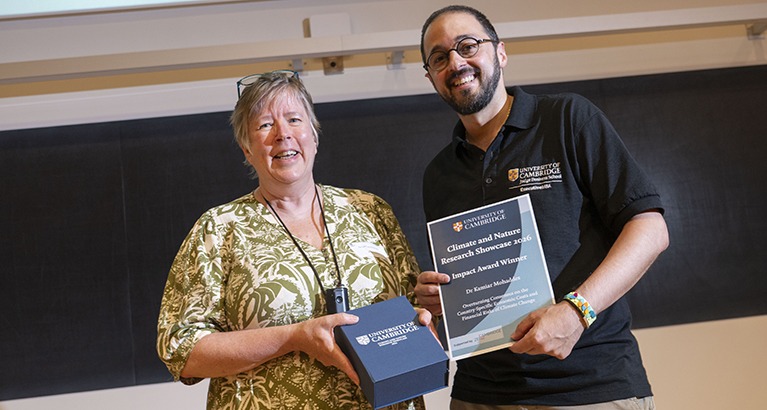
Convention-challenging research on the economics and financial risks of climate change by Kamiar Mohaddes, Director of the Global Executive MBA Programme and Associate Professor in Economics and Policy at Cambridge Judge Business School, was the Impact Award Winner at the inaugural Climate and Nature Research Showcase 2026 at the University of Cambridge.

Research centre news
EPRG Spring Summit focuses on UK and EU energy policies
The Spring Seminar of the Energy Policy Research Group included a panel on the potential convergence of energy and climate policies of the European Union and the UK, against a backdrop of ongoing bilateral negotiations. A decade after Britain voted to leave the EU, negotiating teams from the UK and EU are preparing to meet to discuss details of re-aligning carbon and energy policies including the key issue on whether and, if so, how the UK should rejoin the EU’s emissions trading scheme (ETS).