

Submit a project proposal
Do you want to know if your lab research results or early-stage technology have commercial potential?
Are you aiming to start a new venture, or have you already set it up and need additional market research?
A project accepted onto EnterpriseTECH is free for inventors. Projects form a crucial learning vehicle for the programme’s students, many of whom are medics, PhD students and postdocs from STEM research backgrounds.
Applications to submit a project proposal for 2026/27 are now open.
Deadlines for submitting project proposals
We invite project proposals from inventors across academic and industrial research labs, ventures, and other organisations.
The strongest applications usually come from senior academics, CEOs and founders of early- stage ventures. Projects led solely by PhD students are not accepted.
We usually find the strongest applications come from senior academics, CEOs and founders of early- stage ventures. Projects led by PhD students are not normally accepted.
We select around 20-25 projects annually. We interview shortlisted inventors online to explore the project’s background and its fit for the programme.
While inventors are not required to be based in Cambridge, participating in person for the Programme Launch and Finale is required.
Cohort 19 project deadline
15 July 2026
(Programme runs: 6 October-9 December 2026, Cambridge/Online)
Cohort 20 project deadline
8 November 2026
(Programme runs: 26 January-14 April 2027, Cambridge/Online)
What you will gain from participating
- A comprehensive 3,000-word commercial feasibility report covering IP position, applications, commercial advantages, market analysis, and more.
- Insights and diverse perspectives from a high-calibre student team throughout an 10-week research phase.
- Accelerated commercialisation pathways for your technology, informed by customer and market feedback.
- Enhanced enterprise network within Cambridge’s vibrant entrepreneurship ecosystem and exposure to investment opportunities.
- Pro-bono IP consultation with a Cambridge patent law office.
How inventors are involved
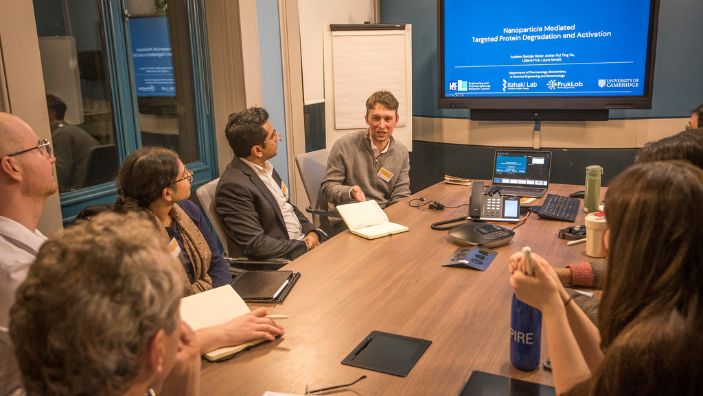
- You’ll join us at Programme Launch to meet your student team and their business supervisor. You’ll give a short presentation about your project to the cohort.
- The most important element of your involvement are the conversations you’ll have with your student team. You should have at least three meetings with them during the research phase (these can be online).
- Support your team at the Programme Finale.
- Provide feedback on the student team deliverables, and your overall programme experience.
About our EnterpriseTECH projects
We’re looking for intellectually stimulating projects that align with our STEM-focused student body, accepting around 20 projects a year. We group projects into 2 broad themes: Health (e.g., drug discovery, medtech devices, cancer innovations) and Earth (e.g., battery technologies, carbon capture solutions, sustainable materials).
EnterpriseTECH teams have worked on over 200 projects since launching in 2018, and these are just some of them:
Securing better health, ageing and wellbeing
- Neurothread: A blood-based diagnostic test for Parkinson’s and related diseases.Cambridge Surgical Models : A new generation of artificial anatomical models to enhance surgical training.
- Smart Gauge: Improving useability, safety, and shortening the duration of fracture fixation surgery.
- Aptamer based organic electrochemical transistors detecting small molecule analytes.
- Micro-incisional strabismus surgery device.
- Second-generation undulating robotic colonoscope.
- Organic-inorganic hybrid direct conversion X-ray detector.
- Sensors for transplanted organs.
- Bio-electronic organs on chip.
- Virtual reality in therapeutic medicine.
- Holographic-based platform for continuous clinical monitoring.
- Additive manufactured spinal fusion cages that conform to vertebral endplates.
- Smart shunts for improving remote neurological care
- Customisable spinal fusion cage.
- Incremental micro dosage brain syringe.
- Papworth organ re-perfusor.
- Minimally invasive spinal cord stimulator.
- Veterinary surgical robot and surgical planning software.
- A nanotechnology-based intelligent toilet to resolve biomarkers.
- Automated 3D printing surgical planning software for neonatal vessel reconstruction.
- AAB Research: Therapeutics to eliminate autoantibody-producing B-cells.
- NAT4Dementia: Harnessing RNA therapeutics to target cellular resilience in Alzheimer’s disease.
- Lung-directed biologic delivery to prevent respiratory failure.
- Drug design using AI and quantum simulation for molecular design.
- Neo-psychedelic medicines.
- A novel orthobiologic therapeutic.
- Circular miRNA sponges.
- A novel, smarter technology to develop orally administered peptide therapeutics.
- Non-viral gene therapy for disease treatment.
- A multifunctional molecular species for nano-bio hybrid design.
- Cell-Lock: Targeted locking of treatments onto cells for human therapeutics.
- Biosensor arrays: Photonic biosensor arrays for high-throughput and multiplexed protein detection.
- Ribotac: Targeted degradation of disease related RNA through a novel screening platform.
- Cell-free protein synthesis.
- Therapeutic platform using targeted protein degradation.
- Multiplexed single-molecule detection of native RNA/ DNA at low concentration.
- Opti-OX – an optimised inducible overexpression system.
- Novel Saccharomyces protein expression system.
- Flow synthesis of biologics.
- High-resolution dynamic modelling of cellular processes.
- Macrophage HT assay for preclinical screening of novel immuno-modulators.
- Hydrogels platform for cell culture and cell therapy.
- The single cell ageing reporter clock.
- Distributed ledger for managing patient data in clinical studies.
- Algorithms for measuring biomolecular interactions.
- Therasen: In vivo detection of senescent cells using nanostructured organic probe.
- AI-powered cancer drug-discovery.
- Nanoemulsion carriers for imaging and targeted cancer therapy.
- Cancer diagnostics using whole-genome sequencing.
- Next generation of drug delivery systems for hard-to-treat cancers.
- RNA trans-splicing technology for cancer.
- Targeted microbubbles for glioblastoma drug delivery.
- COSMIC cancer mutation census.
- Predictive analytics for personalised cancer care.
- Therasen: In vivo detection of senescent cells using nanostructured organic probe.
- Novel device for pelvic organ prolapse treatment.
- Wearable biosensors for at-home rapid testing of vaginal microbiome.
- New therapeutic to enhance pregnancy success after IVF.
- Genomics-powered personalised pregnancy platform.
Tackling infections
Preparing for future disease epidemics and halt the slow motion pandemic of antimicrobial resistance (AMR).
- Thyme Bio: Sustainable antimicrobial coating.
- Early detection of bacterial activity through microscopic cell analysis.
- Topical deposition technology for in situ formation of antimicrobial dressings.
- Central line protective disc against CRBI.
- Bacterial infection sample pot.
- COVID targeting PROTACs.
- Targeting cell senescence to treat chronic wounds.
- DIOSynVax – digitally designed, immune, optimised, synthetic vaccines.
- Aerosol delivery of vaccines to the lungs.
- Exploiting bacterial communication to prevent infections and promote health and wellbeing.
- Gigabiome: Microbiome based solutions for antimicrobial resistance diagnosis.
- Antibiotic discovery with organic electronic technology.
Building a green future
Accelerating the green economy by supporting research and innovation that unlock solutions essential to achieving net zero in the UK by 2050.
- XtaLight: XL crystal imaging.
- NanoAurum: High-performance Au nanoplates unlocking new frontiers in advanced materials engineering.
- Sustainable bio-based alternatives to ceramic tiles.
- Nano-carbon enabled coatings.
- Planet-friendly replacement for plastics.
- Life-cycle assessment of critical materials in the construction sector.
- Watercress protein derived food packaging.
- Micron-scale metal foam wicks for improved electronics cooling.
- Cellulose photonic 2D pigments.
- Watercress Fibre: Utilising the by-product fibre from a Watercress processing.
- biorefinery. Nomaly – Application of predictive genomics technology to agri-tech.
- Naked Clams: Waste wood into sustainable protein.
- NELARIX: Designer disease resistance traits for crop protection.
- Exploiting novel marine yeast to produce sustainable food by precision fermentation.
- Machine learning for automated identification of agricultural features from aerial imagery.
- Carbon Capture Battery.
- ElectroPET: Plastic depolymerisation and electrolysis for upcycling and green hydrogen production.
- ElectroSynth: Electrocatalytic waste biomass upcycling to clean hydrogen and valuable fine chemicals.
- p-Si anodes: Ultra-low temperature method for porous silicon for battery anodes.
- Smarter Thermostats: Model Predictive Control for building thermostats to reduce energy usage.
- Distributed, small scale of green ammonia production using renewable energy.
- Methane capture from hydropower.
- Miniaturised condensation particle counter.
- A novel sheet forming approach to reduce scrap metal waste.
- Roadmap for zero-carbon existing buildings.
Building a secure and resilient world
Strengthening security and resilience, from individual to national level, across a range of social and economic areas at the heart of daily life.
- The Ethicronicers: Software ensuring uncompromised sustainable electronics hardware.
- Pioneering quantum technologies in electron microscopic imaging.
- Rocket propulsion for NewSpace.
- Ultra-low-power edge AI accelerator chip design technology.
- AI-powered, automated crypto trading solution.
- Autonomous, miniaturised, space lab for future space biofabrication, disease modelling, and manufacturing.
- Autonomous solar powered aircraft.
- Quantum key delivery from space.
- Machine learning for automated identification of agricultural features from aerial imagery.
- Photo-bioreactor system for growing microalgae to extract valuable chemicals.
- A bio-electrochemical system using photosynthetic organism.
- Growth of novel crops in controlled environment agriculture.
- Distributed ML for collaborative genomic marker accelerated breeding plant programmes.
- Enabling wearable and textile electronics with printed electronic inks.
- Lead acid battery recycling for informal markets in emerging economies.
- Blockchain-coded stable isotope-labelled compounds for anti-counterfeiting.
- Life-long learning in the engineering and creative sectors.
- Indentation plastometry for portable mechanical testing.
- An AI training algorithm to reduce data curation requirements by 100x.
- Automatic market maker for trading options on the blockchain.
- Botprobe: making threat big data manageable.
Creating opportunities, improving outcomes
Improving outcomes for people and places across the UK by identifying solutions that promote economic and social prosperity.
- Ageing-driven functional decline: Characterisation of brain and body functional decline during ageing.
- Microbes – Harnessing microbes to repel insects.
- Drawing method for capturing human experience to integrate into psychological and physiological monitoring.
- Microbiome-aided removal of toxic pollutants.
- The human experience scanner.
- Novel productivity device for focus management.
- Pesticide assessment platform for mitochondrial health.
- A game to improve episodic memory.
- A revolutionising hearing-assistance device for hearing impaired individual.
- Full-room daylight simulation lighting to combat SAD.
- Rotating Spiral: Bioreactor for industrial biotechnology.
- Identifying the needs of industrial researchers in advanced functional materials applications.
- Thermoelectric energy harvesting for wearable devices.
- Polar ocean observing system.
- A low carbon-monoxide stove.
- Seasonal predictions of air pollution.
- FocalSun, a rooftop solar concentrator.
- A cellular vacuum insulation material.
- System for sustainable rice straw management.
- 3D printed synthetic biology hardware for sustainable food production.
- Connected-autonomous vehicles.
- Connected wheelchairs.
- Parking data for cities: Leveraging vehicle data to create parking space in cities.
- Space Robotics: Reconfigurable Space Robotics.
- OASIS : Offshore Ambient noise seismic imaging solution.
- A server-less messenger that compensates effort and removes middlemen.
- Hypertextual connections from within printed books and documents.
- Automated imaging of nursery strawberry plants for health and quality.
- Quantitation of food-borne receptor-stimulants for safer, healthier processed foods.
- New tools for high-level gene expression, with bioluminescence as a demonstration platform.
- 3D reconstruction of filmed footage from a smartphone.
Intellectual property and confidentiality
All projects adhere to the University of Cambridge’s Non-Disclosure Agreement (NDA) policy. This ensures the confidentiality of discussions, with all IP rights retained by the inventors.
For further inquiries or to assess if your project fits our programme, please contact us.

What we needed was a deeper understanding of the market, the intellectual property landscape in the field, and a general outside opinion. The student team, led by an experienced business mentor, certainly delivered this for us. We received an invaluable report on our project with forecasted milestones, potential hurdles and considerations for us moving forward. It is clear that the team have gained a deep understanding of product development, making them experts in a field outside their own area of expertise. I have no doubt this will be of huge benefit in their own entrepreneurial activities. Being on this journey I feel my own learning has greatly improved and am looking forward to continuing my relationship with EnterpriseTECH.
Submit a project proposal
We welcome and review project proposals from inventors all year round. Please review the hard deadlines associated with each of the programme cohorts:
Programme duration
6 October-9 December 2026
Submission deadline
15 July 2026
Programme duration
26 January-14 April 2027
Submission deadline
8 November 2026
Contact us
General enquiries
Proposal enquiries
Dr Ghina M Halabi
Get updates
Hear the latest from the Entrepreneurship Centre:
Engage with us
Follow the Entrepreneurship Centre on social media:


