

What makes EnterpriseTECH a unique learning experience
Each cohort follows the same structure: Programme Launch, a 40-hour lecture and workshop intensive, a project research phase (including market research), and three supervisions to help you apply the taught material to your project. This is followed by assignment preparation, submission and pitching at the Programme Finale.
Teams and projects are confirmed around a week before the programme begins. You will find out which project you’re working on and who your teammates are when you receive the Project Pack.
Your team’s task is to assess the commercial potential of the technology and identify plausible routes to market. You’ll be supported by a business supervisor, with regular check-ins with the inventor team throughout the programme.
A Certificate of Completion is awarded upon successful completion of the programme requirements.
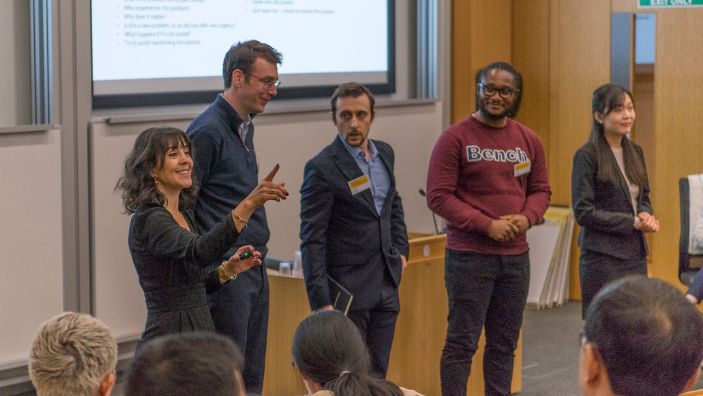
Key elements
- Meet your team at Programme Launch (in person)
- 40-hour lecture and workshop intensive (in person)
- Research phase (hybrid)
- Three formal supervisions (hybrid)
- Assignment prep (hybrid)
- Assignment submission (online)
- Pitching at the Programme Finale (in person)
Your learning experience includes opportunities for:

Experiential learning
Our approach goes beyond traditional lectures, immersing you in real-world projects where learning comes from actual doing.

Expert guidance
You receive supervisions from experienced entrepreneurs and business leaders, leveraging their wisdom to guide your journey.

Career advancement
Develop your business persona, and gain the skills and knowledge to widen your career options and success in the entrepreneurial world.
The programme’s 3 learning components


EnterpriseTECH isn't just a programme; it's a transformative journey that equips researchers with the skills, knowledge and network needed to thrive in today's dynamic entrepreneurship landscape. Invaluable experiences, guidance, and connections!
The lecture curriculum
Our lectures and workshops are delivered by Cambridge Judge Business School faculty, practitioners, fellows and specially invited expert speakers. The content is entirely bespoke, tailored for the practical nature of the programme. While there are many general principles of entrepreneurship, the overall content has a strong focus around the evaluation of the commercial feasibility of bringing new STEM technologies and inventions to market.
Venturing into entrepreneurship: beginners notes
Entrepreneurship offers tremendous value by opening doors to innovation, growth and impact. When you cultivate an entrepreneurial mindset and skillset, you can effectively turn your ideas into successful businesses, understand the commercial potential of your work, secure funding, build valuable industry networks, and enhance your professional abilities. In this first theme, we dive into the theoretical foundations, practical skills, and real-life experiences of accomplished entrepreneurs.
Team dynamics in early-stage ventures
Learn how early-stage teams work in practice – how to set clear goals, align expectations, and maintain momentum under uncertainty. Through talks and workshops, you’ll develop practical tools for collaboration, decision-making, and constructive conflict.
From technology to opportunity: evaluating early-stage ideas
When it comes to early-stage ventures, evaluating business ideas is just one piece of the puzzle. This theme focuses on assessing whether there is a real market and a viable business model before significant time and resources are committed. You’ll learn how to conduct structured market research – defining target customers, understanding needs, mapping competitors, and using data on market size, growth, and trends to test feasibility and guide next steps.
From lab notebook to IP strategy: protecting and positioning your innovation
For early-stage ventures, IP is a critical asset. This theme covers the fundamentals of patents, trademarks, copyrights, and trade secrets, and how they support competitive advantage and investment readiness.
Business models, customers & market fit
This theme helps you turn an early-stage technology into a coherent commercial story. You’ll unpack the Business Model Canvas, use AI tools for customer discovery and idea validation, and apply those insights to refine your assumptions. The module closes with what product–market fit really means—and how ventures iterate toward it beyond the first launch.
Routes to market, marketing & message
This theme focuses on how opportunities are evaluated and communicated in the real world. You’ll learn how investors and partners conduct due diligence, build a practical marketing plan using a clear framework, and connect your venture to wider macroeconomic and strategic forces. The module closes with sharpening your message, and how to communicate value clearly and credibly to the audiences that matter.
Investor readiness: funding strategy, pitching, and term sheets
This theme demystifies how venture funding works in practice. You’ll explore what happens once investors are interested—how they assess opportunities, what questions they push on, and what “credible” looks like. You’ll also develop a funding strategy anchored in your value story: the narrative, evidence, and milestones that make a venture investable.
Beyond EnterpriseTECH: pathways, stories & progression
This theme focuses on what comes next after the programme. You’ll hear about follow-on opportunities such as fellowships, and accelerators available to you. The module also features alumni stories and a panel showing how EnterpriseTECH learning translates into real-world impact – through venture creation, industry pathways, and applying an innovation mindset across different careers and contexts.
Apply
- Programme dates: 6 October-9 December 2026
- Application deadline: 28 June 2026
- Programme dates: 26 January-14 April 2027
- Application deadline: 3 November 2026
Join our mailing list
Sign up to our mailing list to receive updates on future calls for students and inventors.
Join the EnterpriseTECH mailing list
Contact us
Get updates
Hear the latest from the Entrepreneurship Centre:
Engage with us
Follow the Entrepreneurship Centre on social media:


